

1-2-4-All
Engage Everyone Simultaneously in Generating Questions, Ideas, and Suggestions (~15 min.)
“Tell me and I will forget. Teach me and I may remember. Involve me and I learn.”
Purposes
In 1-2-4-All, participants first work alone, second in pairs, then in small groups, to generate solutions to a specific challenge. It engages every voice regardless of group size, generating a kaleidoscopic view of perspectives, and expresses ideas people would otherwise keep to themselves. It sets an active tone for a group and diminishes power differentials. It taps into the group’s collective knowledge, leading to better ideas and shared ownership, which simplifies implementation. This structure reinforces LS Principle #1, Include and Unleash Everyone.
Principle: Include and Unleash Everyone.
Five Structural Elements—Min Specs
Structuring Invitation
“Let’s think about our shared challenge and generate ideas to address it. What opportunities do you see for making progress on this challenge?”
Space and Materials
Space for participants to work in pairs and quartets [breakouts]. Chairs, tables, and paper are optional.
Participation Distribution
Roles include host [tech host] and participants. Minimum group size is four. Everyone has an equal opportunity to contribute.
Group Configuration
Alone, pairs, quartets, whole group
Steps and Time Allocation
Intro: Share the structuring invitation and identify the shared challenge. (1 min.)
Individual Reflection: Individuals silently reflect and write down ideas. (1 min.)
Pair Up: Participants form pairs to share and build on ideas, trying to defer judgment and keep each idea distinct [breakouts of two or three]. (2 min.)
Form Quartet: Pairs join to form quartets to refine and differentiate ideas. [Manually merge pairs into quartets.] (5 min.)
All-Together Sharing: Everyone returns to plenary. A few people share something everyone should hear. [Alternatively, use Chatterfall—Each participant types one idea in chat and doesn’t hit Enter until prompted. Then everyone scrolls up to see what others wrote.] (7 min.)
Taking It Online
When technology or a large group make it difficult to manually transition from pairs to quartets, try 1-3-All. Skip pairs and go straight from individual reflection (1) to trios (3) before bringing the full group together (All). Keep in mind that with trios, it can be easier for one person to dominate the conversation, so make sure you build in time for everyone to share.
Practice Insights
Tips
Stick to precise timing and facilitate quiet reflection. As host, don’t over-help or overcontrol the group’s conversations.
Riffs and Variations
Try reversing the order or doing another round to dig deeper.
Practical Applications
1-2-4-All can be used to help teams prioritize tasks, get rich feedback after a presentation, unlock a discussion that has become dysfunctional or stuck, or include more voices in a challenging transition.
Optional String
Use Spiral Journal to deepen emergent ideas, or Mad Tea/Calm Tea to expand the range of ideas.
Attribution
Liberating Structure developed by Henri Lipmanowicz and Keith McCandless.
Collateral Materials
Link to supporting materials for 1-2-4-All.
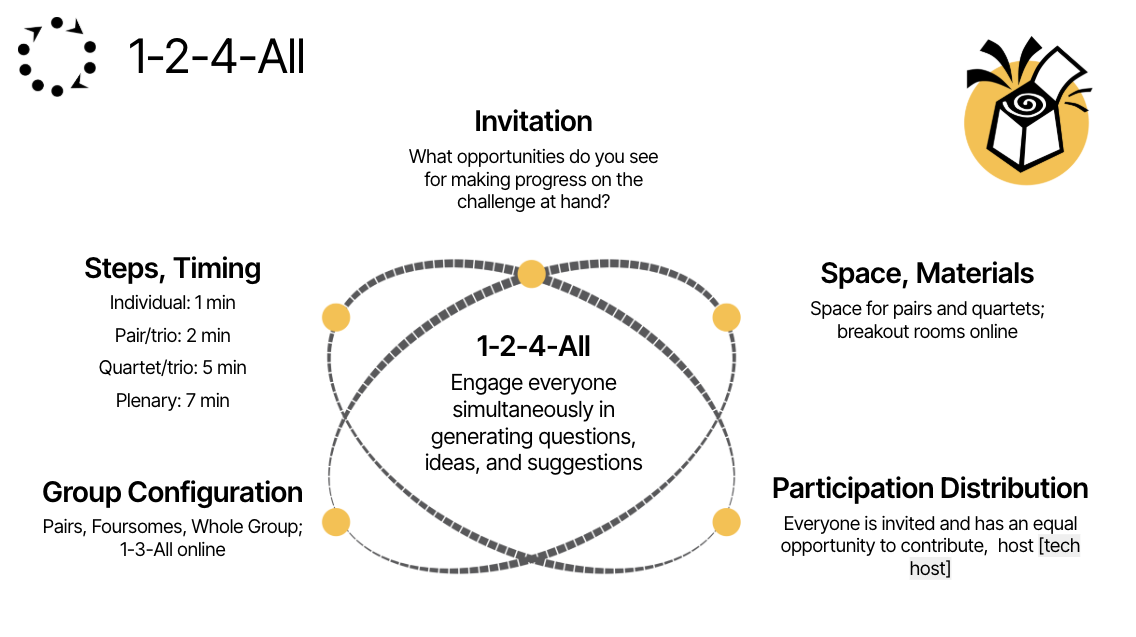
A one-slide overview of the elements of 1-2-4-All in the LS constellation format.