

What, So What, Now What (W3)
Together, Look Back on Progress to Date and Decide What Adjustments Are Needed (~20–40 min.)
“Get the facts first. You can distort them later.”
Purposes
Instead of altering our beliefs to fit new information, we often force information to fit our existing beliefs. To break this pattern, W3 guides groups through three questions—What happened (facts), So What (meaning), and Now What? (next steps). This structured reflection helps us build understanding and reduce biases and misunderstandings so we can move from observation to coordinated action. This structure enlivens LS Principle #4, Learn by Failing Forward.
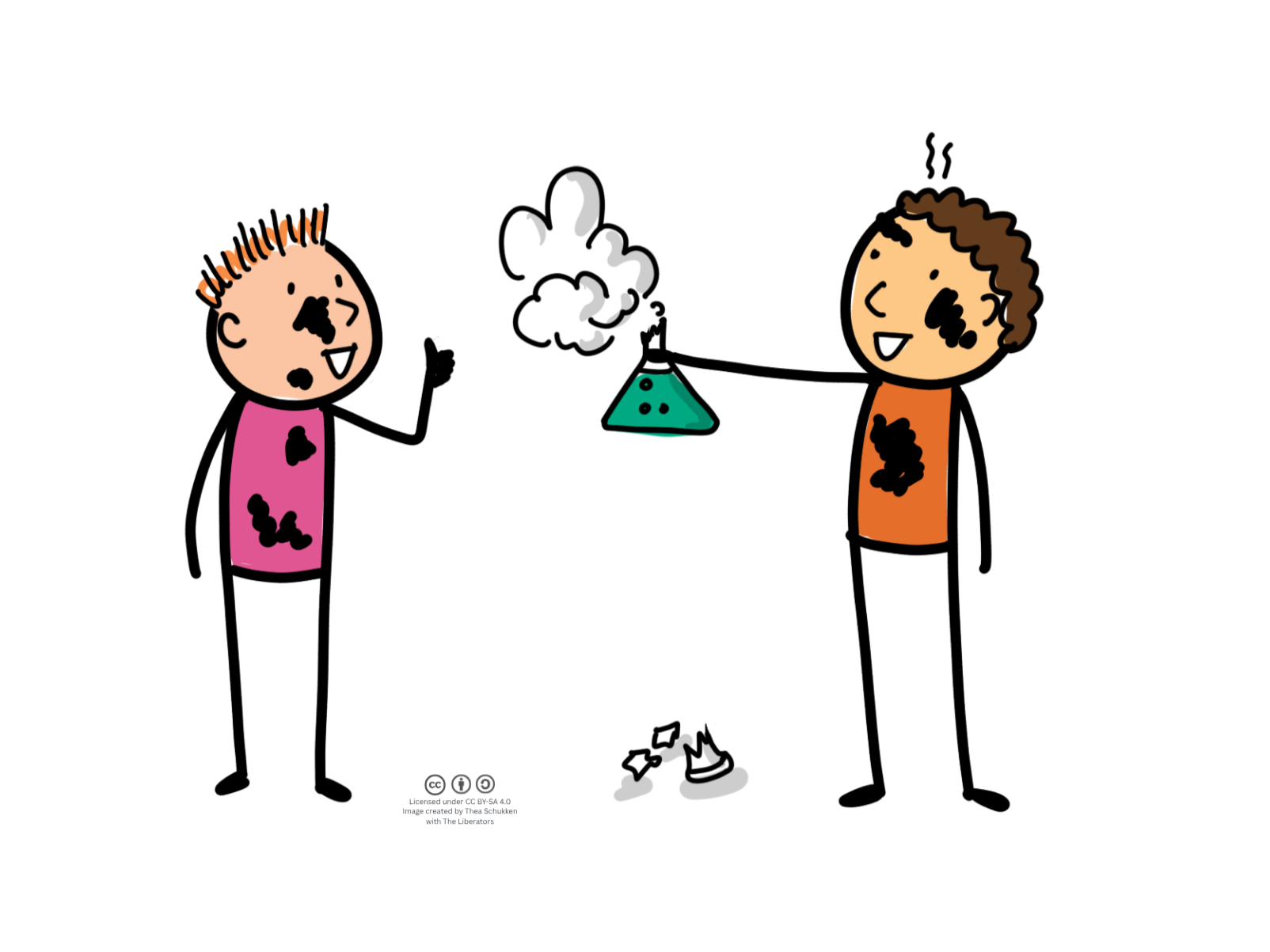
Principle: Learn by Failing Forward.
Five Structural Elements—Min Specs
Structuring Invitation
“Let’s look back on our progress and make adjustments as we move forward. In three phases, we will start with facts and observations by asking what happened. Then we will explore why it is important and what happens next.”
Space and Materials
Chairs for small groups of five to seven [breakouts of five to seven]. Paper for everyone and a flip chart for the whole group [chat or visual collaboration space]. See W3 figure below.
Participation Distribution
Roles include host [tech host] and participants. Minimum group size is four. Everyone is invited and has an equal opportunity to contribute.
Group Configuration
Alone, groups of five to seven, whole group
Steps and Time Allocation
Intro: Share the structuring invitation. Show W3 ladder visual (below). The ladder illustrates a path to avoid misunderstandings by moving from low on the ladder (data) to high on the ladder (beliefs and actions). Preview the three questions:
What? What happened? What did you notice? What facts or observations stood out? Include observations about space, process, emotions you noticed.
So What? What does the data mean? Why is it important? What patterns or conclusions are emerging? What hunches or hypotheses can you make?
Now What? What actions or first steps make sense? (2 min.)
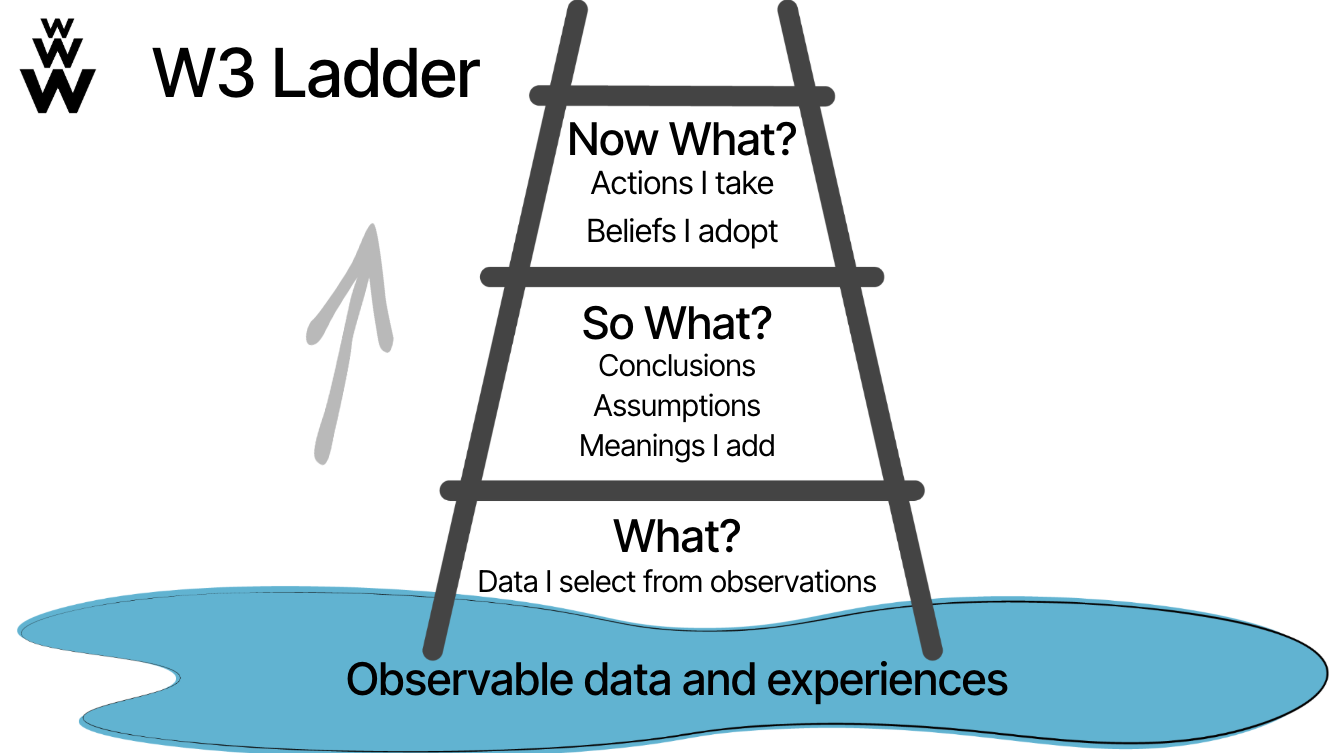
W3 Figure: The Ladder of Inference, displayed when introducing What, So What and Now What
Round 1 (What?): Individuals reflect and write down answers to the first question. (1 min.) They form groups [move to breakout rooms] to share their responses. (3–8 min.) They then return to plenary. A few people share the most important facts they learned and capture them on a flip chart. (2–3 min.)
Round 2 (So What?): Repeat the same steps, asking the second question about meaning and conclusions.
Round 3 (Now What?): Repeat the same steps, asking the third question about actions and next steps.
Taking It Online
The structure W3 works online with no major adjustments. Digital tools like chat make it easy to capture the three Ws.
Practice Insights
Tips
Practice W3 often to make it feel easy for your group. For Question 1, encourage people to record observations as well as facts. Check in with small groups to make sure their answers fit the questions for each round, and share examples with the whole group if needed. Intervene quickly if someone jumps up the Ladder of Inference. Create an artifact at the end of one meeting to enable lift off from where you left off in the next meeting.
Riffs and Variations
Insert a “What If?” question between So What? and Now What? to develop ideas for experiments. Use the W3 visual template (below) to record answers and look for relationships between them.
Practical Applications
LS W3 can be used to draw out the history of previous events at the start of a meeting, to debrief on complex topics, or to make sense of a shocking event.
Optional String
Explore ambitions for the future with Future~Present, Wicked Questions, and 25/10 Crowdsourcing.
Attribution
Liberating Structure developed by Henri Lipmanowicz and Keith McCandless. Dig deeper into the “Ladder of Inference,” first introduced by professor Chris Argyris. Chris Argyris, Reasoning, Learning, and Action: Individual and Organizational (San Francisco: Jossey-Bass, 1982)
Collateral Materials
Link to supporting materials for What, So What, Now What.
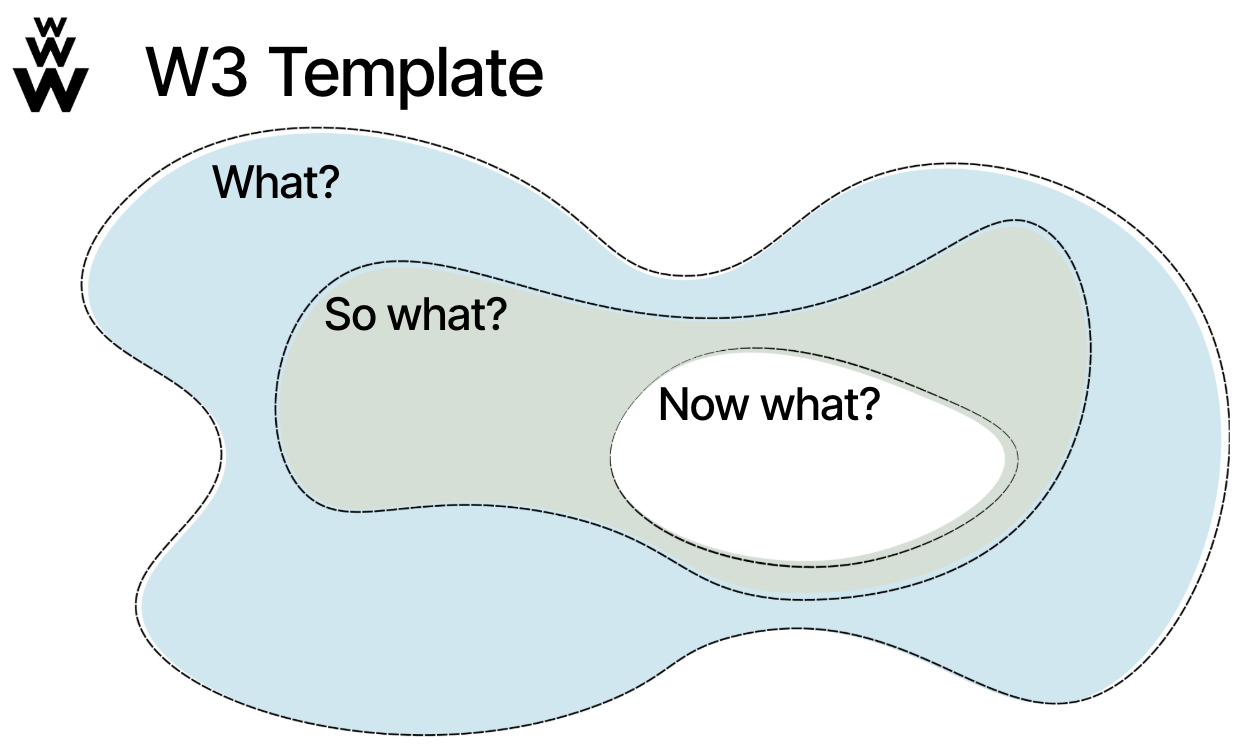
W3 Visual Template
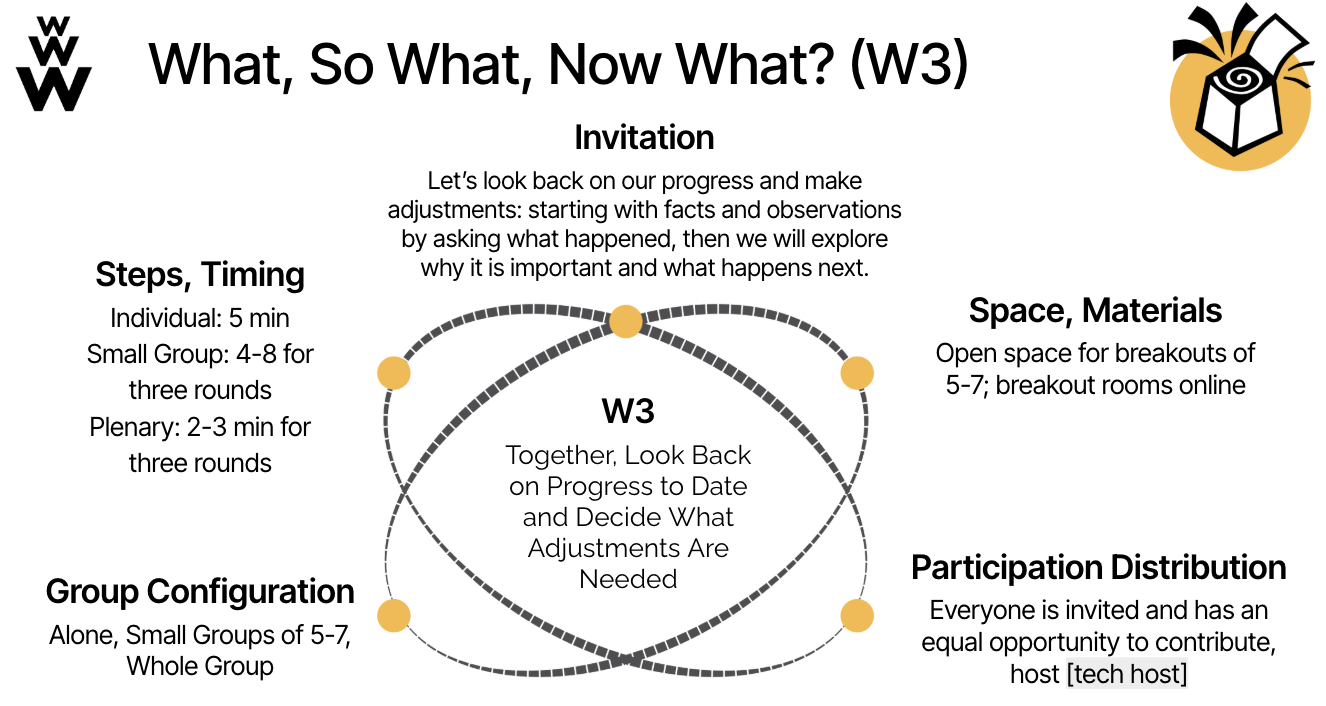
A one-slide overview of the elements of What, So What, Now What in the LS constellation format.