

5 Design Elements
Every Liberating Structure is specified using the same five design elements. We call these minimum specifications, and they are the elements that construct an LS: the arrangement of space in person or online, the central invitation, the distribution of participation, the configuration of groups, and the way steps unfold.
Understanding these five elements is what makes the repertoire learnable. Once you see how they work in one structure, you can approach learning any of them with confidence.
Macro vs. Micro: A Useful Distinction
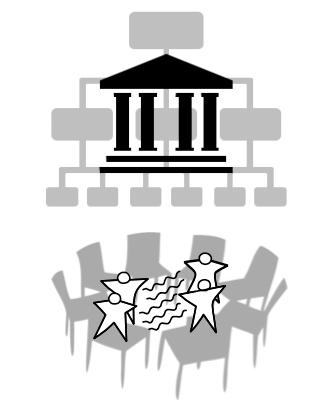
Whatever we do, there is always a structure shaping our interactions.
Buildings, strategies, and organizational hierarchies are macrostructures: built for the long term; hard to change. Group composition, meeting room arrangements, and how discussions are formatted are microstructures: these can be changed easily, from one meeting to the next, or even in the moment.
This distinction reveals a crucial insight: while we can't easily change the systems and physical structures around us, we often have control over the patterns of interaction that shape our experiences day to day. Liberating Structures offer a way to intentionally shape these microstructures to better serve us, our organizations, and our work.
The Five Design Elements
Every Liberating Structure specifies five elements. Together they form the minimum specifications needed to run the LS effectively, in any setting, with any group size. Learn about each element below.
-
Each LS comes with an invitation that introduces its purpose while leaving all participants fully in control of generating responses and content. A good invitation is precisely ambiguous — clear enough that everyone knows what's being asked, open enough that many different answers are possible.
Example (1-2-4-All): "What opportunities do you see for making progress on this challenge?"
-
Each LS has instructions for arranging the space to allow fluid movement and collaboration. We also specify the materials needed for full participation — whether meeting in person or online.
Example (1-2-4-All): Space for pairs and quartets. Chairs, tables, and paper are optional.
-
This element covers roles, minimum group size, and methods of inclusion. Every LS is designed to include everyone affected and provide equal opportunities to contribute. There is no upper limit on the number of participants for any LS.
Example (1-2-4-All): Everyone has an equal opportunity to contribute. Minimum group size is four.
-
This element defines whether participants work independently or collectively, and how groups form. Usually, participants work in small parallel groups, then share results before moving forward in rapid cycles.
Example (1-2-4-All): Alone → pairs → quartets → whole group.
-
A detailed breakdown providing clear instructions for the host and describing participants' actions at each step. The steps follow a simple, logical sequence designed to achieve the structure's purpose.
Novice hosts can follow the steps as a script. Experienced hosts can treat them as a foundation for variation and improvisation.
Example (1-2-4-All): Individual reflection (1 min.) → pairs share (2 min.) → quartets refine (5 min.) → all-together sharing (7 min.) = ~15 min. total.
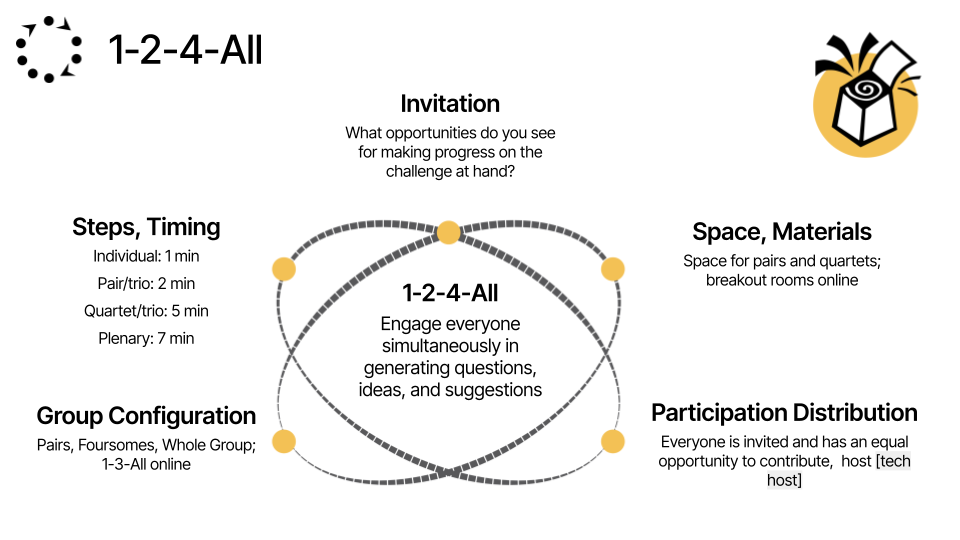
Each individual LS description includes specifications of the five design elements. In the figure, each of the five elements is specified for 1-2-4-All.
A slide deck with all 43 constellation visuals is available here.