
Liberating Structures (LS) are rooted in ten guiding principles. These aren't abstract values — they are specific behaviors that bridge the gap between what we say is important and what we actually do.
Principles
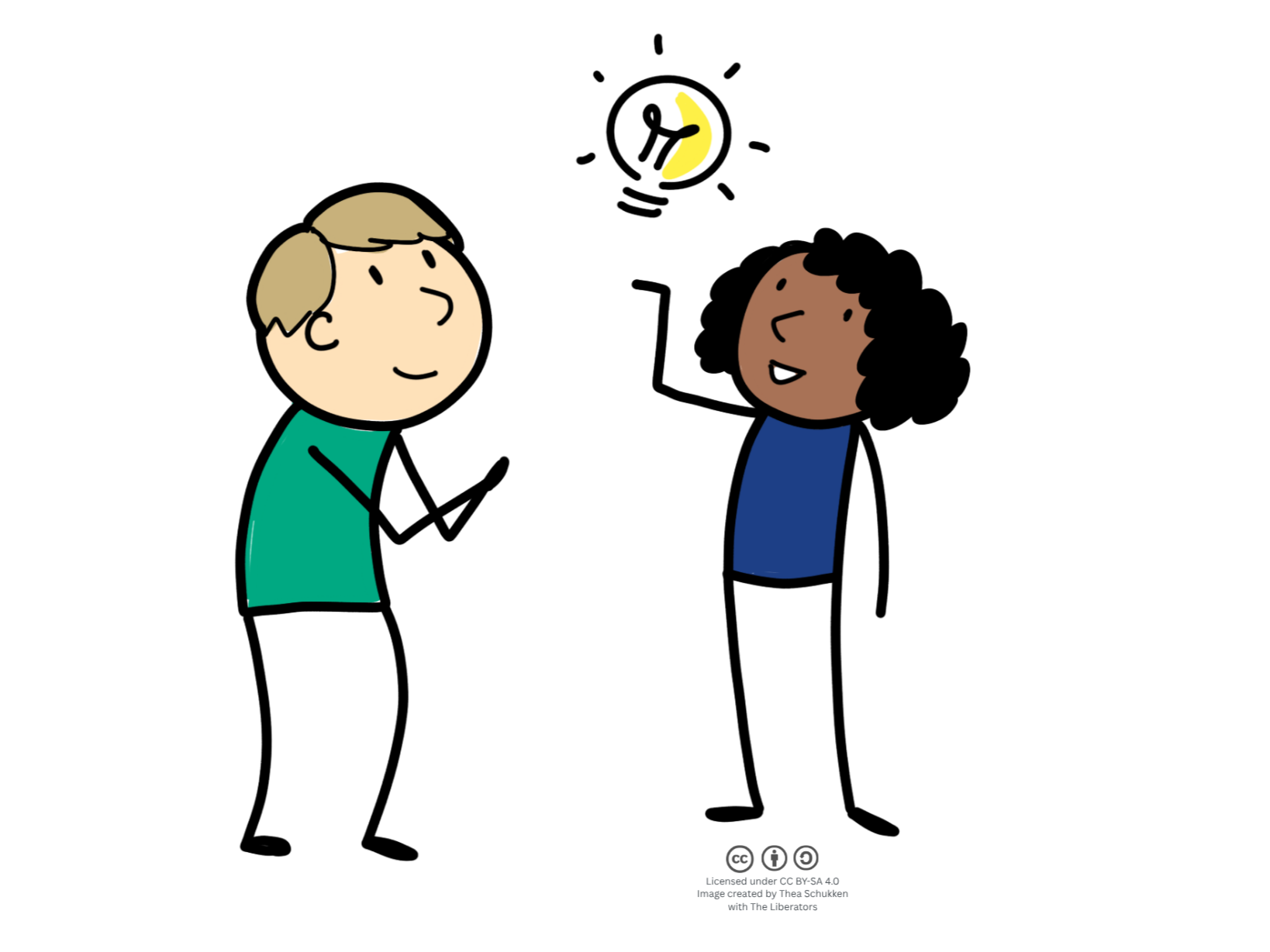
Within the website, each individual LS is linked with one of the principles and its image. Above: Practice Deep Respect for People and Local Solutions.
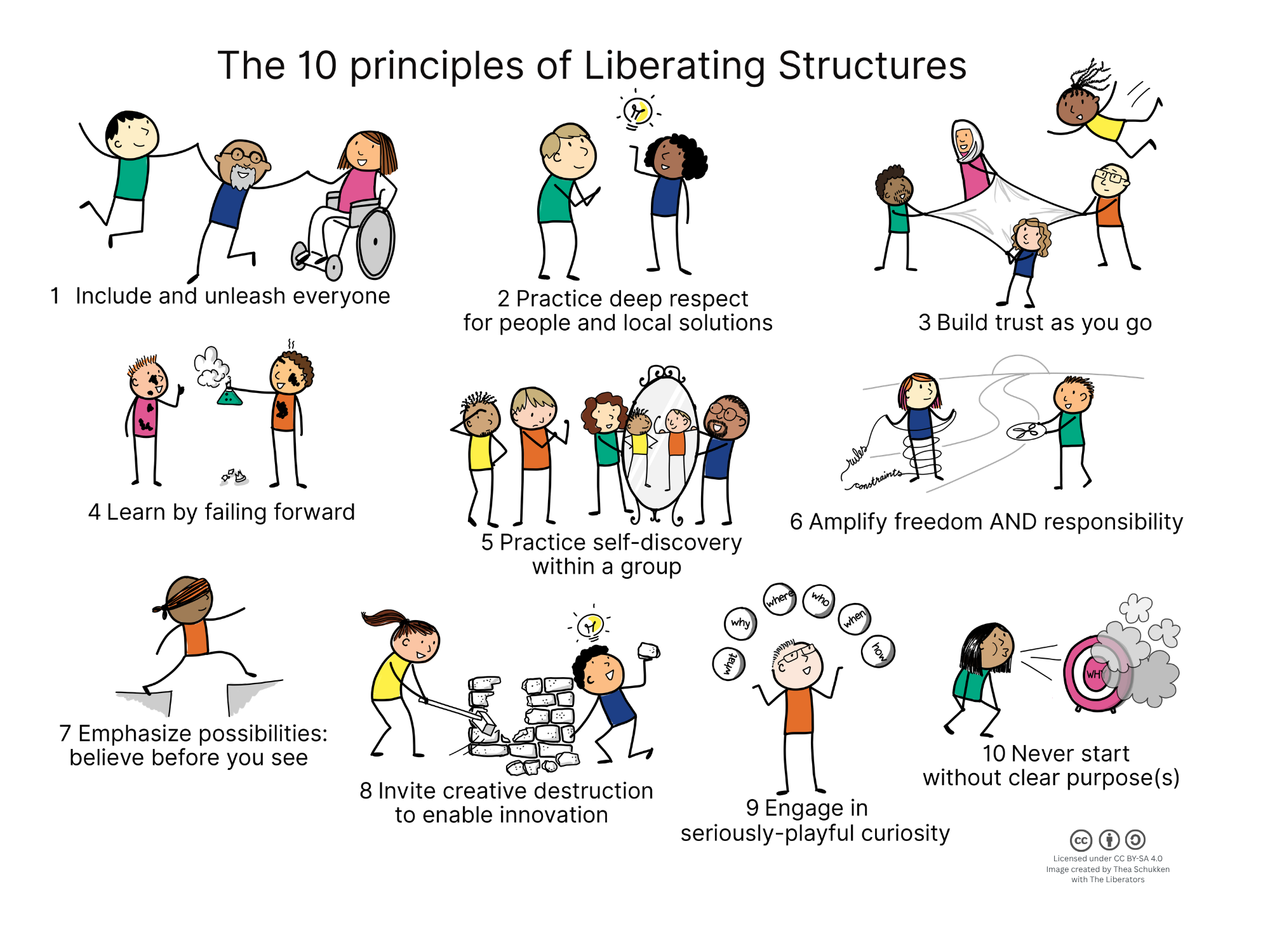
Each of the LS Principles and an associated figure created by Thea Schukken in partnership with The Liberators.
All too often, aspirations such as fostering collaboration, giving people more responsibility, and thinking outside the box lose meaning when they don't come with a set of practices people can use to enact them. This is where LS comes in.
More About Each of the Liberating Structures Principles
In the accordion menu below, you will find each principle and a description of Must Do’s and Must Not Do’s. The Must Do’s are often valued and espoused, but less often practiced. LS aim to make it possible to start or amplify these practices. Must Not Do’s are often unnoticed, or “autopilot” behaviors. LS aim to make it possible to stop or reduce these practices.
-
Must Do’s
Invite everyone touched by a challenge to share possible solutions or invent new approaches together. Actively reach across levels, beyond the usual suspects.
Must Not Do’s
Appoint a few to design an “elegant solution” and then tell all others to implement it after the fact. Confront resistance with hours of PPT presentations. Force buy-in Separate deciders from doers.
-
Must Do’s
Engage people doing the work & familiar with the local context. Trust and unleash their collective expertise and inventiveness to solve complex challenges. Let go of the compulsion to control.
Must Not Do’s
Import best practices, drive buy-in, or assume people need more training. Privilege experts and computer systems over local people and know-how
-
Must Do’s
Cultivate a trusting group climate where speaking the truth is valued and shared ownership is the goal. Sift ideas & make decisions using input from everyone. Practice "nothing about me without me." Be a leader and a follower.
Must Not Do’s
Over-help or over-control the work of others. Praise and pretend to follow the ideas of colleagues. Indirectly, respond to ideas from others with cynicism, ridicule, criticism, or punishment.
-
Must Do’s
Debrief every step. Make it safe to speak up. Discover positive variation. Include and unleash clients as you innovate. Take small risks quickly, reducing time between iterations.
Must Not Do’s
Focus on doing and deciding. Avoid difficult conversations and gloss over failures. Punish risk-takers when unknowable surprises pop up.
-
Must Do’s
Engage groups to the maximum degree in discovering solutions on their own. Increase diversity to spur creativity, broaden potential solutions and enrich peer-to-peer learning. Encourage experiments on multiple tracks
Must Not Do’s
Impose solutions from the top. Let experts "educate" and tell people what to do. Assume that people resist change no matter what. Substitute laminated signs for conversation. Exclude front line people from innovating
-
Must Do’s
Specify minimum constraints and let go of over-control. Use the power of invitation. Privilege fast experiments over playing it safe. Track progress rigorously and feed back results to all. Invite the frontline to create local performance metrics. Celebrate mistakes as sources of progress.
Must Not Do’s
Unleash people without structure such as a clear purpose or minimum specifications. Let rules and procedures stifle initiative. Ignore the value of people understanding how their work affects one another. Keep frontline staff in the dark about group performance data.
-
Must Do’s
Expose what is working well. Focus on what can be accomplished now with the imagination and materials at hand. Take the next steps that lead to the edge of creativity and renewal.
Must Not Do’s
Focus on what's wrong. Wait for all the barriers to come down or ideal conditions to emerge. Work on changing the whole system all at once.
-
Must Do’s
Convene conversations about what is keeping people from working on the essence of their work. Remove the barriers even when it feels like heresy. Make it easy for people to deal with their fears.
Must Not Do’s
Avoid or delay stopping the behaviors, practices and policies that are revealed as barriers. Assume obstacles don't matter or can't be removed.
-
Must Do’s
Stir things up - with levity, paradoxical questions, and improv - to spark a deep exploration of current practices and latent innovations. Make working together both demanding and inviting.
Must Not Do’s
Keep it simple by deciding in advance what the solutions should be. Control all conversations. Ask only closed yes or no questions. Make working together feel like drudgery.
-
Must Do’s
Dig deep for what is important and meaningful to you and to others. Use 9 Whys routinely. Take time to include everyone in crafting an unambiguous statement of the deepest need for your work.
Must Not Do’s
Maintain ambiguity by using jargon. Substitute a safe short-term goal or means-to-an-end for a bold reason to exist or a deep need. Impose your purpose on others.