

Impromptu Networking
Rapidly Share Challenges and Expectations, Build New Connections (~20–25 min.)
“Once individuals link together they become something different. Relationships change us, reveal us, evoke more from us. Only when we join with others do our gifts become visible, even to ourselves.”
Purposes
In Impromptu Networking, participants connect briefly with several others in pairs to talk about challenges they are facing. This quick structure helps everyone share ideas, spot patterns, and build strong connections. By focusing on key challenges, it ignites curiosity and taps into the group’s collective knowledge. Impromptu Networking is designed to immediately involve everyone, avoid long introductions, and deepen shared understanding of a complex challenge.

Principle: Engage in Seriously Playful Curiosity
Five Structural Elements—Min Specs
Structuring Invitation
“In fast and fun rounds, you will connect with a few people to find out what they think about a big challenge and their role in it.”
Space and Materials
An open space for participants to stand in pairs and move around easily [breakouts of two or three].
Participation Distribution
Roles include host [tech host] and participants. Minimum group size is four. Everyone has an equal opportunity to contribute.
Group Configuration
Alone, pairs, or trios
Steps and Time Allocation
Intro: Share the structuring invitation. Invite participants to silently reflect on two questions: What big challenge do you bring to this gathering? What do you hope to get from and give to this group or community? (3 min.)
Round 1: Participants form pairs [breakouts of two or three] with people in different groups/functions to share their answers. (4–5 min.)
Rounds 2 and 3: Participants find a new partner and repeat the process [return participants to plenary, then remix breakout rooms]. (4–5 min. per round)
All-Together Sharing: Everyone returns to plenary. A few people share ideas everyone should hear. (3 min.)
Taking It Online
Technical limitations can make it difficult to get the maximum mix between rounds, especially with small groups. If your group is small enough, manually assign participants to new breakout rooms with new people each round. This adds time to transitions, so give participants something to do while they wait.
Practice Insights
Tips
It can feel awkward when one person shares for too long. Address this issue playfully: Say, “If you used too much time, fix it by talking less in the next round!” If people end up with the same partner in later rounds, tell them, “Lucky you! You can dig deeper.” Resist shortening this LS to one or two rounds.
Riffs and Variations
Play with different questions, using one challenge question and one “give-and-take” question. Use the structure at both the beginning and end of a meeting. Online, use trios to prevent participants from ending up alone in a breakout room.
Practical Applications
Spark deeper connections on the first day of class, jump-start an interdisciplinary learning session, or connect far-flung innovators.
Optional String
Use 15% Solutions to follow up on new ideas. Strengthen network connections with Social Network Webbing and Network Relationship Patterns.
Attribution
Liberating Structure developed by Henri Lipmanowicz and Keith McCandless. Dig deeper with June Holley’s network weaving practices.
Collateral Materials
Link to supporting materials for Impromptu Networking.

Impromptu Networking in action. Photo credit: Arvind Singhal.
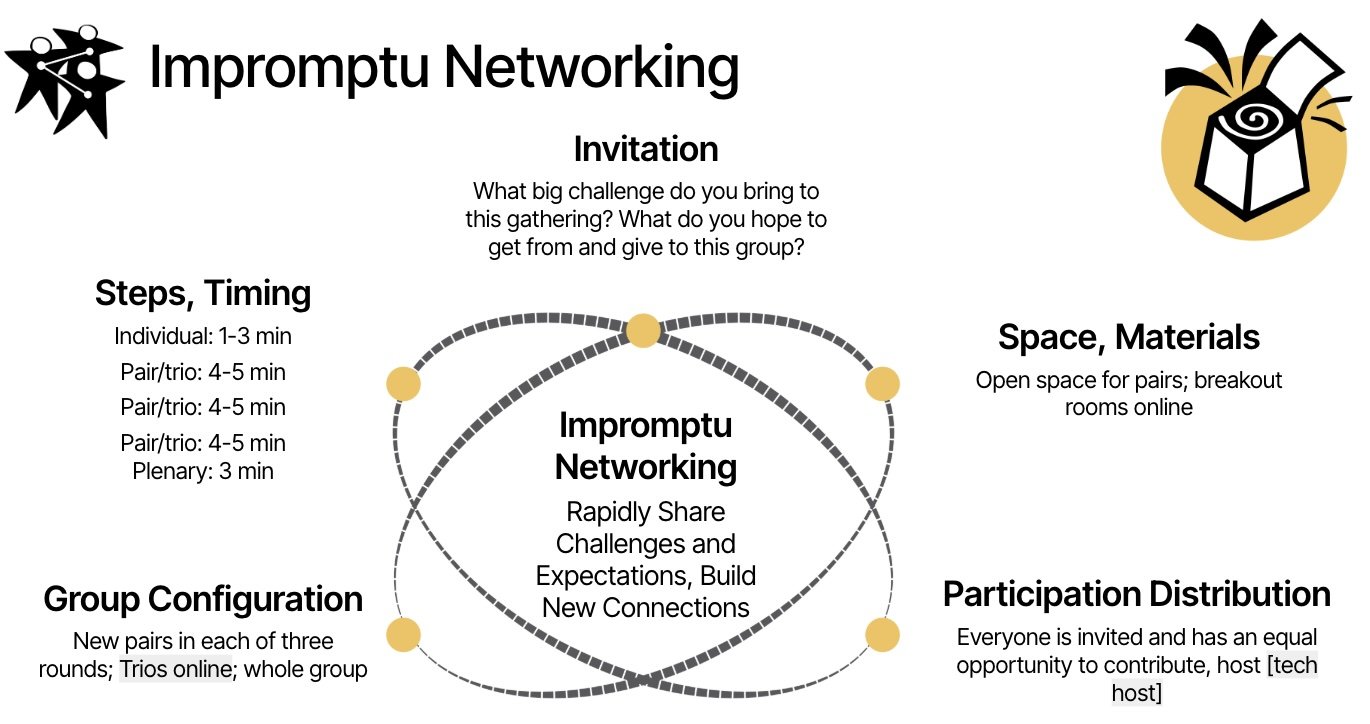
A one-slide overview of the elements of Impromptu Networking in the LS constellation format.