

Spiral Journal
Calmly Prepare and Sharpen Observations for the Work Ahead (~1–20 min.)
“The quieter you are, the more you will be able to hear.”
Purposes
In Spiral Journal, participants reflect calmly on challenges or opportunities by drawing a spiral and responding to four open-ended prompts. This structure focuses thoughts and unleashes creative ideas, creating a comfortable space for quieter people to contribute. When shared, these responses reveal patterns and potential new directions for our work. Spiral Journal enacts LS Principle #5, Practice Self-Discovery Within a Group.
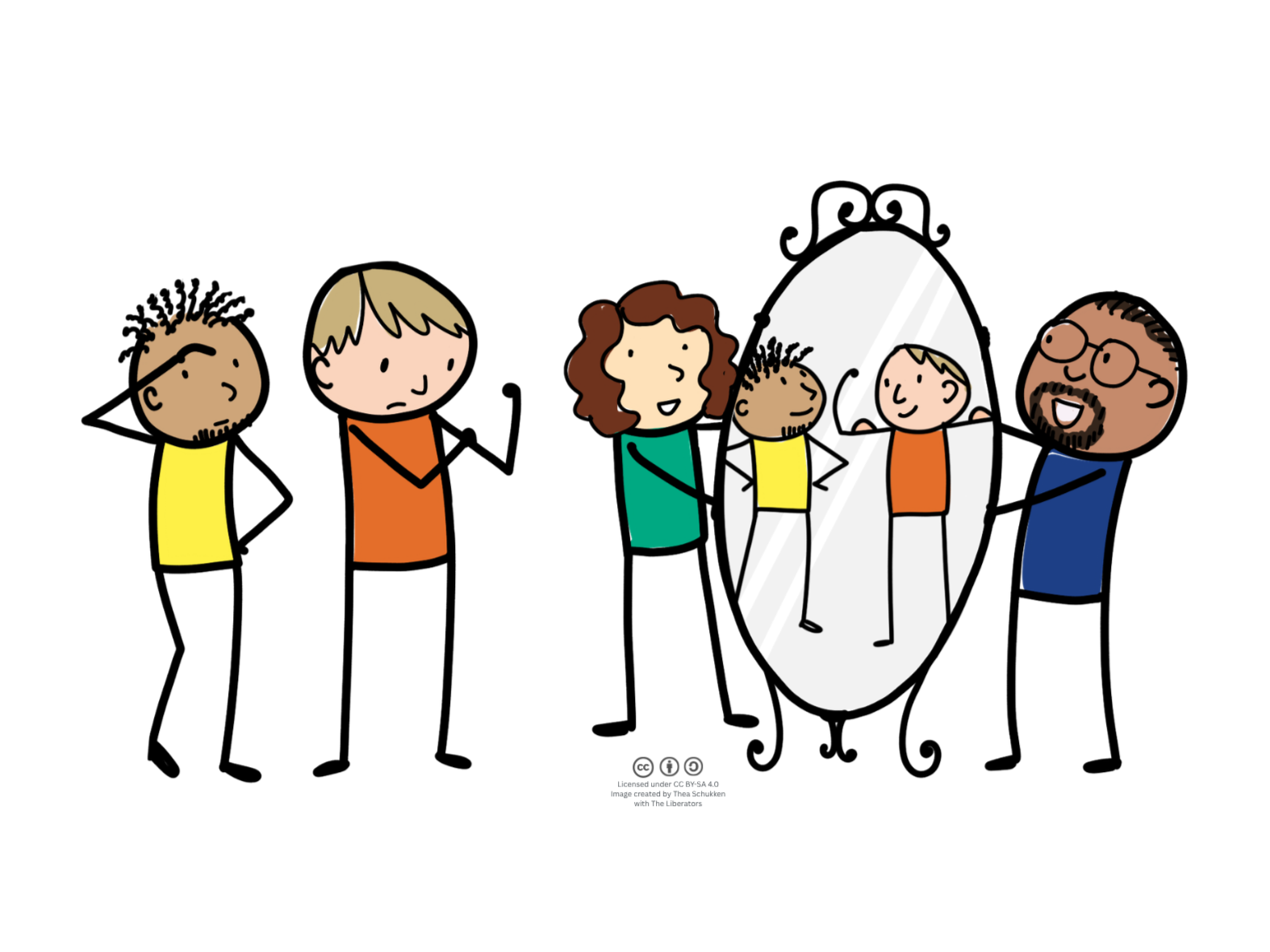
Principle: Practice Self Discovery in a Group
Five Structural Elements—Min Specs
Structuring Invitation
“Before we jump into talking about our topic, let’s take a few minutes to collect our thoughts. We are going to do a quiet activity to prepare for the work ahead.”
Space for participants to form pairs and trios [breakouts of two to three]. Paper and pen/pencil for each participant. Prompts prepared in advance [ready to paste into chat] (see sample below for examples).
Space and Materials
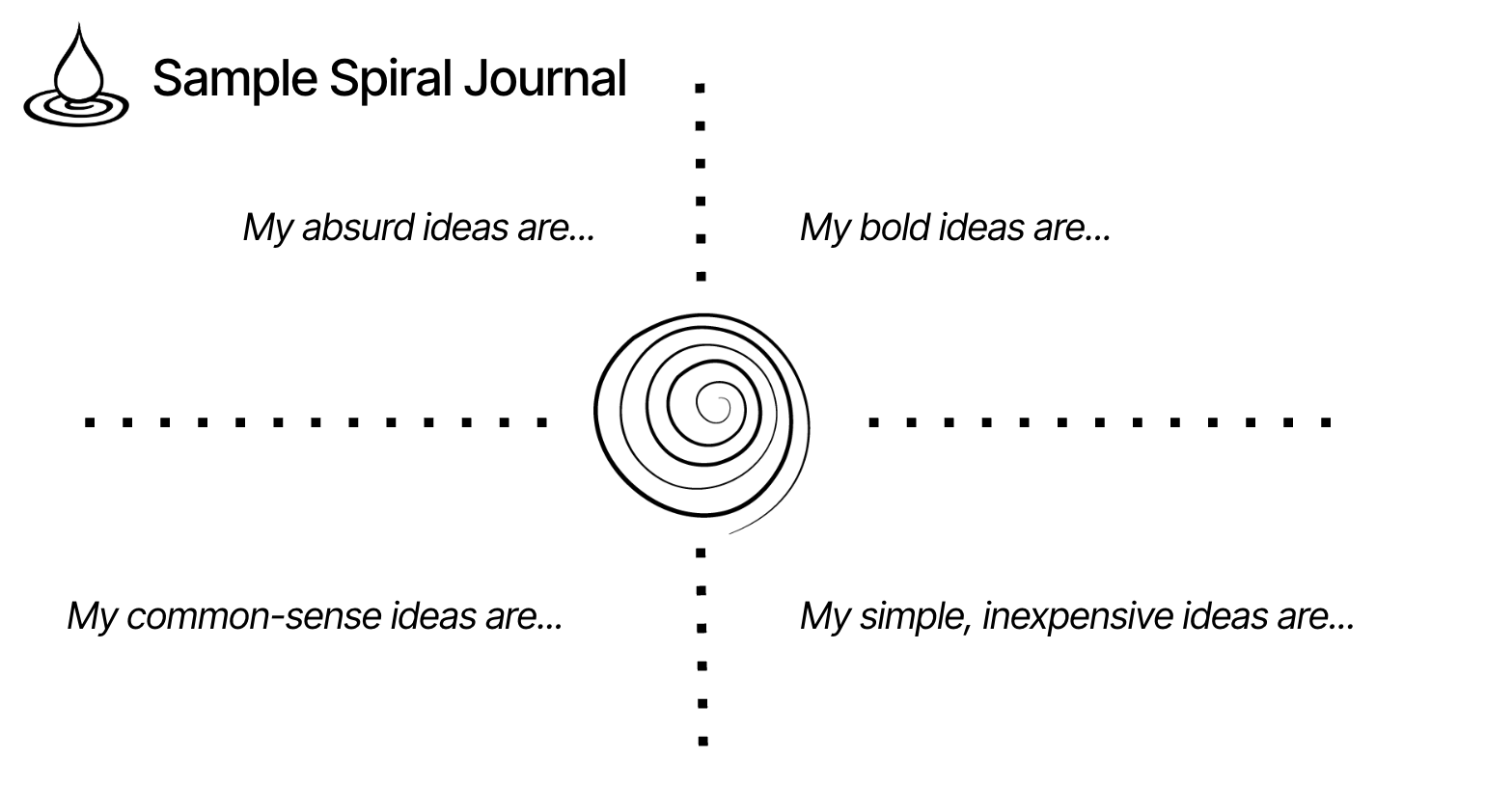
A sample page layout for Spiral Journal with four sample open-ended sentences.
Participation Distribution
Roles include host [tech host] and participants. Everyone is invited and has an equal opportunity to contribute.
Group Configuration
Alone, pairs or trios, whole group.
Steps and Time Allocation
Intro: Share the structuring invitation and hand out paper. (1 min.)
Spiral Setup: Instruct participants to fold their paper in half and then in half again to create four equal quadrants, draw a dot at the center of the page, and slowly draw a spiral outward, keeping the lines close together. (1–2 min.)
Generate Ideas: One by one, the host reads a prompt and participants take 1–2 minutes to respond to the prompt in a quadrant. Host reads second prompt and they respond in the next quadrant. Repeat until all quadrants are filled. (See sample above.) (8 min.)
Review and Select Ideas: Participants read and circle one or two ideas per quadrant that stand out or surprise them. (2 min.)
Group Sharing: Participants form pairs or trios [breakouts] and share their circled ideas. (3 min.)
Collective Insights: Everyone returns to plenary. A few people share key insights or common themes [in Chatterfall]. (3 min.)
Taking It Online
Spiral Journal works well online to start a meeting, helping people transition calmly from other activities. Working on paper brings physical activity online.
Practice Insights
Tips
All spirals are perfect, whether neat or wobbly. Encourage people to write all their ideas without filtering or critiquing. Avoid interruptions that can break concentration, which is essential for this activity.
Riffs and Variations
Adapt the prompts for different situations, such as navigating a transition or loss. Play gentle background music while people are drawing. Adapt the prompts for different situations. For example, to expand options for the work ahead, ask “What must we protect? What must we resist? What must we invent?” and, “What must we let go of?”
Practical Applications
Use this structure at the beginning of a meeting to help people in diverse groups see common or divergent perceptions. Help a group slow down and generate fresh ideas or reflect more deeply on a challenge.
Optional String
Follow with 15% Solutions to bring ideas into action. Use as a bridge between What I Need From You and What, So What, Now What to settle thoughts. Use after multiple layers of new ideas or strategies have been generated in Ecocycle Planning or Critical Uncertainties.
Attribution
Developed by Fisher Qua and Anna Jackson with inspiration from Lynda Barry (cartoonist).
Collateral Materials
Link to supporting materials for Spiral Journal.
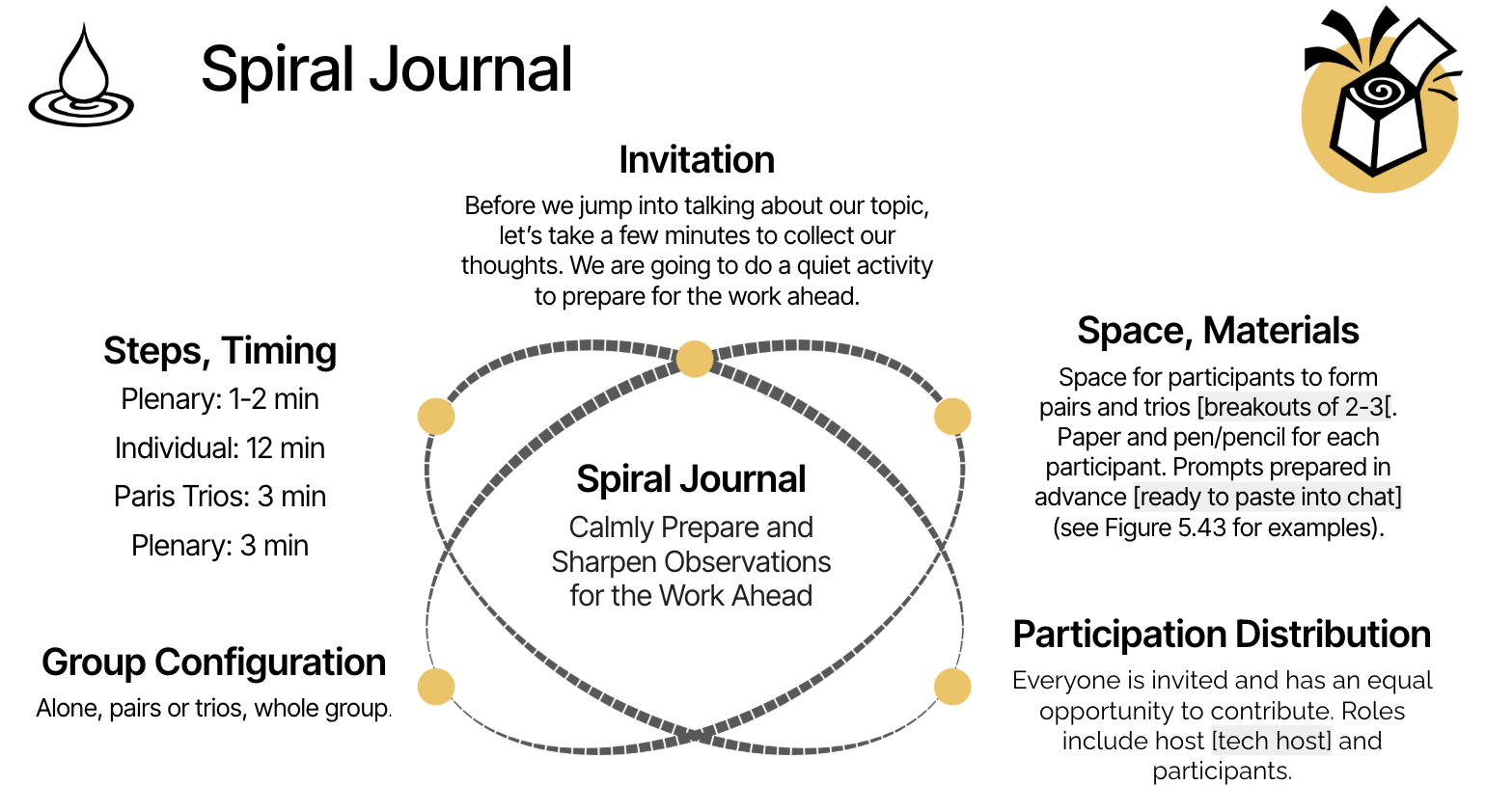
Microstructural elements of Spiral Journal in the constellation format.