
25/10 Crowdsourcing
Rapidly Generate and Sift a Group’s Most Powerful Actionable Ideas (~20–25 min.)
“Reality is only a consensual hunch.”
Purposes
In 25/10 Crowdsourcing, a group can generate bold ideas and sort them to find the top ten in thirty minutes or less. This activity taps the group’s collective wisdom, paving the way for innovations to spread as patterns emerge. It is a fast and fun way to find actionable ideas. 25/10 Crowdsourcing is challenging to take online, so the instructions below are for F2F settings only. This structure brings to life LS Principle #1, Include and Unleash Everyone.
Principle: Include and Unleash Everyone.
Five Structural Elements—Min Specs
Structuring Invitation
“If you were ten times bolder, what big idea would you recommend? What first step would you take to get started? Let’s generate and sort your bold ideas for action and spread innovations as everyone notices the patterns in what emerges.”
Space and Materials
Open space to move about with no chairs or tables. Index cards and pens for each participant.
Participation Distribution
Roles include host and participants. Minimum group size is fifteen. Everyone is invited and has an equal opportunity to contribute.
Group Configuration
Alone, whole group
Steps and Time Allocation
Intro: Share the structuring invitation and describe a shared challenge. (3 min.)
Generate Bold Ideas: Participants think of bold ideas for responding to the shared challenge. They write their boldest idea and the first step to implement it on an index card. Encourage people to write briefly and clearly. Tell them that spelling and grammar are much less important than their ideas! (5 min.)
Move and Pass Cards: Participants take their card and a pen and move around the room. Each time they pass another person, they trade cards without looking at the new card. After one minute, they will hear a signal to stop moving. They will read the card in their hand, rate it on a scale of 1 to 5 (1 for low, 5 for high), and write their rating on the back. They should not look at any previous ratings until they have decided on a score. They will raise their cards in the air to signal they are ready for the next round. Demonstrate the process to clarify expectations. (2–3 min.) Invite participants to start Round 1. Repeat this process for five rounds. (5 min.)
Add Scores: Participants add up the scores on the card they are holding. (2 min.)
Countdown: Find the best-scoring ideas by counting down, beginning with “Who has a 25?” Stop when the top ten ideas have been identified and shared. (3–5 min.)
Wrap-Up: Ask two questions to wrap up: Are you holding a wild-card idea that did not get a high score but is an intriguing option or long shot? Looking at everything we’ve come up with, where might these ideas take root and gather momentum? (2 min.)
25/10 Crowdsourcing in Action
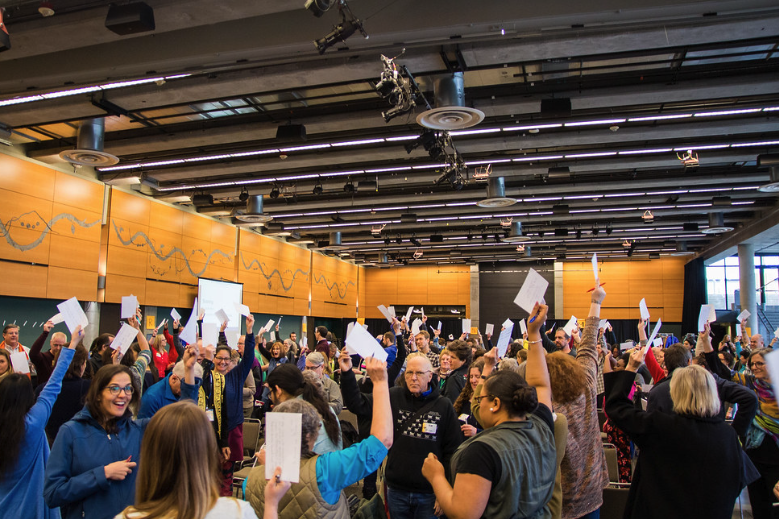
Photo credit: Lisanne Lentink

Photo credit: Lisanne Lentink
Taking It Online
25/10 Crowdsourcing is not recommended for online use due to logistics.
Practice Insights
Tips
Make sure participants are not reading the cards as they pass them or peeking at scores before they make their own score. Scoring may be erratic; if a card has fewer or more than five ratings after Round 5, they can find the average and multiply by 5.
Riffs and Variations
Use a different rating scale, such as “1 = not my cup of tea” to “5 = sends me over the moon.” Instead of asking for bold ideas, change the question to something like “If you could unmake one decision that is holding you back, what would it be, and what is your first step to unmake it?” or “What courageous conversation are you not having, and what first step could spark your courage?” Begin a meeting with 25/10 Crowdsourcing and then repeat it at the end, asking what ideas participants have that may be bolder and more actionable.
Practical Applications
LS 25/10 Crowdsourcing can help to prioritize ideas after Options Place or a participant-driven meeting. It can also generate bold ideas at the start of a conference or task-force meeting. Wrap up an important meeting with clear, actionable ideas.
Optional String
Pair with Options Place to refine ideas and Purpose-to-Practice and Principles Walk-Around to identify next steps.
Attribution
Liberating Structure developed by Henri Lipmanowicz and Keith McCandless.
Collateral Materials
Link to supporting materials for 25/10 Crowdsourcing.
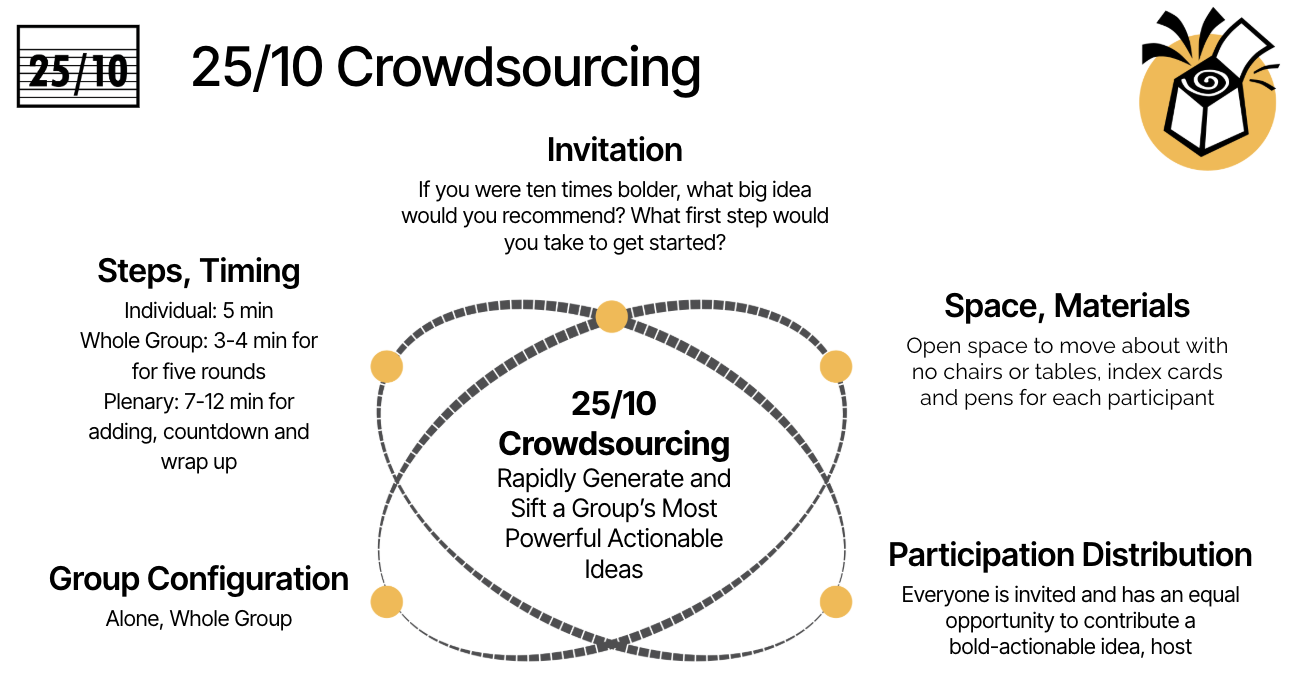
A one-slide overview of the elements of 25/10 Crowdsourcing in the LS constellation format.