

Strategy Knotworking (SKW)
Answer Six Questions Together to Develop Strategy Everyone Owns (~6 hrs., all at once or split over up to four days)
“To be prepared against surprise is to be trained. To rely on surprise is to be educated.”
Purposes
In Strategy Knotworking (SKW), participants answer six questions to develop a strategic initiative in a complex context. It is designed to engage everyone who will execute the strategy in its development, building shared ownership of higher-order goals and capacity to respond to uncertainty. SKW reinforces LS Principle #6, Amplify Freedom and Responsibility.
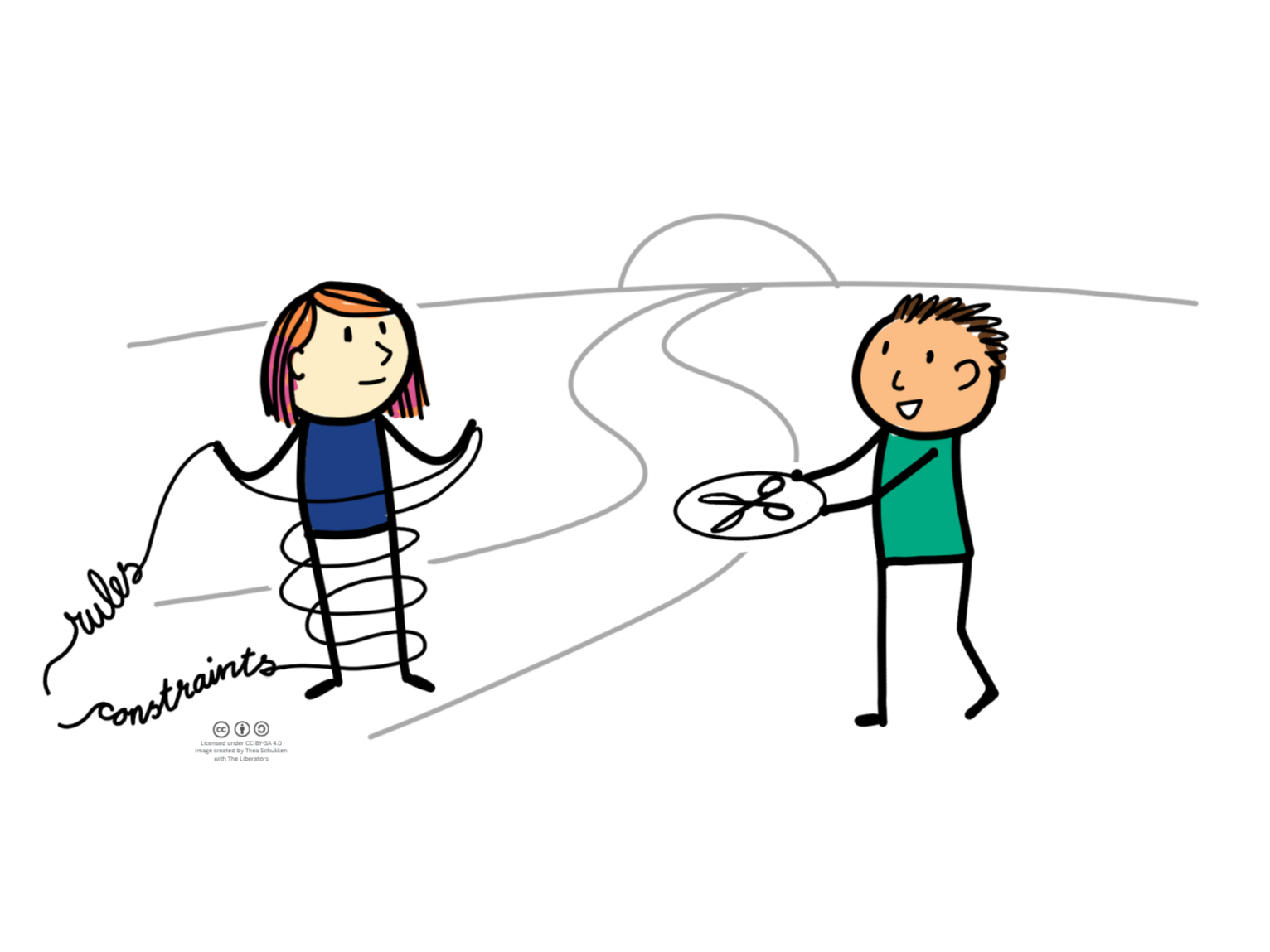
Principle: Amplify Freedom and Responsibility
Five Structural Elements—Min Specs
Structuring Invitation
“Today we are a group of intrepid explorers planning a route for our adventures over the next five to ten years. We will develop our strategic plan by mapping our purpose, context, challenges, current state, and next steps in quick iterative cycles and collecting our insights as we go.”
Space and Materials
An open wall with an SKW template, a large roll of paper, markers, and sticky notes [digital versions]. SKW template handouts for each F2F participant or paper for everyone to draw their own. Templates and handouts for each embedded LS (see Steps).
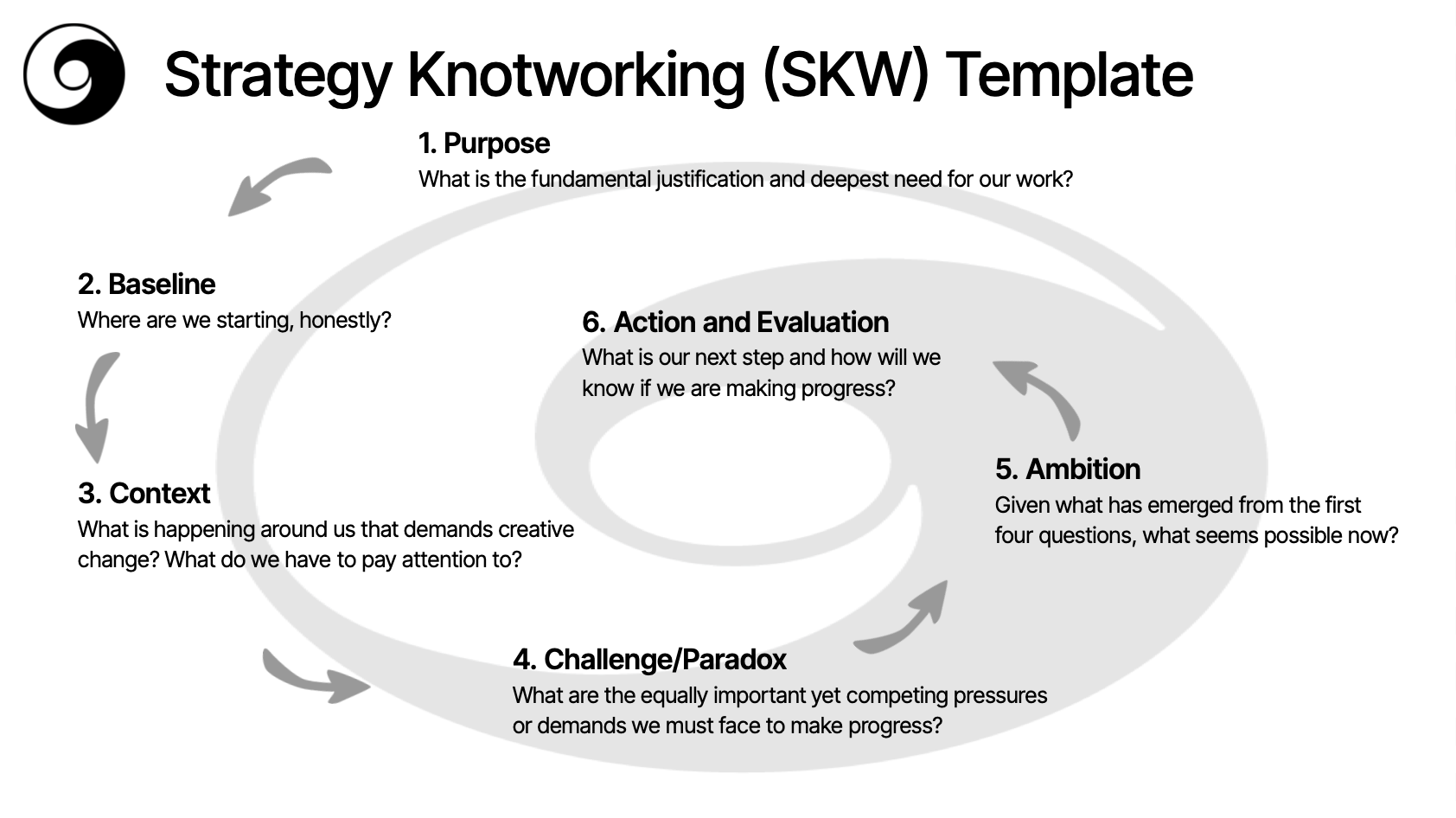
Participants use the SKW template to capture their answers as they explore the six questions. Sticky notes allow answers to be updated and moved around.
Participation Distribution
Roles include host [tech host] and participants. Minimum group size is one. Everyone with a stake in the strategy is included.
Group Configuration
e.g. Alone, pairs, quartets, whole group [1-3-All].
Steps and Time Allocation
Introduction: Share the structuring invitation. Explain the process. The group will explore six questions and capture results on the SKW template, using sticky notes so they can be updated and moved around. At the end, the group will be able to tell the strategy story by talking through the six questions. Display the SKW template and hand out copies. [Participants draw their own copy] (3 min.)
Question 1 (Purpose): Ask “What is the fundamental justification and deepest need for our work?” Define the group’s purpose by using 1-2-4-All.
Paired Interviews. First alone, then in pairs [alone only], participants reflect on the question “Why does our work truly matter, both to us and to the wider world?” (10 min. F2F, 5 min. online)
Draft Purpose. Pairs join to form quartets [breakouts of three] and share their ideas, stories, and perspectives for ten minutes. Next, they draft a purpose statement on their template and prepare to share their purpose drafts with the whole group. [Broadcast instructions to all groups. The host visits breakouts to check group dynamics and make sure they are on track] (20 min.)
Sharing and Finalizing Draft Purposes. Everyone returns to plenary. A few small groups share their ideas. Consolidate them into one purpose and write it on the shared SKW template. Have participants generate ideas about how they will know they are making progress on the purpose, using this format: “We are making progress on our purpose when (who) does (what) and that creates (desired outcome).” (30 min.)
Question 2 (Baseline): Ask “Where are we starting from, honestly?” Use Ecocycle Planning to establish the baseline for existing capabilities, actions, and relationships. Place the Ecocycle at the center of the shared SKW template. Everyone can refer back to and refine the Ecocycle as they move through the other questions. (60 min.)
Question 3 (Context): Ask “What is happening around us that demands creative change? What do we have to pay attention to?” Use Critical Uncertainties to help the group see different futures unfolding, prepare for distributed action, and be resilient to disruptions. Everyone places the robust and hedging strategies they have identified on the shared SKW template. Everyone can refer back to it when they get to Question 5. (90 min.)
Interlude and Break: Explain the process. For each additional element, the group will break into small groups and then return to share discoveries and add them to the shared template. The process is not always linear, and the group may need to revisit and revise earlier steps, particularly Purpose, as they gain new insights. Everyone takes a quick break. (10–20 min.)
Question 4 (Challenge/Paradox): Ask “What are the equally important yet competing pressures or demands we must face in order to make progress?” Use Wicked Questions to identify paradoxical or competing pressures that need to be addressed simultaneously, or swap in another LS such as Creative Destruction. (30 min.)
Question 5 (Ambition): Ask “Given what has emerged from the first four questions, what seems possible now?” Follow these steps or use 25/10 Crowdsourcing or Future~Present to identify bold yet actionable ideas for next steps. (50 min. total)
Intro. As a group, review everything captured in the SKW template. Ask “Do we need to adjust our purpose? What patterns do you notice that make a current strategy obsolete or open a new door?” (10 min.)
Individual Reflection. Participants list bold yet actionable next steps, which could be small or large. (10 min.)
Compare Ideas in Groups. Participants form quartets to compare their ideas and select the best ideas to bring to the full group. (10 min.)
Share Ideas. Everyone returns to plenary. A few small groups share their ideas. Add key options to the SKW template as a first draft of the group’s potential strategy. (20 min.)
Question 6 (Action & Evaluation): Ask “What is our next step and how will we know if we are making progress?” (60 min.)
Intro. Invite the group to consider next steps and how they will know they are making progress on possibilities they have identified. (3 min.)
Share Ideas in Groups. Participants return to the same groups from Question 5 and develop strategies and next steps. Ask “What limited number of strategies should we prioritize for immediate action? What are our next steps for each strategy? How will we know we are making progress with each strategy and ensure they serve our purpose?” (20 min.)
Finalizing Ideas. Everyone returns to plenary. A few groups share their ideas. Add key options to the SKW template to create the final draft of the group’s strategy. As a group, discuss how the strategies will work together to amplify results. Use an Ecocycle template to track and evaluate progress and a visual tracking tool like a kanban board to track timing and coordinate actions. (30 min.)
Setting Future Milestones: The group decides when to review and adjust the strategic plan. (5 min.)
Taking It Online
SKW works online with no major adjustments. Using digital tools makes it easy to revisit and adjust the strategy. Due to the frequent back-and-forth nature between the main room and breakouts, keep participants in the same small groups for each round.
Practice Insights
Tips
Crafting a powerful, wildly attractive purpose is critical. Work in quick cycles, starting each step on schedule. Don’t confuse Context with Challenge; Context creates a map of obstacles and opportunities, while Challenge specifies paradoxical or opposing tendencies that must be addressed together. When splitting up sessions, thoroughly address at least one question with time to reflect back on purpose and look forward to what is coming next.
Riffs and Variations
Any of the six questions can be answered using a different LS. Work the questions iteratively over time to deepen and clarify. Use the six SKW questions routinely as a checklist for reviewing progress on a particular strategy.
Practical Applications
SKW is useful for guiding an Agile team to become more strategic, helping an international NGO develop adaptive strategies, or preparing a group for a major transition.
Optional String
Preface with Spiral Journal or Drawing Together to prepare people to expand their insights. Follow with P2P and WINFY to operationalize and execute new strategies. Use Celebrity Interview to share the SKW results more widely.
Attribution
Liberating Structure developed by Keith McCandless, Johannes Schartau, Fisher Qua, and Nancy White. Dig deeper by exploring field stories from four LS maestros working in different domains.
Collateral Materials
Link to supporting materials for Strategy Knotworking
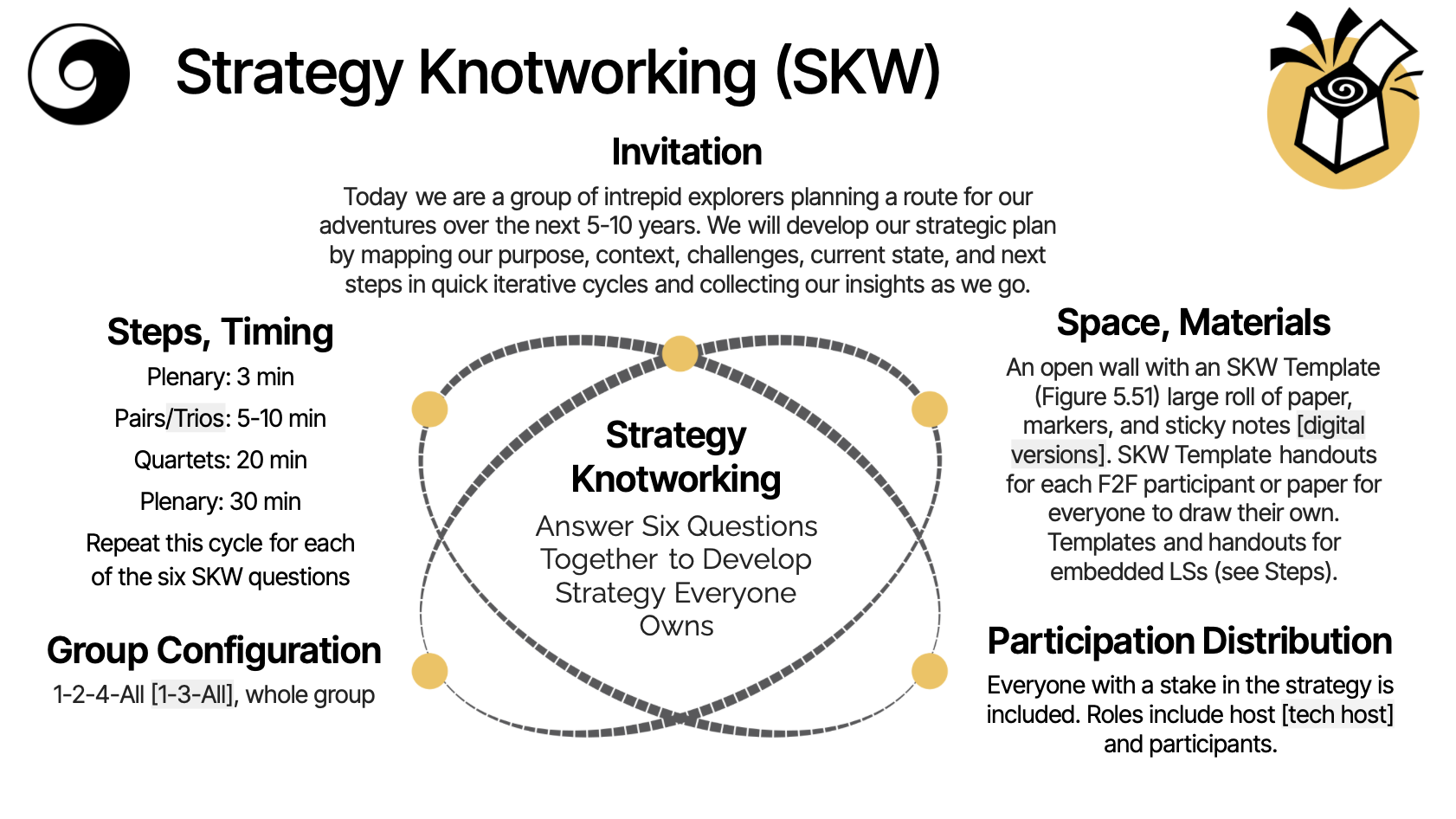
A one-slide overview of the elements of Strategy Knotworking in the LS constellation format.