
9 Whys
Make the Purpose of Your Work Together Clear (30 min. F2F, ~25–30 min. online)
“If you want to build a ship, don’t drum up people to collect wood and don’t assign them tasks and work, but rather teach them to long for the endless immensity of the sea.”
Purposes
In 9 Whys, participants ask each other guided questions to dig deep into their purposes and uncover what’s essential in their work. It helps people find a personal sense of purpose and see how their efforts align with higher-order goals that are taking shape as the work proceeds. This simple and flexible approach makes it easy to clarify purpose. This LS helps us enact LS Principle #10, Never Start Without Clear Purpose(s).
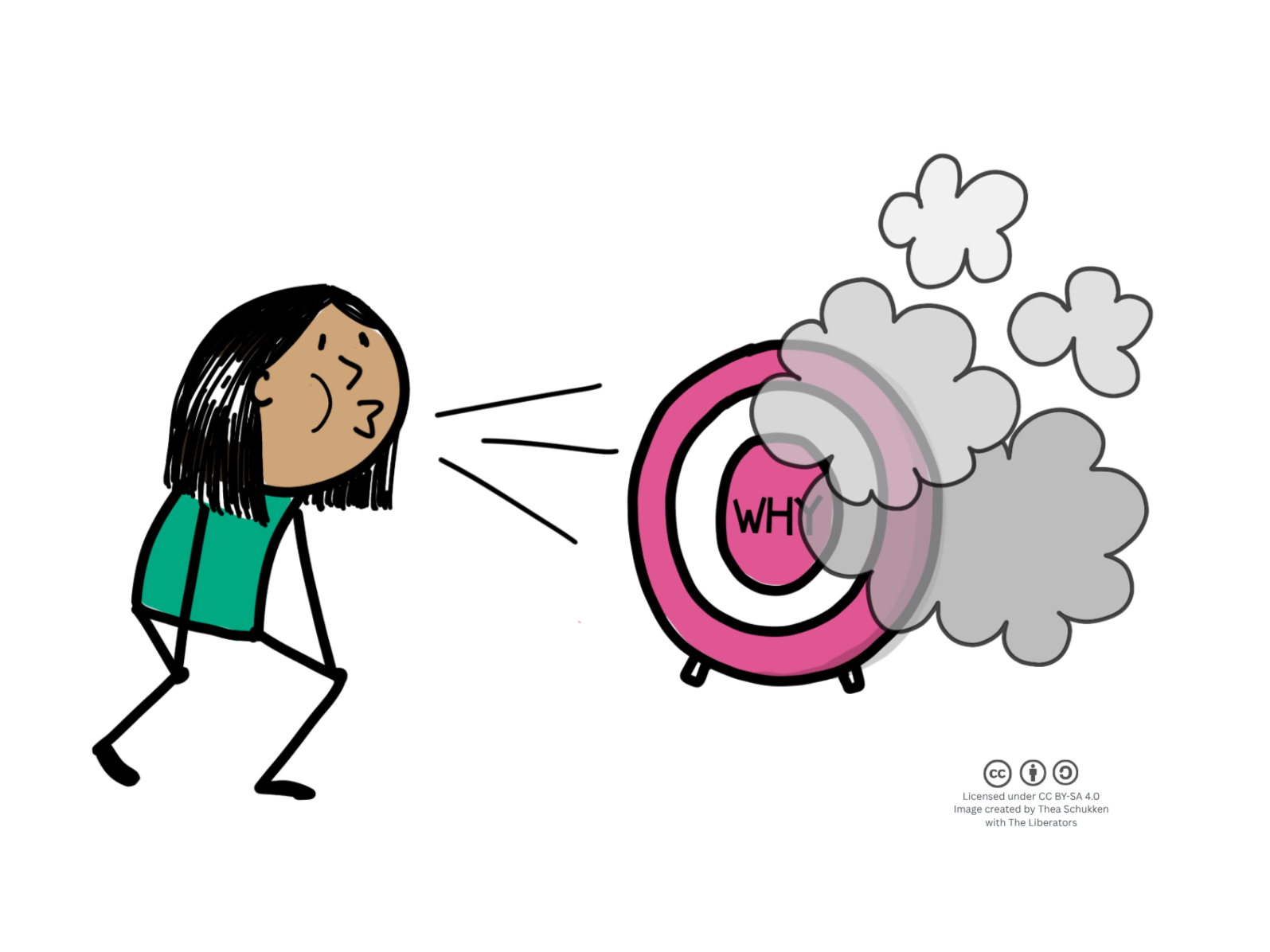
Principle: Never Start Without Clear Purpose(s).
Five Structural Elements—Min Specs
Structuring Invitation
“Let’s paint a clearer picture of what you do at the heart of your work and the purpose of our work together. Everyone will uncover their own gem of purpose, and together we will create a vivid mosaic that will help us address our challenges. Let’s start by exploring what you spend your time doing.”
Space and Materials
Chairs for people to sit face to face in pairs [breakouts of two]. No tables. Paper for each participant.
Participation Distribution
Roles include host [tech host] and participants. Everyone is invited and has equal time to contribute.
Group Configuration
1-2-4-All. [1-3-All unless it is easy to go directly from pairs to quartets.]
Steps and Time Allocation
Intro: Share the structuring invitation. If a clear challenge is already identified, share that challenge. (1 min.)
Individual Reflection: Invite everyone to consider their role in addressing the group challenge. Participants jot down activities they personally engage in as part of the group’s collective work. (1 min.)
In Pairs: Participants form pairs [breakouts]. One person interviews the other by asking, “Why are those activities important to you?” Then they delve deeper, asking, “Why is that important to you?” followed by more questions beginning with “Why…” up to nine times. The interviewer creates a short, action-oriented title (three to five words starting with a verb, like Moving the Mountain) that captures the essence of their partner’s purpose. They share the title and ask permission to share it with others later. (7 min.)
Switch Roles: Partners switch roles and repeat the interview process. [Broadcast a message when it’s time for pairs to switch roles.] The second interviewer creates a title for their partner.
Share in Quartets (Optional for Online): Pairs join to form quartets. [Create new breakouts of four with maximum mix.] Participants share their experiences and insights from the interviews. (5 min.)
Collective Insights: Everyone returns to plenary and reflects on what emerged. Ask: What fundamental justification or deep need for our collective work emerged? What overarching purpose resonates most strongly? [Use Chatterfall: Participants who have permission add their partners’ purpose titles to the chat without their name.] (5 min.)
Shared Purpose and Next Steps: The group discusses how the most powerful purposes influence their next steps. (5 min.)
Taking It Online
Use the chat for engagement, encouraging participants to respond to each other with likes or emojis.
Practice Insights
Tips
Ask “Why is it important to you?” to keep the focus on personal purpose. Be aware that asking “why” repeatedly can feel rude in some cultures, which can be addressed by varying the way the question is asked. For example, in a business context, ask, “Why would people spend their money with you?” For a project with local stakeholders, ask, “Why is that important to your community?”
Riffs and Variations
Use emojis or drawings to express purposes creatively. Once a group’s members have used 9 Whys to define their individual purposes, they can collaborate to create a single nine-word purpose statement for the group. This statement provides a practical focus by framing the purpose in terms of what the group aims to stop or end and what it wants to start or create. A clear purpose statement guides collective efforts, attracts new members, and maintains engagement.
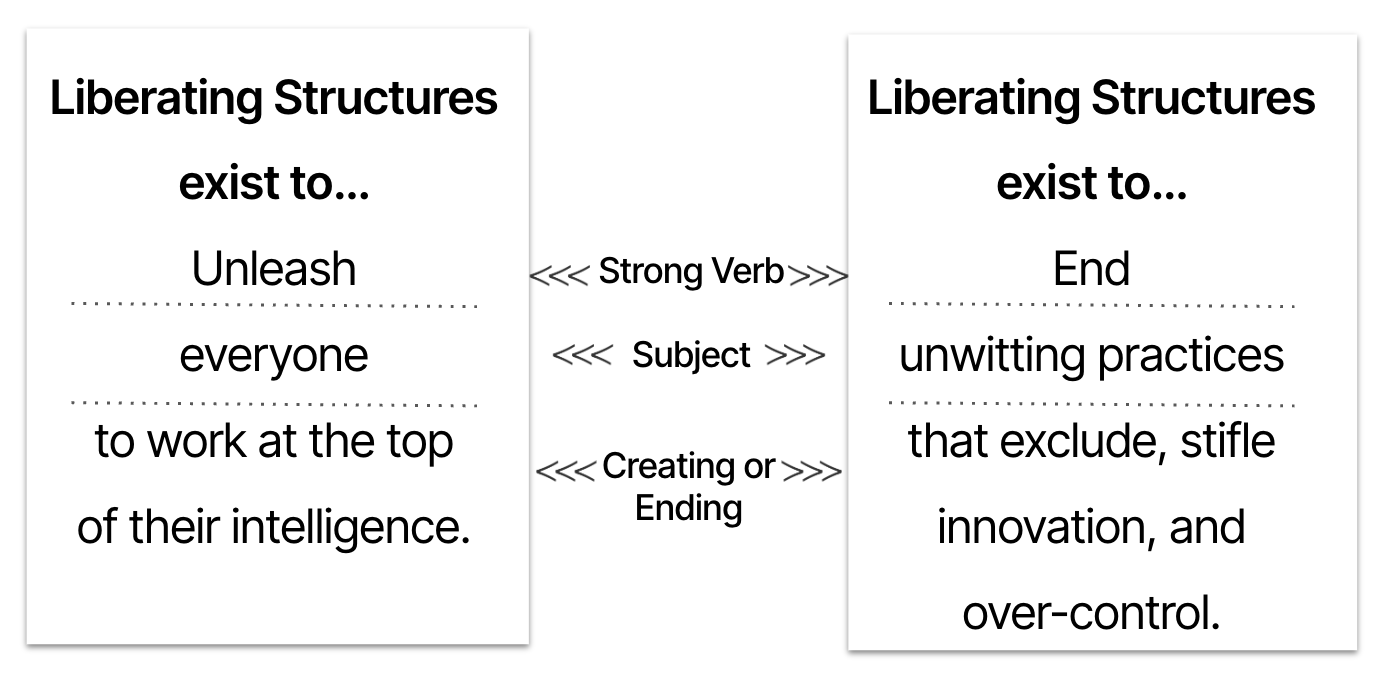
Two types of LS purpose statements. One focuses on what to start, the other on what to stop.
Template to Sharpen Purpose
The purpose of our work is to is to <do what> so that <who> can <do what/benefit how>.
We know we are making progress when <describe what happens>.
Other tips:
If a group can’t figure out how to answer “We know we are making progress when…” then go back and refine.
If the draft needs a lot of explanation for others to understand or feels like a slogan, then go back and refine.
Additional questions to help sharpen purpose and evaluate progress.
The LS 9 Whys can help identify an organization’s purpose, clarify the purpose behind a new product launch, or identify the purpose of a coaching session
Practical Applications
Optional String
String together with Purpose-to-Practice, Generative Relationships STAR, and What, So What, Now What to prioritize ideas and bring them to life.
Attribution
Liberating Structure developed by Henri Lipmanowicz, Keith McCandless, and Nancy White.
Collateral Materials
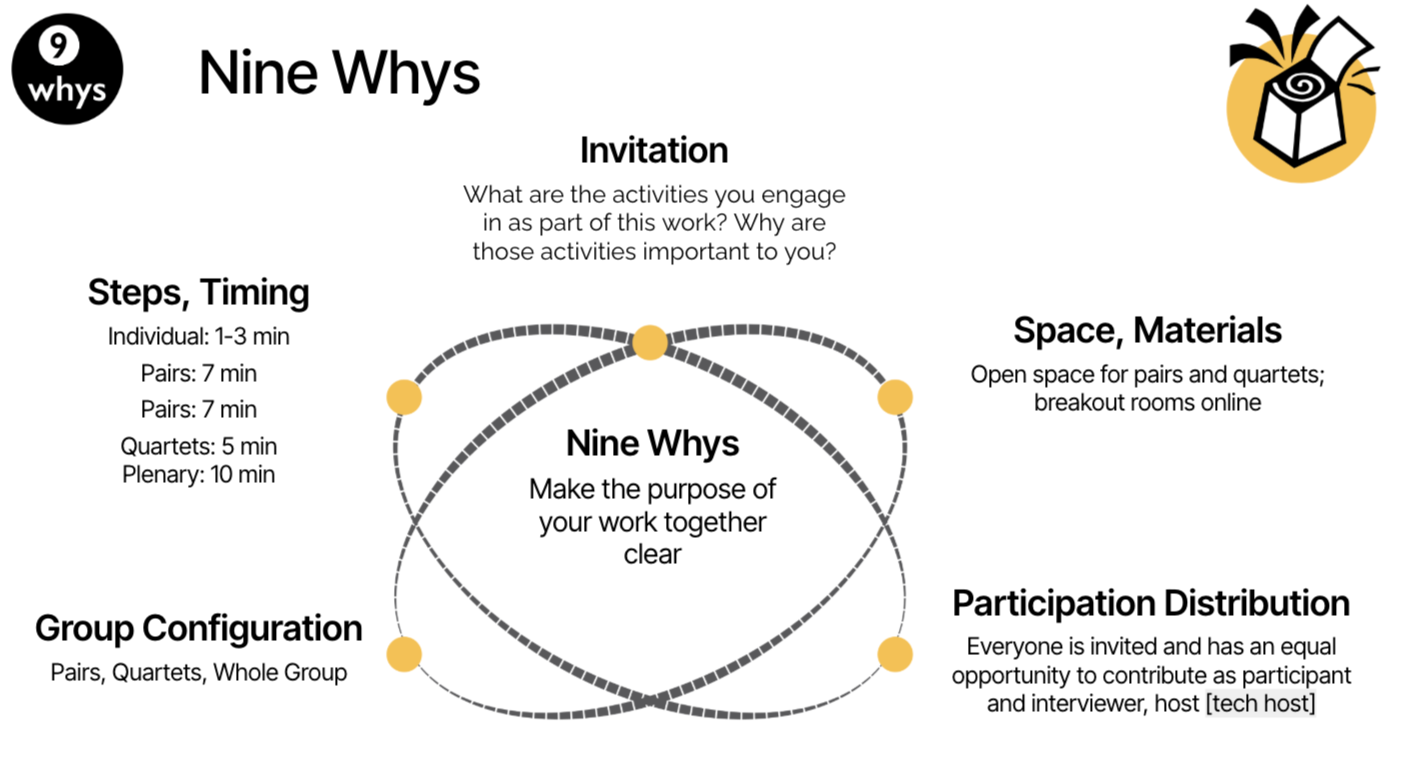
Link to supporting materials for 9 Whys.
A one-slide overview of the elements of 9 Why’s in the LS constellation format.