Grief Walking
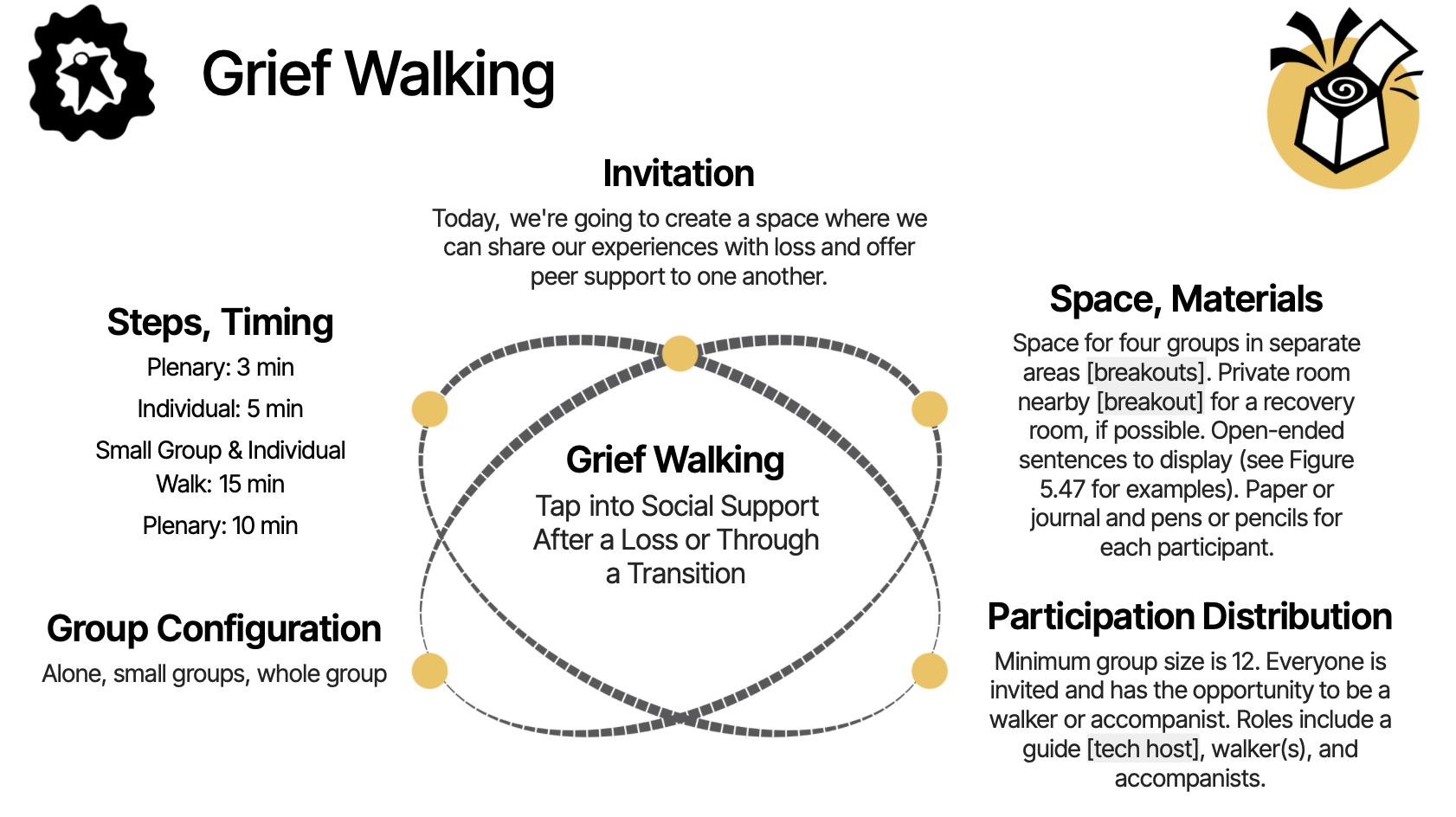
Tap into Social Support After a Loss or Through a Transition (~35 min. per cycle)
“When we deny or repress our pain for the world, or view it as a private pathology, our power to take part in the healing of our world is diminished.”
Purposes
In Grief Walking, participants offer or receive social support by sharing a loss or walking with the person sharing. This structure is not therapy or an effort to fix something broken. Instead, it allows us to share gifts of empathy and caring to support each other through a loss or difficult transition. Grief Walking embodies LS Principle #3, Build Trust as You Go.

Principle: Build Trust as You Go
Five Structural Elements—Min Specs
Structuring Invitation
“Today, we’re going to create a space where we can share our experiences with loss and offer support to one another.”
Space and Materials
Space for four groups in separate areas called stations [breakouts]. Private room nearby [breakout] for a recovery room, if possible. Open-ended sentences to display (see below). Paper or journal and pens or pencils for each participant.
Participation Distribution
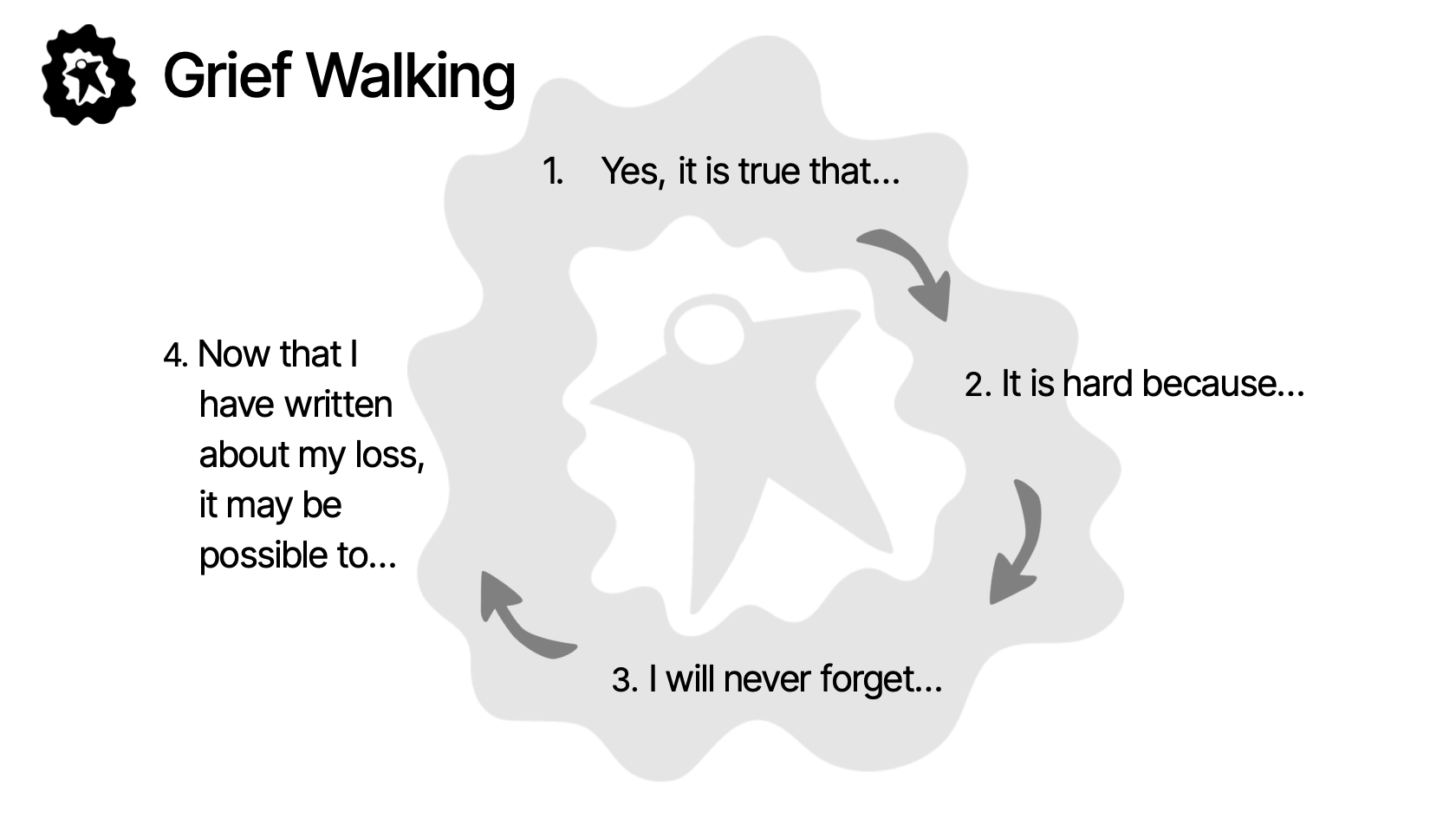
Open-ended sentence fragments to display during group work
Roles include a guide [tech host], walker(s), and accompanists. Minimum group size is twelve. Everyone is invited and has the opportunity to be a walker or accompanist.
Group Configuration
Alone, small groups, whole group.
Steps and Time Allocation
Intro: Share the structuring invitation. Describe the process. Each participant thinks about a loss or transition and completes four open-ended sentences: One or two people who feel comfortable sharing their loss read their responses out loud. Everyone else has the chance to “walk alongside” those who share, offering silent support and empathy. Emphasize that Grief Walking is not about therapy or fixing anything. It’s about creating a safe space where everyone can connect and care for each other. Participants’ responses will be private unless they choose to share them. Tell participants how to join the recovery room [breakout]. (3 min.)
Complete Sentences: Display open-ended sentences. Participants reflect privately [with mic and camera off] on a loss or transition and write responses to four open-ended sentences (5 min.):
Yes, it is true that . . .
It is hard because . . .
I will always remember, I will never forget . . .
Now that I have written about my loss, it may be possible to . . .
Call for Volunteer(s): Ask for one to two volunteers to be “walkers” who will share their sentences and receive support from the group. (1 min.)
Instructions: The first walker comes to the front of the room. Explain the process. The walker visits each group or station [stays in plenary] and reads one sentence. After each sentence, if anyone feels moved to offer support, they join the walker and guide as they walk to the next group [turn on their camera and mic and say, “I will walk with you”]. Participants can gently place a hand on the walker’s shoulder with consent [reach out on camera, out loud, or in the chat]. Participants keep the group small, with just one to two “accompanists” from each group. Everyone pauses between sentences. [Before the next sentence, accompanists turn off their cameras and mics.] (5 min.)
Walk: Invite participants to form four subgroups stationed around the room within hearing distance. The walker visits each subgroup or station, reading their sentences and allowing time for accompanists to join. The guide stays by the walker’s side. [The guide provides more narration online to signal their supportive presence.] (8–10 min. total)
Share Insights: The walker and accompanists stay together and debrief the experience. Ask accompanists “What made you join the walk and what did you notice?” Ask walker, “How was that experience for you?” The whole group shares their thoughts. (7 min.)
Other Applications: Everyone reflects on where this structure could be used in the future. (3 min.)
Taking It Online
Participants can simulate walking by turning on their camera and mic and saying, “I will walk with you.” The tech host can spotlight the guide, walker, and accompanists. Be aware that facial expressions, body language, subtle gestures, and tone of voice make a difference in Grief Walking, and it’s easy to miss these signals online.
Practice Insights
Tips
Recommend that participants choose a loss they feel ready to explore and potentially share. Be prepared for intense emotions to arise. Select a location that amplifies the power of movement, voice, and light (e.g., a place of worship or outdoor space with an even surface).
Riffs and Variations
With a large group, do the first session in the main room, then divide into subgroups of fifteen to twenty [in breakouts]. Assign hosts to serve as guides in each breakout. Ask them to repeat the instructions and steps for online or face-to-face Grief Walking.
Practical Applications
Help caregivers and managers respond to losses. Help a team work through a reorganization. Run an outdoor breakout session during an immersion workshop.
Optional String
Follow with a quiet activity or a punctuation that includes movement. String with Critical Uncertainties to work through hard challenges.
Attribution
Prototyped in the Seattle LS User Group by Fisher Qua and Keith McCandless. Dig deeper by exploring grief in the work of Stephen Jenkinson and Joanna Macy.
Collateral Materials
Link to supporting materials for Grief Walking.
A one-slide overview of the elements of Grief Walking in the LS constellation format.