

Social Network Webbing
Map Informal Connections and Decide How to Strengthen the Network to Achieve a Purpose (~55 min)
“Life co-evolves through relationships and networks...assembled from the bottom up following simple rules of organization and communication.”
Purposes
Social Network Webbing is a structure for mapping relationships from a core working group to potential supporters on the periphery. This uncovers hidden resources within our existing relationships, helping us tap informal connections and make progress without complicated plans or major investments. By making it easy for participants to see their role in the network and notice gaps, this structure encourages individual initiative. It embodies LS Principle #1, Include and Unleash Everyone.
Principle: Include and Unleash Everyone.
Five Structural Elements—Min Specs
Structuring Invitation
“Let’s get ready to expand our circle of influence and build our superpowered dream team. We’ll use a template to identify roles, name key players who can contribute to our success, and create a plan to engage them.”
Space and Materials
An open wall with space to move around, large paper, and sticky notes in eight colors. Bold markers. [Visual collaboration space with sticky notes.]
Participation Distribution
Roles include host [tech host] and participants. There is no minimum group size. Everyone in the core group is invited and has an equal opportunity to contribute.
Group Configuration
1-2-4-All [1-3-All]
Steps and Time Allocation
Intro: Share the structuring invitation. (1 min.)
Identify Roles: Using 1-2-4-All [1-3-All], individuals generate a list of all key roles in the group’s work and then consolidate their lists in pairs and quartets [trios]. A few people share their consolidated lists in plenary. (10 min.)
Create a Legend: Create a legend of role types in the network and assign a sticky note color to each. (3 min.)
Map the Core Network: Participants write their names on sticky notes and place them in the “Core” area at the center of the large paper. (2 min.)
Expand the Network: Participants add people they know to the “Immediate Network.” (10 min.)
Extend the Network: Participants add people who are missing or who could also be included to the “Periphery.” (10 min.)
Annotate and Draw Connections: Participants add symbols [and/or emojis] and connecting lines to indicate the following: Who knows whom? Who has influence and expertise? Who knows someone who could make a positive difference in your work? (See the Social Network Webbing Example image below for an example.) (5 min.)
Identify New Connections: The group looks for opportunities to connect people, called closing triangles, and indicate new connections with symbols and lines. Everyone commits to using the network to invite, attract, and weave new people into their work; work around blockages; and boost progress. (15 min.)
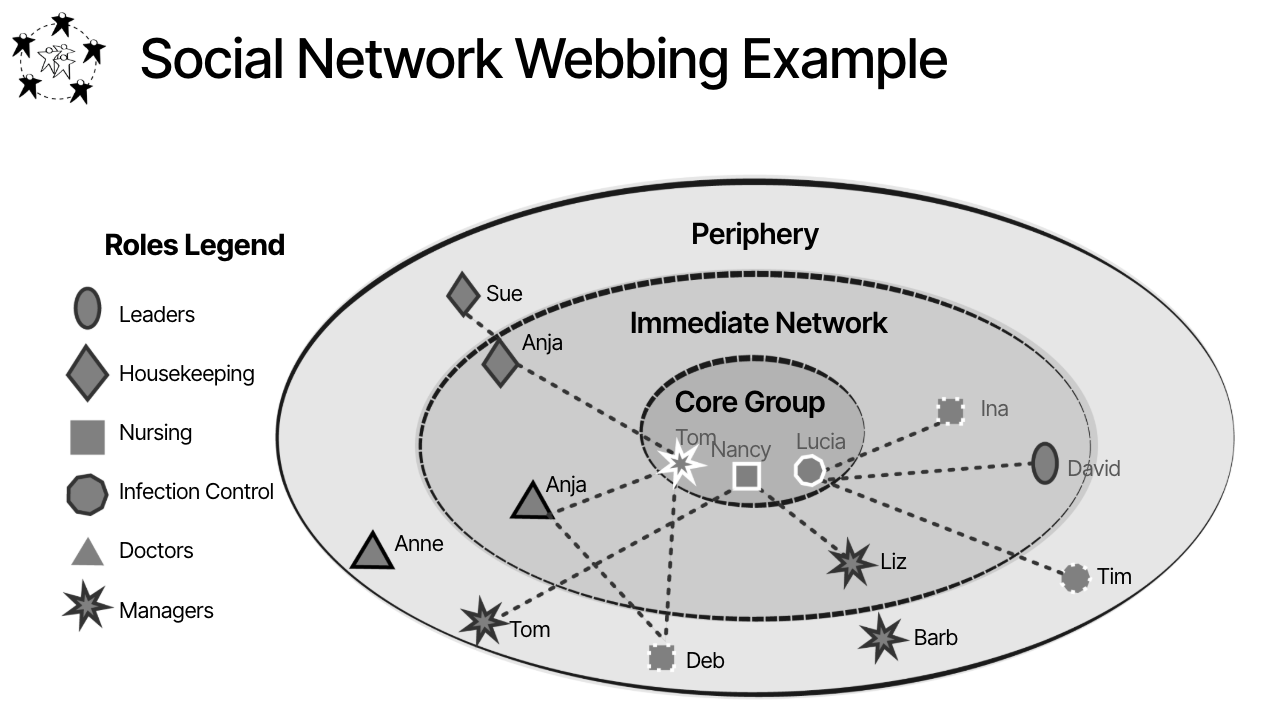
Social Network Webbing map in progress, featuring roles and relationships to improve safety in a hospital.
Taking It Online
This structure works online with no major adjustments. Online visual tools can generate network maps, but start small to avoid being overwhelmed by data.
Practice Insights
Tips
Keep the focus both on informal relationships and the org chart. Don’t include more than 8 functions in the legend—it gets too confusing. Emphasize that being on the periphery is not negative! People on the periphery can provide vital information and skills that are missing from the core.
Riffs and Variations
Invite participants to draw their own personal network webs before moving to a group vision. Ask deeper questions to understand how new ideas spread (e.g., Who takes ideas across groups and up the hierarchy? Who do you go to with a tender idea or a hunch for a prototype?). Revisit the map frequently to add new people and chart growth patterns.
Practical Applications
Engage a hospital’s core team in preventing infections. Help coaches spread lean methods among frontline staff. Expand the use of a new technology by gathering early adopters to map their networks.
Optional String
String together with Network Relationship Patterns to imagine potential network reconfigurations.
Attribution
Liberating Structure developed by Henri Lipmanowicz and Keith McCandless. Dig deeper with June Holley’s network weaving practices.
Collateral Materials
Link to supporting materials for Social Network Webbing.
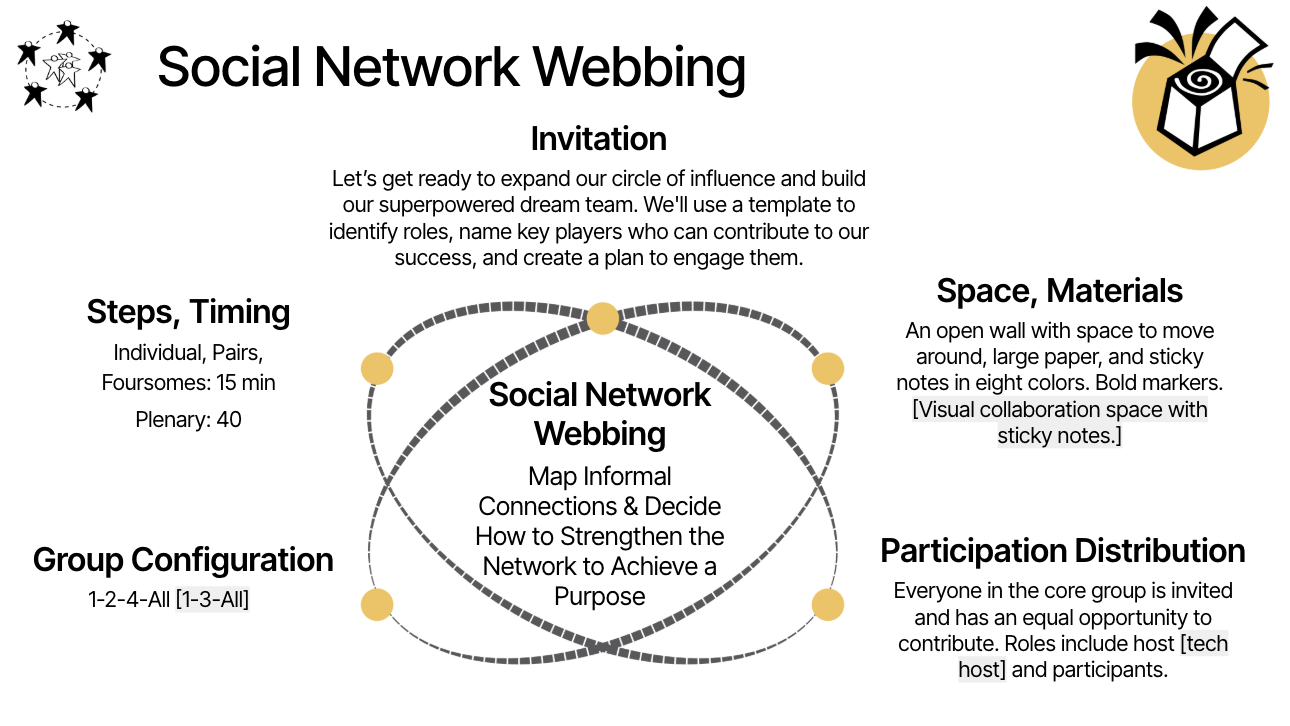
Microstructural elements of Social Network Webbing in the constellation format.