

Mad Tea and Calm Tea
Grasp a Bigger, Funner, Deeper Context for Taking a Next Step (~20–25 min.)
“All persons are caught in an inescapable network of mutuality, tied in a single garment of destiny. Whatever affects one directly affects all indirectly.”
Purposes
In Mad Tea/Calm Tea, everyone rapidly completes sentences related to a shared challenge. Mad Tea is the louder, more energetic F2F version, while Calm Tea is the quieter online alternative. They both get people thinking differently, sharing new ideas, and understanding different perspectives while generating fellowship and laughter. Both bring to life LS Principle #9, Engage in Seriously Playful Curiosity.
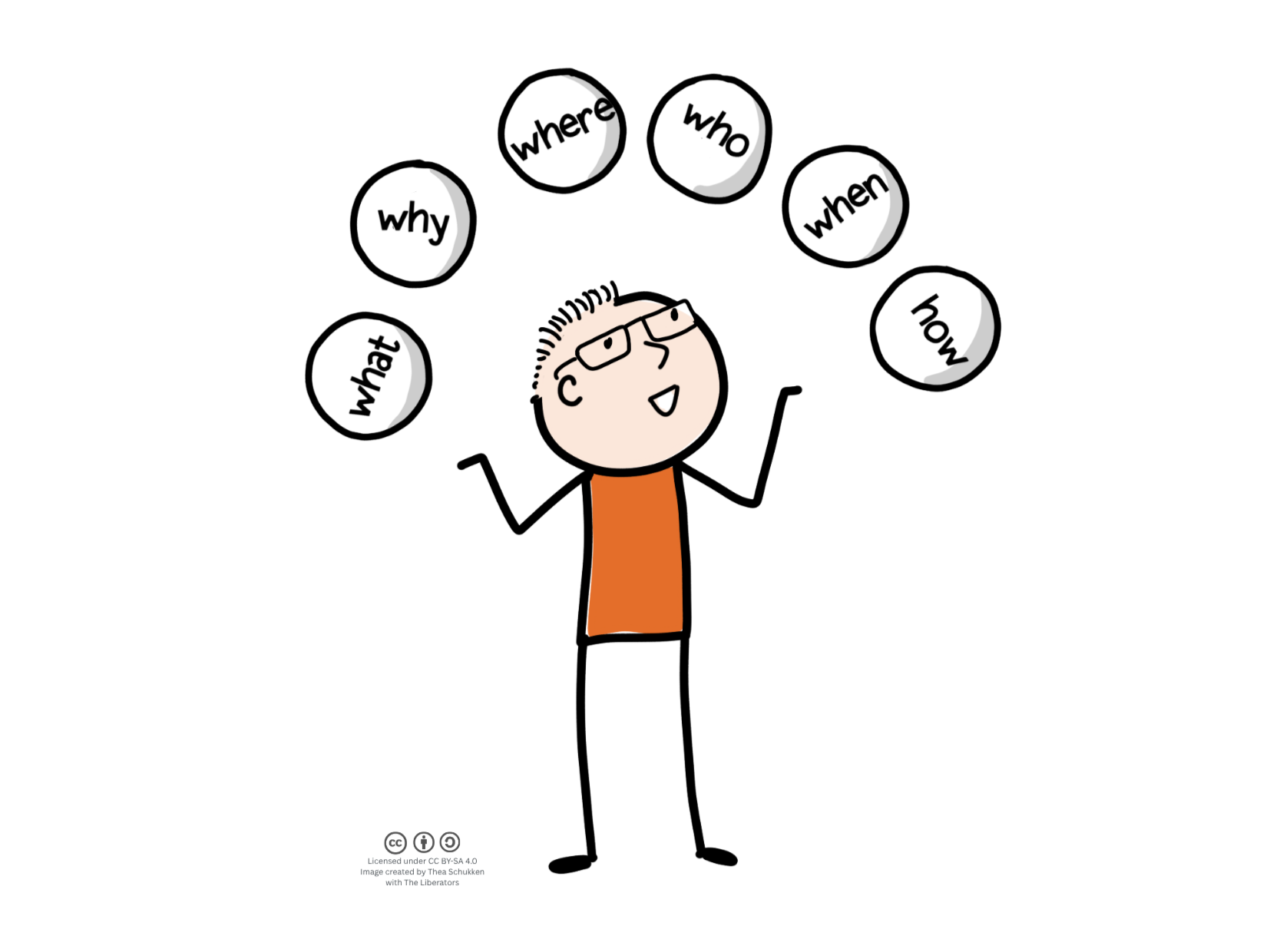
Principle: Engage in Seriously Playful Curiosity.
Five Structural Elements—Min Specs
Structuring Invitation
“Get ready to explore our challenge at warp speed! We will be sharing our perspectives, uncovering hidden insights, and unleashing new ideas, all while having fun and inspiring our next steps.”
Space and Materials
For in-person Mad Tea, an open space large enough for participants to stand in two concentric circles (see figure for spatial set-up). Open sentences prepared to display [in ALL CAPS to paste in the chat] (see under Collateral Material for examples).
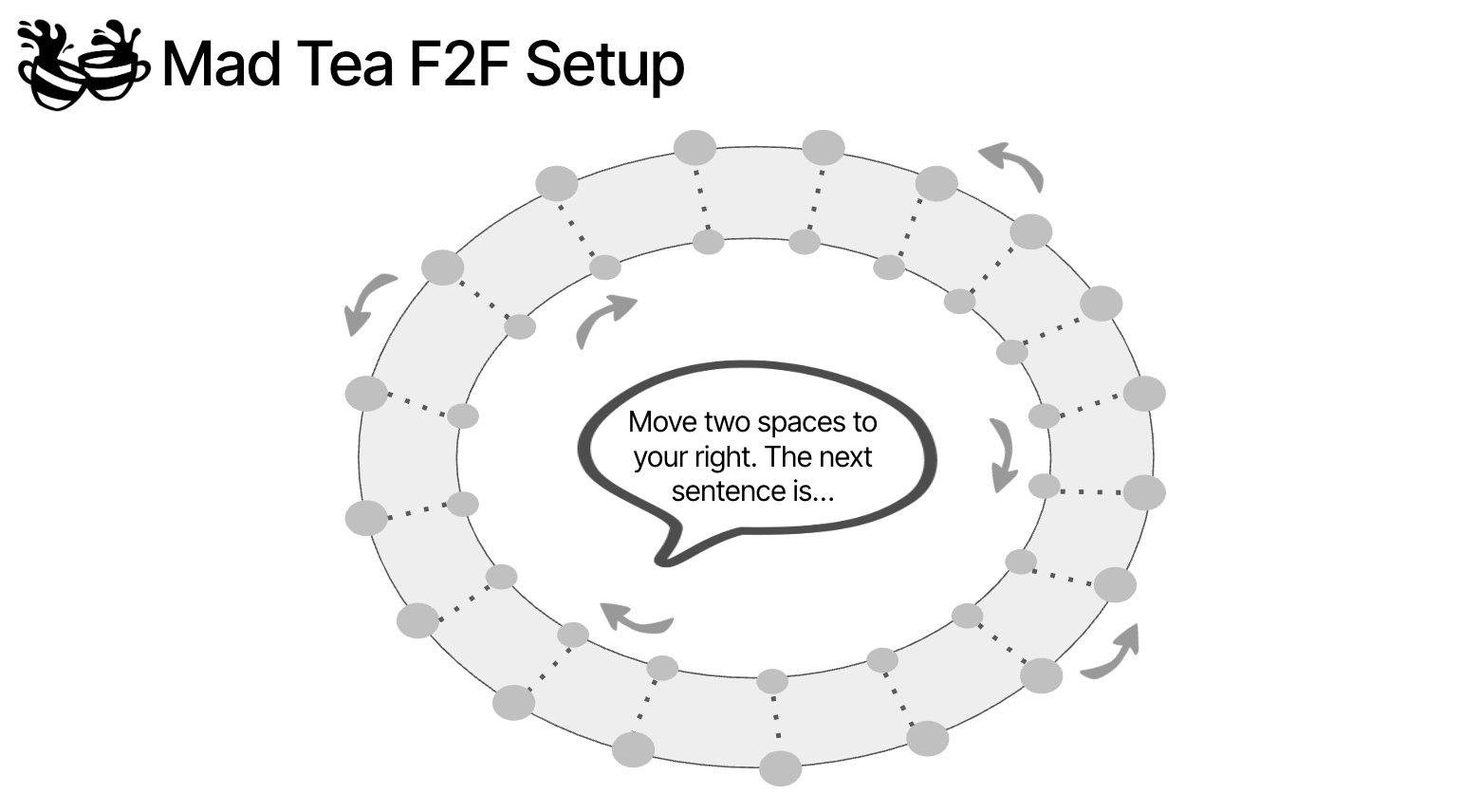
F2F Mad Tea arrangement of space and movement.
Participation Distribution
Roles include host [tech host] and participants. Minimum group size is twelve [six]. Everyone is included and completes each sentence.
Group Configuration
Pairs, whole group [whole group only]
Steps and Time Allocation
Face-to-Face Mad Tea/ Calm Tea
Intro: Share the structuring invitation. (1 min.)
Setup: Participants stand face to face in pairs in two concentric circles, with the inner circle facing out and the outer circle facing in (see diagram, above). (2 min.)
Instructions: Explain the process. An open sentence is shown. In each pair, one person quickly completes the sentence while the other listens. After thirty seconds, they switch roles. Then everyone moves to their right for a new pair and new sentence. (2 min.)
Complete Sentences: Read and display the first open sentence. Every thirty seconds, signal time to switch partners or rotate to new pairs. Repeat for up to twelve open sentences. (up to 12 min.)
All-Together Sharing: Everyone returns to plenary. A few people share observations about differences and similarities in the responses and what seems possible now. (2–5 min.)
Online Mad Tea/ Calm Tea
Intro: Share the structuring invitation. (1 min.)
Setup and Instructions: Everyone mutes themselves. Explain the process. An open sentence is shown. Participants complete the sentence in the chat. They do not hit Enter until the signal. Spelling and grammar mistakes are okay. (2 min.)
Complete Sentences: Read the first open sentence and paste it in the chat. Everyone types a response. After thirty to forty seconds, say, “Go, hit Enter.” Give the group one minute to read the responses. Repeat these steps for up to six open sentences. (up to 12 min.)
Reread: Everyone scrolls up and reads the responses again, reflecting on differences and similarities in the responses and what seems possible now. (2–3 min.)
All-Together Sharing: A few participants reflect on what they noticed out loud or in the chat. (2-5 min.)
Taking It Online
Mad Tea’s physicality is hard to replicate online. Calm Tea, the recommended online variant, uses Chatterfall to quickly capture ideas from everyone. To prevent distractions, ask participants to hit Enter in the chat only when prompted.
Practice Insights
Tips
Mad Tea goes very fast and can be noisy, so encourage participants to lean in close to their partner and try not to shout. Use a bell or device to get everyone’s attention when you signal transitions. In Calm Tea, it may take a round or two for participants to stop hitting Enter automatically. Use a balanced mix of open sentences, such as prompts that are appreciative (e.g., “What’s working is . . .”), problem focused (e.g., “The biggest challenge is . . .”), hopeful (e.g., “I hope it’s possible to . . .”), and action oriented (e.g., “The next step we could take is . . .”).
Riffs and Variations
Make the open sentences more lighthearted or serious and vary which part of the sentence is open-ended (e.g., “I hope to get . . . from today’s session,” “I know a team is dysfunctional when . . . ,” or “ . . . prevents teams from working well together.”) Online, make contributions anonymous by inviting people to rename themselves with a collective pseudonym (e.g., Bootsy) for this LS.
Practical Applications
Use this structure at the beginning or end of a meeting to quickly connect and get to a shared purpose, or reflect on takeaways. Identify ambitions and next steps in a transition or planning initiative.
Optional String
Use before or after LS that requires participants to dig deeper with more imagination and curiosity (e.g., Critical Uncertainties, Future~Present, Strategy Knotworking).
Attribution
Liberating Structure developed by Henri Lipmanowicz, Nancy White, and Keith McCandless.
Collateral Materials
Link to supporting materials for Mad Tea/ Calm Tea.
Mad Tea/ Calm Tea Sample Prompts
In regard to (the topic / challenge)
What I appreciate in this situation is…
An entangled challenge I face is…
What I hope can happen for us is…
A next step for me is…
What must be protected is…
What must be resisted is…
What must be let go of is…
What must be invented or developed is…
All I want is…

Sample prompts for Mad Tea/ Calm Tea
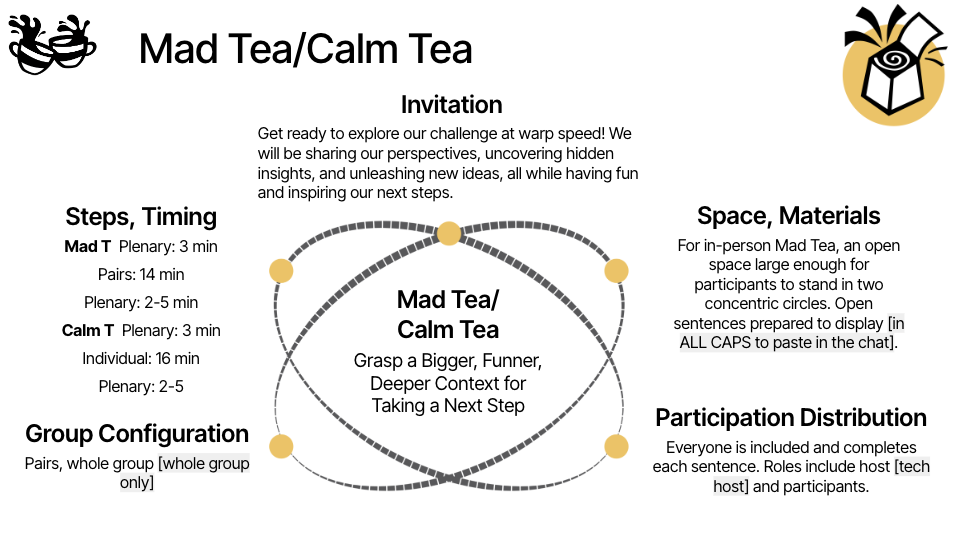
Microstructural elements of Mad Tea / Calm Tea in the constellation format.