

Helping Heuristics
Offer, Request, and Receive More Precise Forms of Help ~15 min. F2F, ~18–20 min. online
“If you have come here to help me, you are wasting your time. But if you have come because your liberation is bound up with mine, then let us work together.”
Purposes
In Helping Heuristics, small groups practice different ways of asking for, giving, and receiving help. Through short exchanges, participants gain insight into their patterns of interaction and expand their repertoire of strategies for offering help. This structure enacts LS Principle #5, Practice Self-Discovery Within a Group
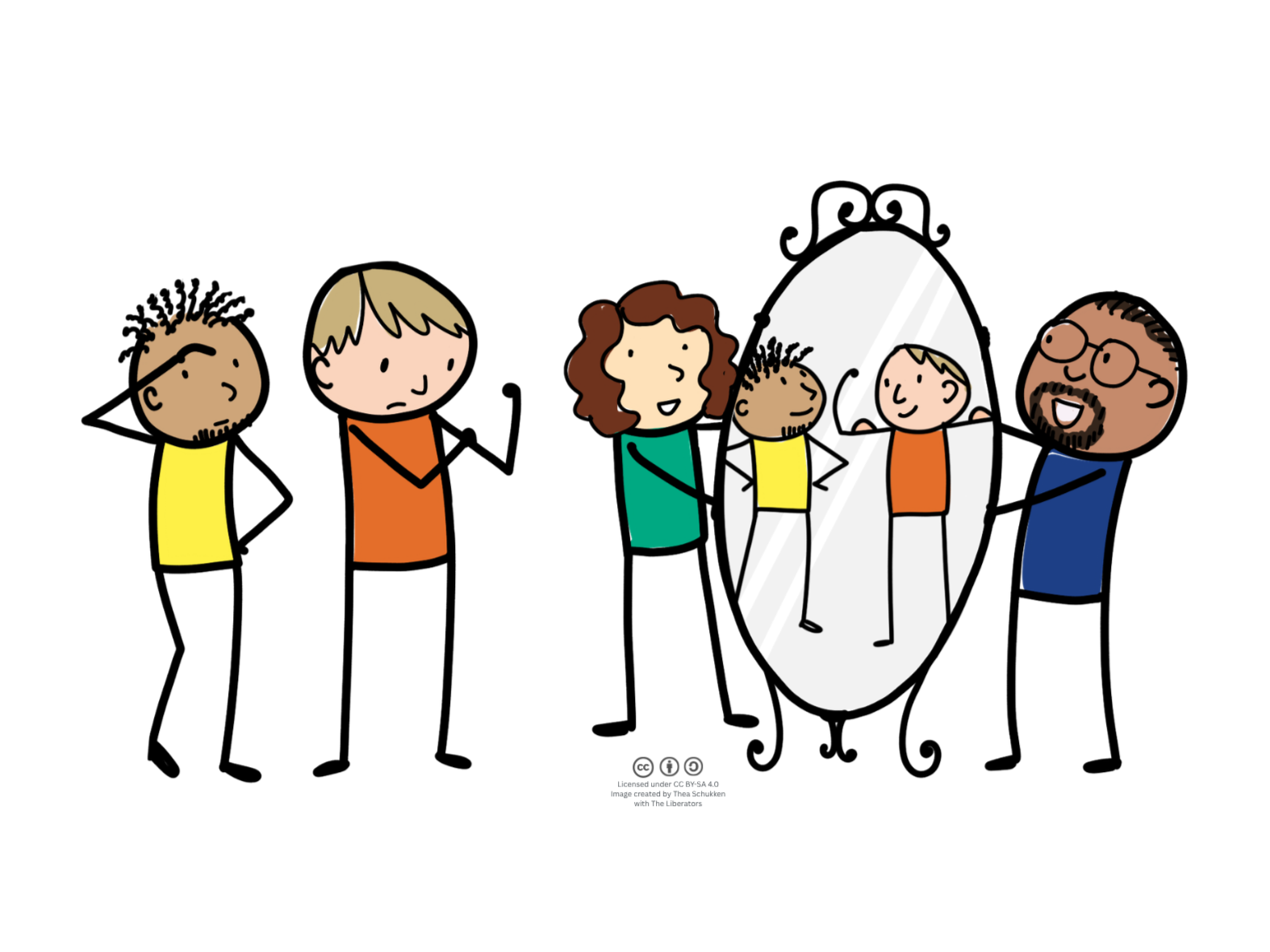
Principle: Practice Self-Discovery Within a Group
Five Structural Elements—Min Specs
Structuring Invitation
“Every human interaction is an offer that we can either accept or block, just as improv artists say yes to every suggestion. In this activity, we’ll use heuristics, or mental shortcuts, to practice different ways of accepting or blocking offers when we ask for, give, and receive help.”
Space and Materials
Space for groups of three to stand or sit [breakouts]. No tables.
Participation Distribution
Roles include host [tech host], client, coach, and observer. Minimum group size is three. Everyone is invited and has an equal opportunity to learn and contribute.
Group Configuration
Trios, whole group. Encourage diverse roles within groups.
Steps and Time Allocation
Intro: Share the structuring invitation. Display Helping Heuristics Patterns and Prompts (see figure below) and explain the process. In small groups, everyone will pick a role—client, coach, or observer. During each round, the client shares a challenge they are passionate about, the coach responds using one of the four helping patterns in the figure, and the observer pays close attention to how the other two accept or block each other’s ideas. Participants play the same roles for all rounds. There will be four rounds of one to two minutes of improvised interactions and a five-minute debrief round, for a total of thirteen to fourteen minutes. The host will signal [broadcast a message] when it’s time for everyone to move to the next question. Participants form trios [breakouts]. (3 min.)
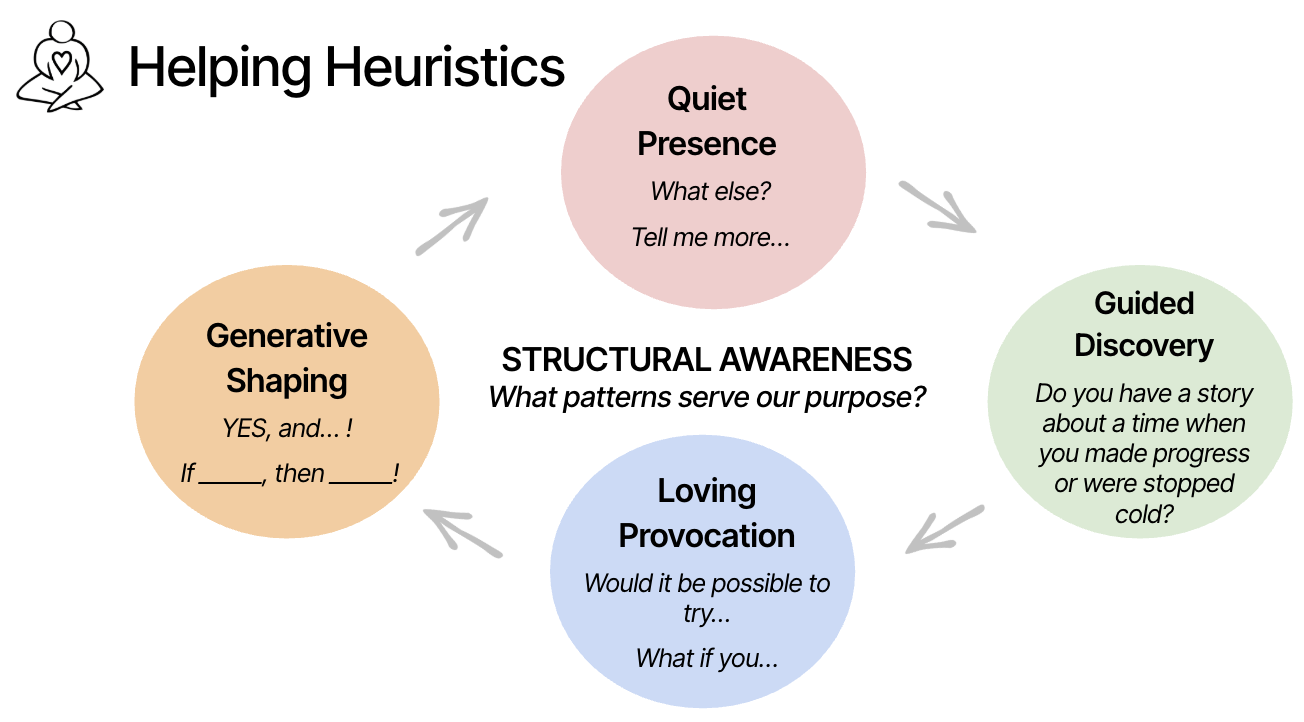
Helping Heuristics patterns and prompts that build structural awareness.
Round 1 (Quiet Presence): The client shares, and the coach listens compassionately, asking only “What else?” The observer looks for accepting and blocking. [Bring everyone back to plenary to check in.] (1–2 min. F2F, 3–4 min. online)
Round 2 (Guided Discovery): The coach asks, “Do you have a story about a time when you made progress or were stopped? What influenced the progress or blockage?” The observer looks for accepting and blocking. (1–2 min.)
Round 3 (Loving Provocation): The coach offers advice asking, “Would it be possible to try . . . ?” The client accepts and blocks the coach’s suggestion. The observer looks for accepting and blocking. (1–2 min.)
Round 4 (Generative Shaping): The coach and client accept all offers from each other, building on each other’s ideas with “Yes, and . . . “ and “If . . . then . . . ” The observer looks for accepting and blocking. (1–2 min.)
Debrief: In their small groups, participants discuss the impacts of the four helping patterns. The client and coach debrief for one minute each, and the observer takes three minutes to share the accepting or blocking they noticed in each pattern. (5 min.)
All-Together Sharing: Everyone returns to plenary. A few participants share a takeaway everyone should hear. (1 min.)
Taking It Online
After the first round, bring everyone back to the main room to check for understanding and progress. If the groups are on track, send them back to complete the remaining rounds. If not, bring them back after the second round for another check-in.
Practice Insights
Tips
When introducing the approach, create a climate of playful mutual discovery and trust. For example, share a story about a pattern you overlook that is obvious to everyone else. Encourage the observer to focus on patterns that will help the client find their own solutions or next steps and not to ignore status differences, body language, demeanor, subtle signals of blocking, or the setting itself.
Riffs and Variations
Invite participants to self-identify their default patterns and practice using other ones. Incorporate extreme but fun patterns such as neutral (zero response via a poker face) and blocking (ignoring or interrupting incessantly). After the initial cycle, let trios choose the roles they want to play and the patterns they want to focus on in their group. For example, if the default approach in their groups is generative shaping, take time to practice using other approaches.
Practical Applications
Use this structure when other Liberating Structures such as Wise Crowds, WINFY, and Options Place fail to achieve their purpose because of unwanted patterns. Help people in the helping professions (e.g., nurses, coaches, teachers) learn new relational skills. Expand your options when you feel frustrated trying to help another person.
Optional String
String with another LS that gives the opportunity to practice the behaviors, such as Troika Consulting, Wise Crowds, or What I Need From You.
Attribution
Attribution: Liberating Structure developed by Henri Lipmanowicz and Keith McCandless. Dig deeper into helping patterns with theorist and psychologist Edgar Schein.
Collateral Materials
Link to supporting materials for Helping Heuristics.
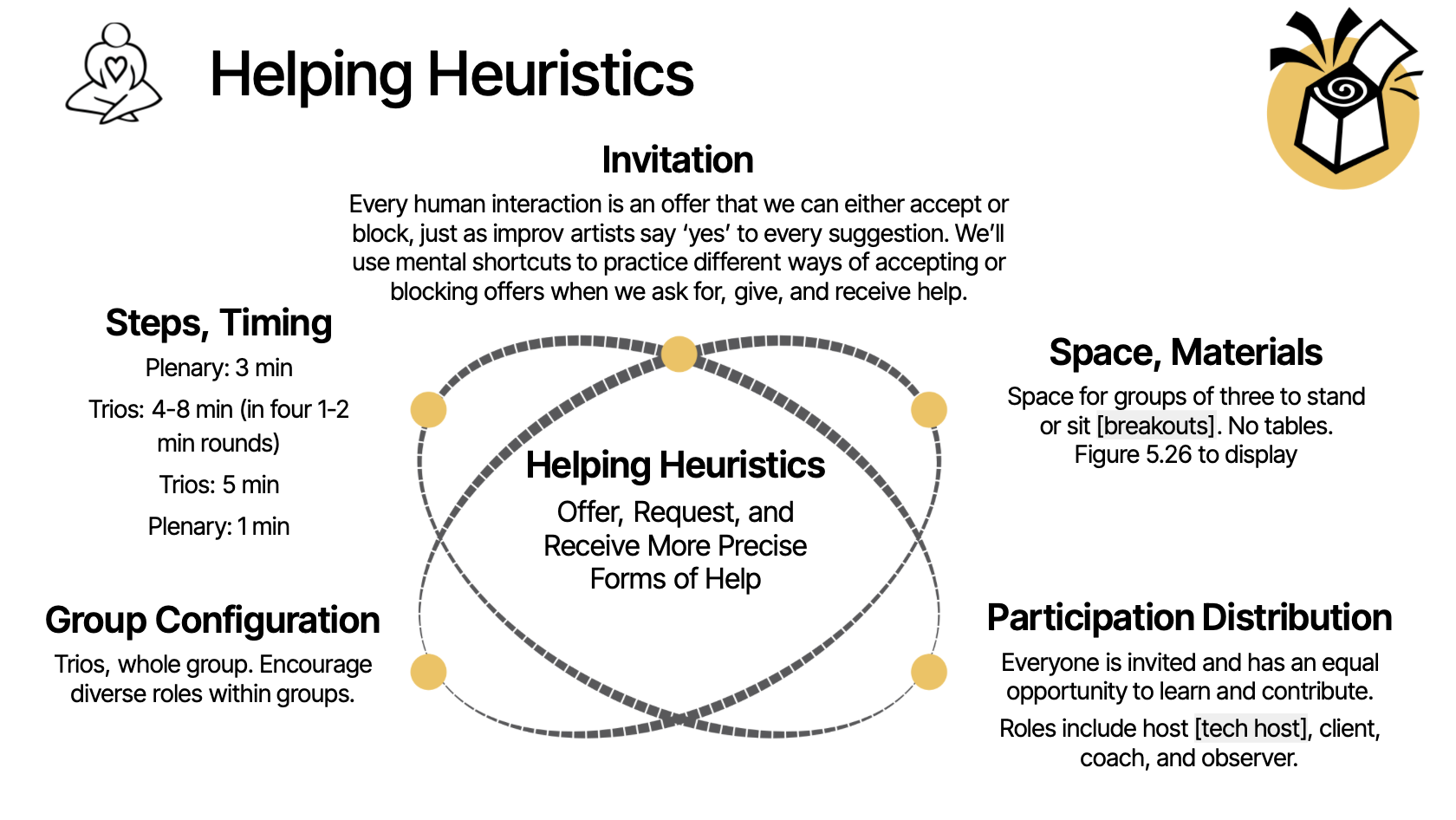
Microstructural elements of 1-2-4-All in the constellation format.