

Panarchy
Understand How Embedded Systems Interact, Spread Innovation, and Transform (~130 min.)
“If a living system is suffering from ill health, the remedy is to connect it with more of itself.”
Purposes
In Panarchy, groups identify opportunities and obstacles for spreading ideas at multiple levels of their operating environment. This helps us see how systems interconnect and how changes ripple between levels. The change dynamics for Panarchy are fast at the bottom (local) and slow at the top (macro). By recognizing these dynamics, groups can create opportunity windows for innovations to spread across boundaries. This structure enacts LS Principle #2, Practice Deep Respect for People and Local Solutions
Principle: Practice Deep Respect for People and Local Solutions
Five Structural Elements—Min Specs
Structuring Invitation
“Let’s zoom in and zoom out, exploring the levels of our world like Russian nesting dolls and looking for shifts in one layer that can create opportunities in another. Our first step is to visualize how systems are layered and embedded.”
Space and Materials
An open wall with a large Panarchy chart (see below for an example). Groups of four chairs around small tables [breakouts of three]. Sticky notes and copies of the Panarchy chart for each participant [digital versions].
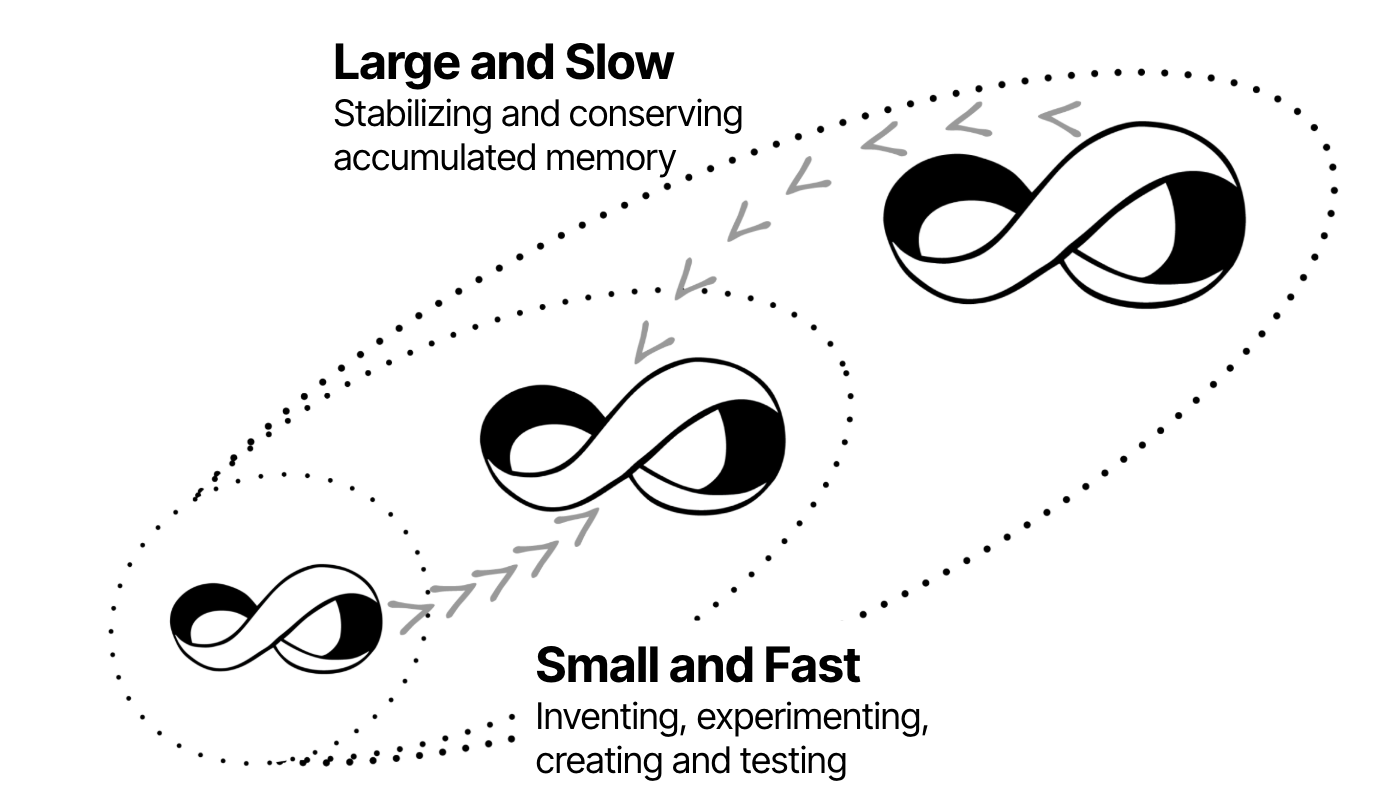
In panarchies, different levels move at different speeds. Emphasize the creative and conserving dynamics. Small and fast creative experiments at lower levels may move up to larger and slower levels that conserve successful innovations. Likewise, accumulated knowledge at higher levels may move down to stabilize lower levels. Highlight this fast-slow dynamic.
Participation Distribution
Roles include host [tech host] and participants. No minimum group size; works best with eight or more people at multiple levels of an organization. Everyone involved in spreading an innovation or making a transition is included and has an equal opportunity to contribute.
Group Configuration
1-2-4-All [1-3-All]
Steps and Time Allocation
Intro: Share the structuring invitation and identify a shared challenge. Show an example such as the figure below. Emphasize the creative and conserving dynamics. Small and fast creative experiments at lower levels may move up to larger and slower levels that conserve successful innovations. Likewise, accumulated knowledge at higher levels may move down to stabilize lower levels. Show the figure above to highlight this fast-slow dynamic. Hand out Panarchy charts [everyone draws their own]. (5 min.)
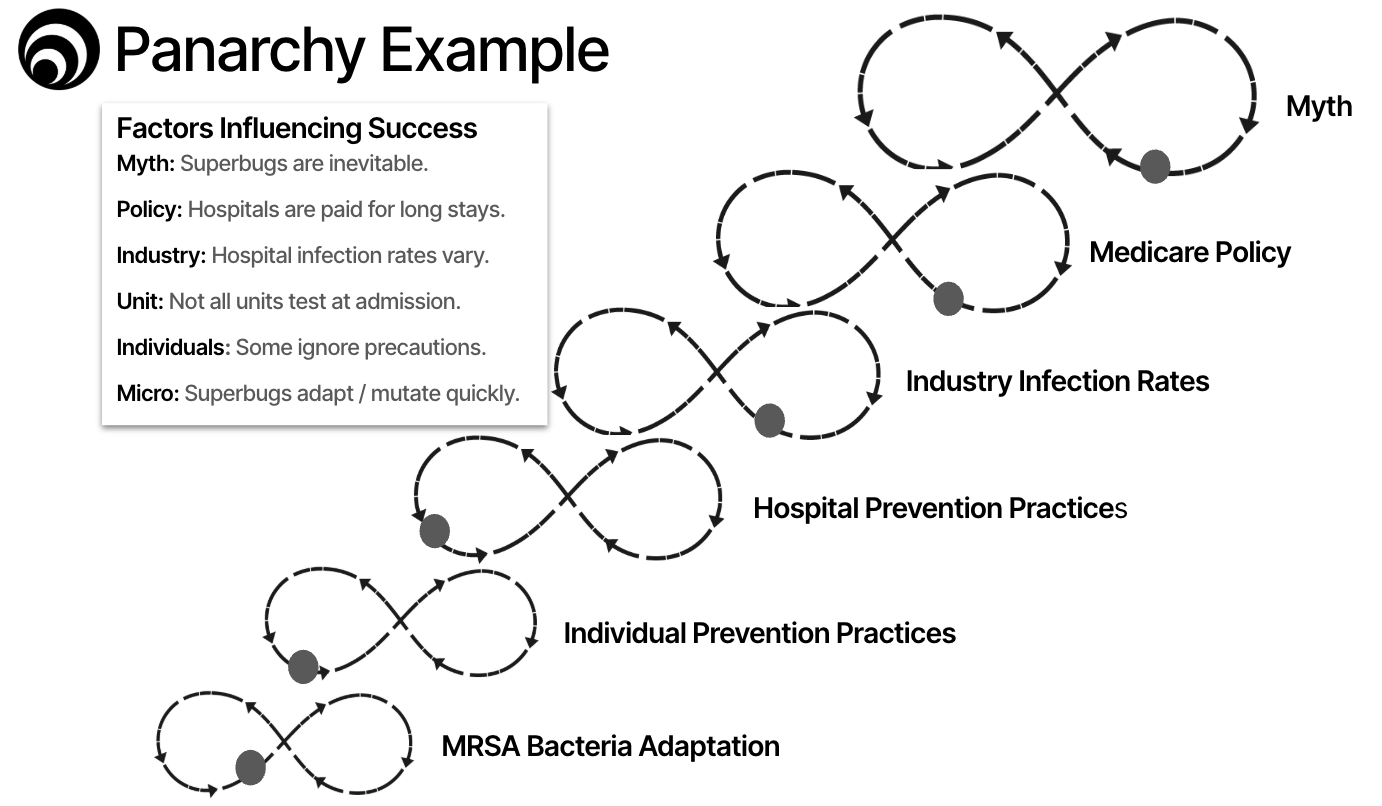
Panarchy example from a multisite infection-prevention project. Dots represents a “current status” assessment by participants working at that level. Note that both MRSA (methicillin-resistant Staphylococcus aureus bacteria) and the societal myth of inevitability can be framed in the Panarchy lens. Each has a unique set of complex interactions that generate novelty.
Identify Factors: Participants list factors that influence their work on the shared challenge and order them from smallest to largest. (5 min.)
Translate Factors to Levels: Participants form pairs [breakouts of three] to translate the factors into levels, using one Panarchy chart per small group. (10 min.)
Compare Levels (F2F only): Pairs join to form quartets. They compare their charts, consolidate them into a single chart, and write the name of each Panarchy level on a sticky note. (10 min.)
Integrate Levels: Everyone returns to plenary. Invite three to four people from different groups to create a shared Panarchy chart by placing their group’s sticky notes on the chart. Everyone else observes but does not interrupt [comments in Chatterfall or on sticky notes]. (10 min.)
Generate Insights: Participants form quartets [remain in plenary] to reflect, writing insights on sticky notes [Chatterfall]. Ask “Which levels have received attention and resources? Which ones have been neglected? What do we know about the status and dynamics in play at the different levels?” (15 min.)
Share Insights: Everyone returns to plenary to add their sticky notes to the chart. [Transfer from the chat to stickies.] (10 min.)
Break: Invite everyone to check devices [step away from devices!] and adjust fluids. (10 min.)
Identify Opportunities and Obstacles: Participants form new quartets [breakouts of four] to brainstorm opportunities for spreading positive change and write them on sticky notes. Ask “Looking up and down the levels, what opportunities and obstacles do you see for movement and changes between or across levels? What windows for new ideas are opening above? What resources are flowing downward from creative destruction unfolding above? What small-scale developments from below are disrupting the level above?” (15 min.)
Share Opportunities and Obstacles: Everyone returns to plenary. Invite three to four people from different groups to add their sticky notes to the shared chart. A few people share reflections and insights. (10 min.)
Prioritize Opportunities and Obstacles: The group votes on the three most important opportunities and obstacles. [Use digital polling.] (10 min.)
Identify Action Steps: Participants use 1-2-4-All [1-3-All] to discuss actions they can take immediately to act on the top opportunities or obstacles. They identify anyone they know who influences more than one level simultaneously. Take notes on the shared chart. (15 min.)
Next Steps: Participants form trios [breakouts] to discuss when they will revisit and update the chart. (5 min.)
Taking It Online
Panarchy works similarly online and offline. It’s harder to observe small groups online, so cycle more quickly between the main room and breakouts until people are comfortable with the process.
Practice Insights
Tips
Select a challenge that requires coordination across scales to make progress. Panarchy uses Ecocycles at each level, so participants will benefit from familiarity with Ecocycle Planning. When you are unfamiliar with dynamics at different scales, do research to understand how the levels relate to each other—for example, in the education system, things work differently in local schools than at the school district, state, and federal levels.
Riffs and Variations
When all levels have been named, have small groups use Ecocycle Planning to assess the status of innovations or positive change efforts at a specific level (adds thirty to fifty minutes). Use Panarchy with individuals by asking, “What is contributing to your challenge at levels above and below you? What are the different speeds for making changes at each level?”
Practical Applications
Help educators identify opportunities at different levels of their operating environment. Plan the spread of innovations from local to national scale. Help individuals reimagine their role in their operating environment.
Optional String
When Panarchy reveals a need to engage more people from across levels, string with What I Need From You, Network Relationship Patterns, or Social Network Webbing.
Attribution
Developed by Henri Lipmanowicz and Keith McCandless. Dig deeper by exploring socio-ecological systems and the adaptive cycle.
Collateral Materials
Link to supporting materials for Panarchy.
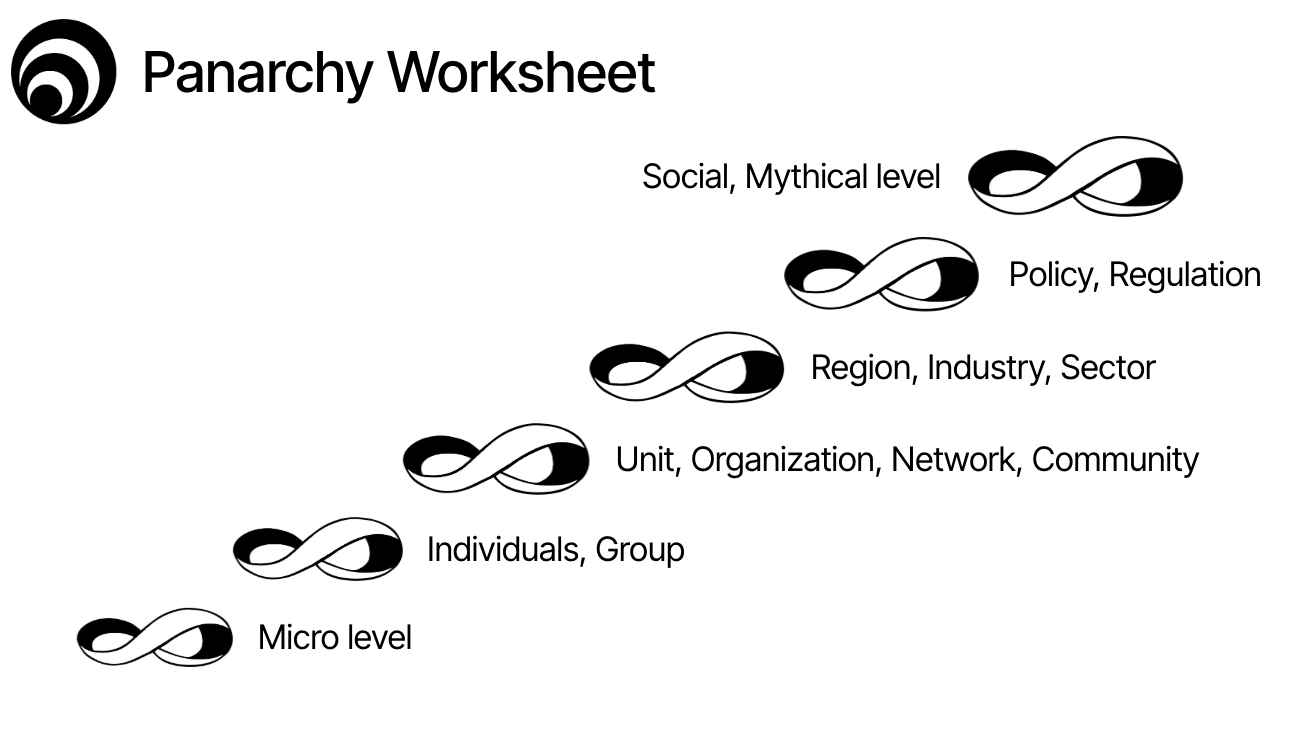
Panarchy Worksheet
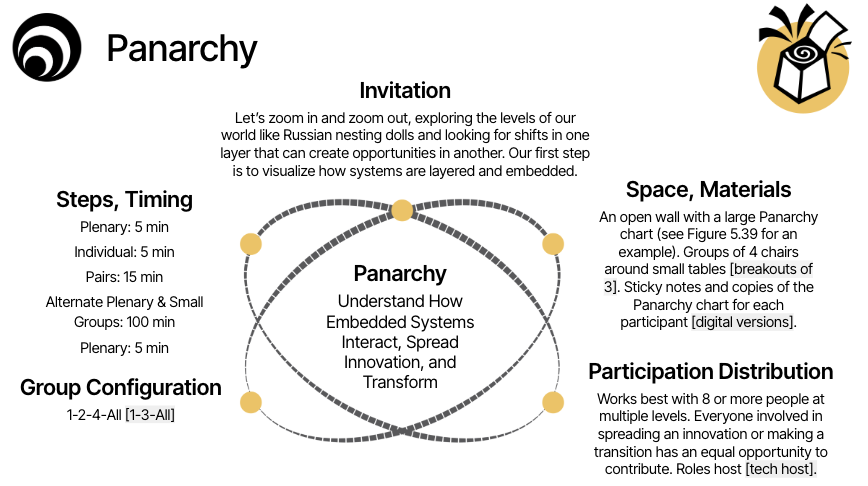
Microstructural elements of Panarchy in the constellation format.