

Wicked Questions
Articulate the Paradoxical Challenges That a Group Must Confront to Succeed (~30 min.)
“How wonderful that we have met with a paradox. Now we have some hope of making progress.”
Purposes
In Wicked Questions, participants ask, “How is it that we are doing two things in tension with each other simultaneously?” These questions reveal entangled challenges that are unintuitive or difficult to discuss. Wicked Questions can reduce either-or thinking and engage everyone in thinking strategically about how to balance competing priorities. It can be particularly useful in transitions because it exposes the tension between what is being said and what is actually being done. This structure reinforces LS Principle #7, Emphasize Possibilities: Believe Before You See.
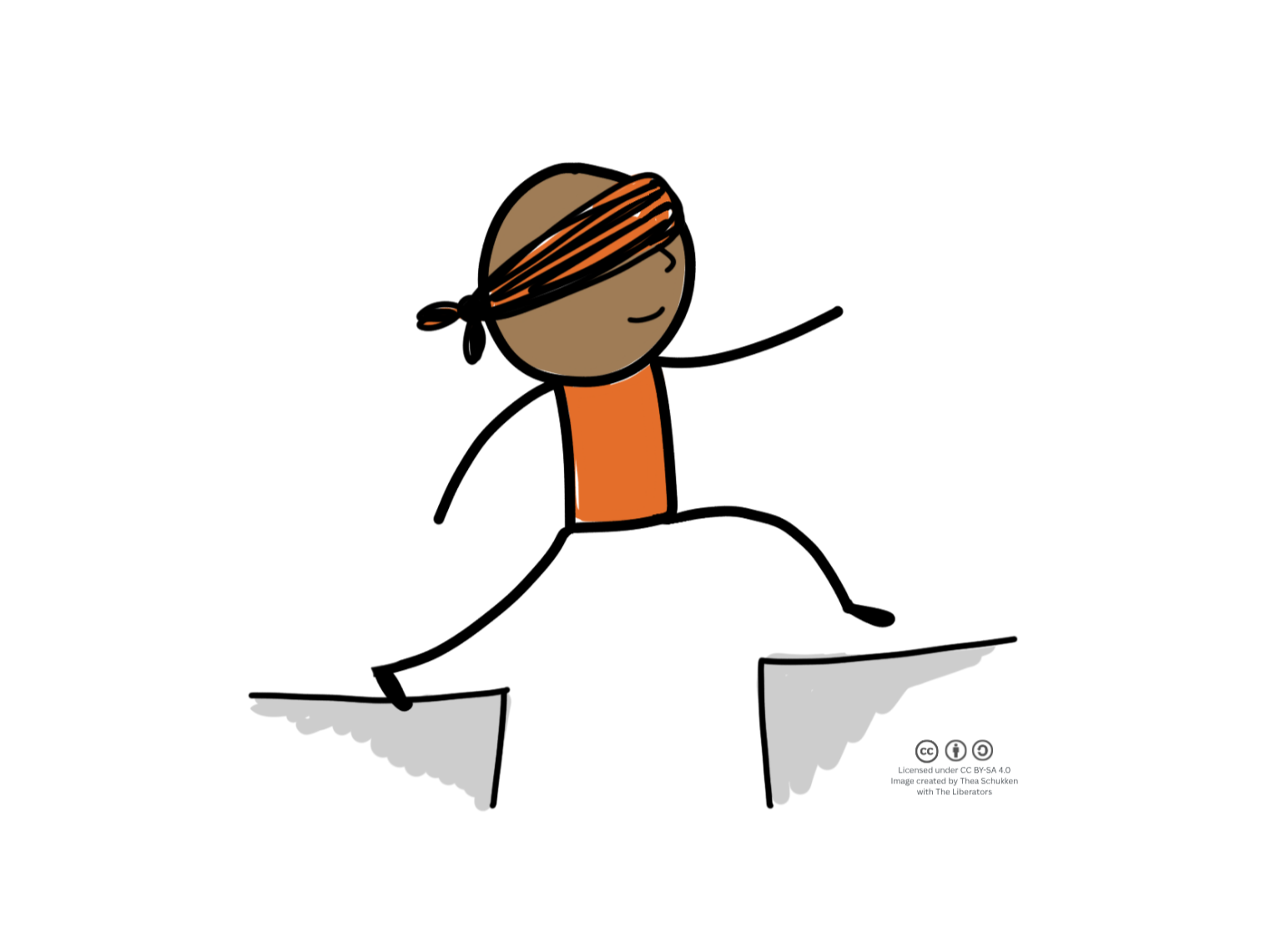
Principle: Emphasize Possibilities: Believe Before You See
Five Structural Elements—Min Specs
Structuring Invitation
“Let’s identify realities that make progress in our work challenging and rewarding. We will look for opposite forces or tendencies that, when addressed together, can actually be complementary and lead to amazing solutions. What opposing-yet-complementary strategies do we need to pursue simultaneously in order to be successful?”
Space and Materials
Groups of four to six chairs [breakouts of four to six], with or without small tables. Paper for each participant. Examples of Wicked Questions (see below) and sentence template to display.
Wicked Questions
Question Format
“How is that we are ___ while simultaneously ___?”
Wicked Question Examples
How is it that we are operating as an INTEGRATED whole AND as AUTONOMOUS locally adapted units?
How is it that we are being more STRUCTURED AND more LIBERATED in our interactions?
How is it that I am raising my children to be fiercely LOYAL to the family AND INDEPENDENT, self-authored beings?
How is it that we making it SAFE to take bolder RISKS?
How is it that we are DECIDING what to do while keeping all of our OPTIONS OPEN?
Wicked Questions feature two words with opposite meanings or connotations. When addressed together, they can become complementary pairs.
Participation Distribution
Roles include host [tech host] and participants. Minimum group size is two. Everyone is invited and has an equal opportunity to contribute.
Group Configuration
Alone, groups of four to six, whole group
Steps and Time Allocation
Intro: Share the structuring invitation and identify a shared challenge. (1 min.)
Individual Reflection: Each participant lists things or forces that are true about the challenge, including both challenges and opportunities. (3 min.)
Find Tensions: Participants circle two truths that are seemingly opposed or in creative tension. (2 min.)
Explain Next Steps: Explain the format of a Wicked Question: “How is that we are ________ while simultaneously _________?” Display examples and the sentence template. (2 min.)
Ask Wicked Questions: Participants use the template to draft a sentence using their circled truths. (5 min.)
Form Groups and Refine: Participants form groups of four to six [breakouts] to help each other make the questions more wicked. You know you have a truly Wicked Question when you get “arrrgh” in response. (10 min.)
All-Together Sharing: Everyone returns to plenary. A few participants share their most dramatic questions. Record the questions where everyone can see them. [Have each participant share one Wicked Question in the chat.] (3 min.)
Group Reflection: The group considers which questions have the most potential to move the group’s work forward if they are creatively addressed. Have everyone vote for the top three with applause or “arrrghs.” [Vote using likes, thumbs-up/down reactions, or a poll.] (2 min.)
Taking It Online
The main advantage of using Wicked Questions online is the ability to easily capture insights digitally in the chat or on a shared whiteboard, which can accelerate the process.
Practice Insights
Tips
If the group does not have a shared challenge, invite participants to focus on individual challenges. Wicked Questions work best when a single word represents each opposing truth. Play with words that have different connotations until you get to “arrrgh.” Avoid questions that lay blame or complain.
Riffs and Variations
Draw on participants’ field experience by asking, “When have you noticed these two things to be true at the same time?”
Practical Applications
Wicked Questions are useful during transitions to help a group move beyond old ways of thinking (e.g., “How is it that we both include and transcend the old way?”). Use them to consider next steps (e.g., “How is it that we are deciding what to do while keeping all of our options open?”), manage global operations (e.g., “How is it that we maintain our global identity and uniquely adapt to each local setting?”), or surface personal challenges (e.g., “How is it that I am dedicated to my work while being fully present for my family?”).
Optional String
Follow up with 1-2-4-All, 25/10 Crowdsourcing, and Critical Uncertainties to generate and sift imaginative options.
Attribution
Liberating Structure developed by Henri Lipmanowicz and Keith McCandless. Dig deeper by exploring the work of professor Brenda Zimmerman and the Plexus Institute, and neuroscientist Scott Kelso on complementary pairs and metastability.
Collateral Materials
Link to supporting materials for Wicked Questions.
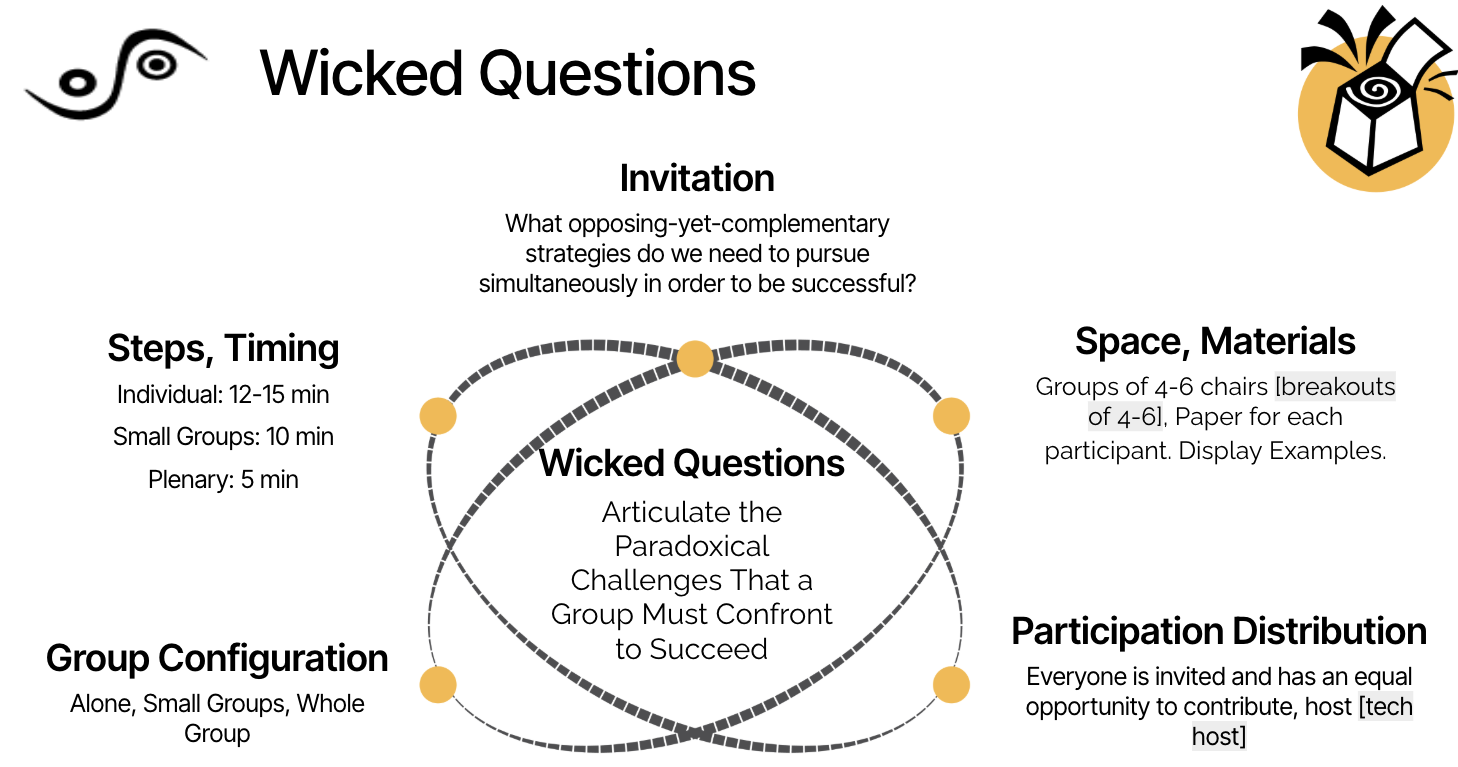
A one-slide overview of the elements of Wicked Questions in the LS constellation format.