

Options Place
Without a Preset Agenda, Distribute Control of Meeting Content and Process to Participants (55–85 min.)
“One day a student asked, “What is the most difficult part of painting?” The master answered, “The part of paper where nothing is painted is the most difficult.”
Purposes
In Options Place, participants propose and lead their own breakout sessions instead of following a preset agenda. This unleashes people’s creativity and invites them to attend sessions that match their interests. When given the freedom to shape the agenda, participants become more engaged and take greater ownership of solutions, which leads to greater commitment, action, innovation, and follow-through. In this way, Options Place brings to life LS Principle #6, Amplify Freedom and Responsibility. This structure works well for large groups.
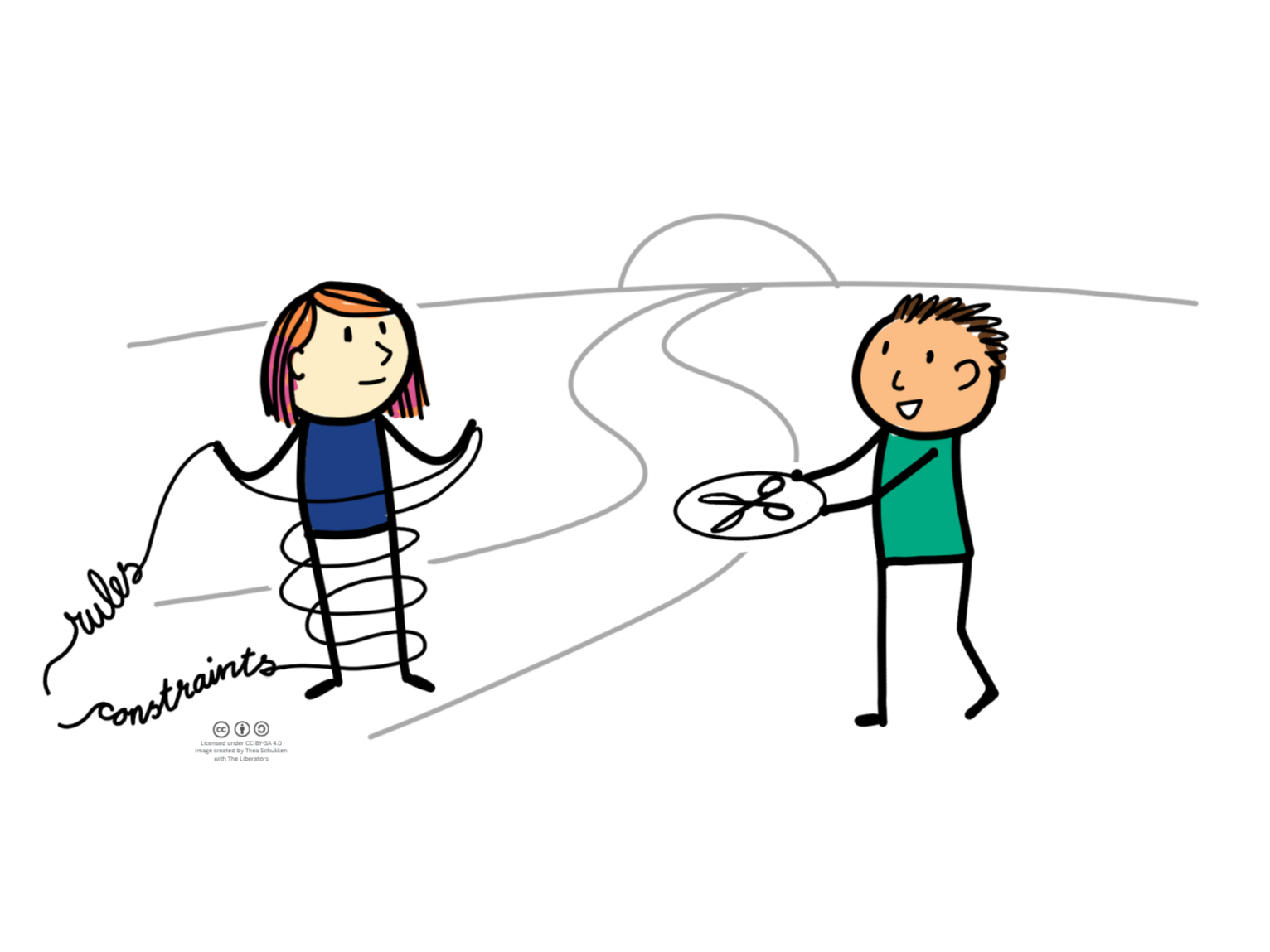
Principle: Amplify Freedom and Responsibility
Five Structural Elements—Min Specs
Structuring Invitation
“What burning questions or key topics do you want to explore within our theme? Let’s build an agenda together.”
Space and Materials
An open wall with a large blank agenda, called a Breakout Board (see figure below). Chairs arranged in small groups around the room, one station per session in each round. [Breakout rooms for each session.] Sticky notes and flip charts for each station [visual collaboration space with digital sticky notes]. Microphones for a large group. Simple Rules for Options Place (see figure below) to display.
Preparing the Breakout Board: Estimate that three in ten participants will post a session (e.g., there will be about fifteen sessions for fifty participants). Include enough slots to accommodate one to three rounds of concurrent sessions, estimating fifteen minutes per session with two-minute transitions in between.
[Preparing the Breakout Rooms: The number of breakout rooms will depend on the number of topics and rounds. For example, if a group generates fifteen topics, set up eight rooms for the first round and eight rooms for the second round. Label them with the session names.]
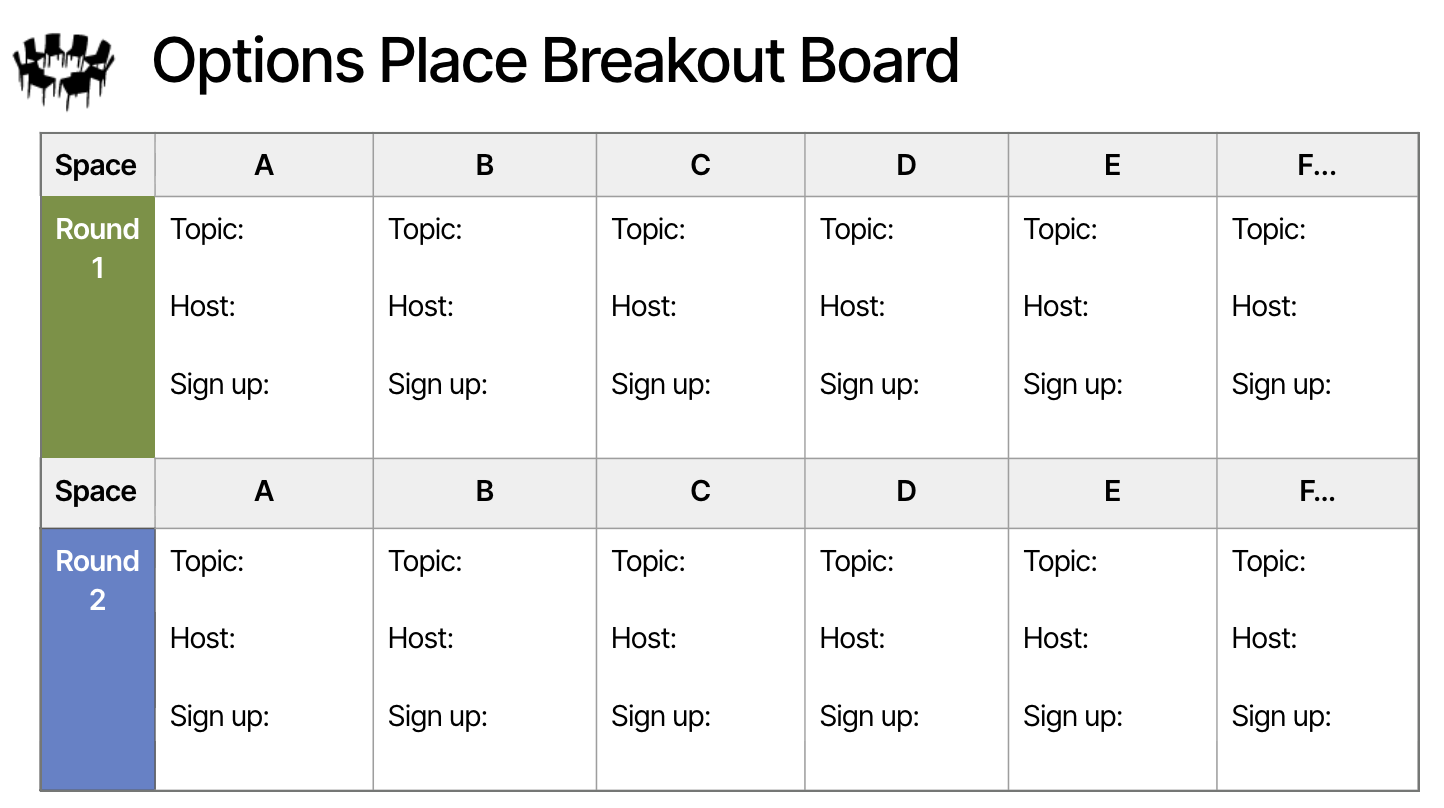
Breakout board template for Options Place.
Simple Rules for Options Place
1. Go to where you are learning or contributing.
2. Use a liberating approach in your breakout
(e.g. 1-2-4-All).


Simple rules for Options Place.
Participation Distribution
Roles include host [tech host], session leaders, and participants. Minimum group size is ten. Everyone is invited and has an equal opportunity to contribute.
Group Configuration
Small groups, whole group
Steps and Time Allocation
Intro: Share the structuring invitation. Establish a purpose, theme, or shared challenge for the meeting. (1 min.)
Create the Agenda: Participants create an agenda for X rounds of sessions that are Y minutes long. To propose a session, they write the session title and their name on a sticky note and place it on the Breakout Board. (5–20 min.)
Individual Agendas: Participants choose which sessions to attend, following Simple Rule 1: If you find yourself in a session where you are not learning or contributing, go somewhere else! Session leaders prepare their stations by writing the name of their session, their name, and the LS they will use on a flipchart. Encourage everyone to jot down important notes, next steps, and key recommendations or actions during the sessions. (5 min.)
Attend Sessions: Participants move to their first session. Signal when it is time to move to the next session. (one to three sessions of ~15 min. each; 32–50 min. total).
All-Together Sharing: Everyone returns to plenary. A few participants debrief on the structure and share notes and next steps from the sessions. (10 min.)
Taking It Online
Options Place works online with no major adjustments. Allow participants to choose their own breakout rooms. If self-selection isn’t an option, a tech host can manually assign participants.
Practice Insights
Tips
A compelling theme is a key requirement for Options Place. To sharpen the topics proposed, invite participants to reflect individually on topics before they start adding to the Breakout Board. If there are challenges with overlapping agendas, encourage participants to resolve them before the agenda is complete. Don’t rush to consolidate—often sessions that sound the same are not.
Riffs and Variations
Reopen the Breakout Board for a second round or schedule longer rounds for deeper work. For small groups, try the “Lean Coffee” method: cover multiple topics all together in fast-paced, seven- to ten-minute sessions.
Practical Applications
Options Place can help plan any type of meeting. After a merger, bring together all employees of both companies to shape next steps and take action together. Share prototypes among widely distributed teams.
Optional String
Develop ideas for sessions with 25/10 Crowdsourcing and follow up with Purpose-to-Practice.
Attribution
Options Place designed to fit in the Liberating Structures repertoire by Nancy White and Keith McCandless. Dig deeper by exploring Open Space Technology created by Harrison Owen, and Lean Coffee by Jim Benson and Jeremy Lightsmith.
Collateral Materials
Link to supporting materials for Options Place.
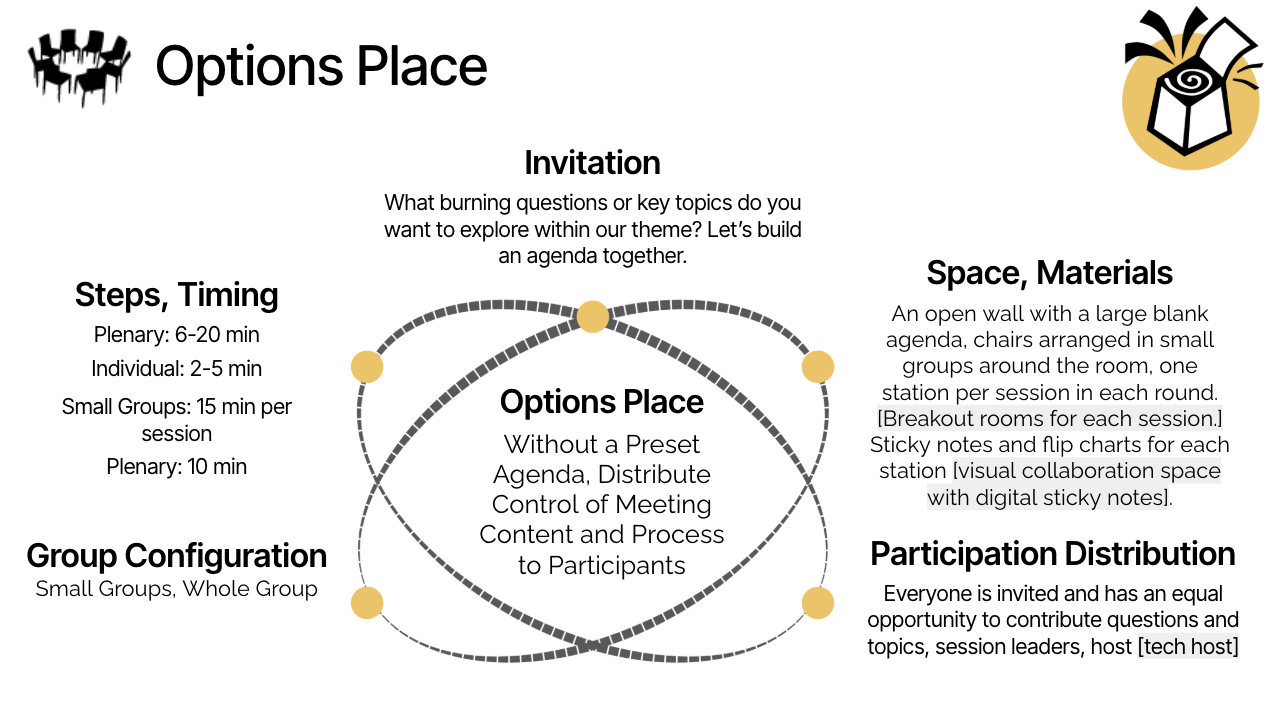
Microstructural elements of Options Place in the constellation format (above).