

Simple Ethnography
Observe and Record Actual Behaviors of Users in the Field (~50 min.to 7 hrs.)
“Scientific knowledge . . . appears now to be pointing us toward a new relationship with the natural world based on sensitive observation and participation, rather than control.”
Purposes
In Simple Ethnography, a team observes its own context to gain deep insights into people’s experiences, needs, and pain points. Instead of relying on outside experts, the group learns directly from the people it serves in their local setting, embodying LS Principle #2, Practice Deep Respect for People and Local Solutions. This immersive connection fosters empathy and leads to more meaningful solutions. Understanding actual behavior enables rapid improvements and innovative prototypes, allowing positive change that once seemed impossible.
Principle: Practice Deep Respect for People and Local Solutions
Five Structural Elements—Min Specs
Structuring Invitation
“We are going to immerse ourselves with the people who work closest to our challenges in our local settings. Our aim is to learn from their direct experience and discover new approaches to our shared challenge.”
Space and Materials
A convenient space for sharing findings and artifacts. Observation sites can take place in physical and virtual spaces. Provide notebooks, pens, and cameras, or ask participants to bring their own. Copies of Simple Ethnography Guide for each participant [digital version].
Simple Ethnography Guide
Observations Using All Your Senses
Site: Describe the setting. What objects and furniture are in the space? How is it laid out? Who is in the space?
Activities: What are people doing? Pay attention to tiny details like facial expressions, gestures, and body language. What do you notice about the transitions between activities?
Communication: Who is speaking and who is listening? What do you notice about the way people are sharing these roles?
Sound: What do you hear? What kinds of background noise do you hear? How are people reacting to sounds in the space?
Pacing: What do you notice about the way people are using time? Do they move quickly or slowly? Does everyone move at the same pace?
Preliminary Interpretations
Site: How might the site configuration contribute to the challenge we seek to understand? Where in the space are issues occurring? Whose needs are prioritized and whose are not?
Activities: How might people’s activities contribute to the challenge? Which activities are most important for us to understand? Which activities have the greatest impact?
Communication: How might people’s ways of communicating contribute to the challenge? What does this communication indicate about the group dynamic?
Sound: How might sound contribute to the challenge? How are sounds affecting people in the space?
Pacing: How might the pacing of activities contribute to the challenge? Where does it feel like people are moving too quickly or too slowly?

Simple Ethnography Guide.
Participation Distribution
Roles include host [tech host] and ethnographers. Minimum group size is two. Everyone working on a challenge is included as an ethnographer and has an equal opportunity to contribute.
Group Configuration
Ethnographers conduct observations alone or in pairs. 1-2-4-All to debrief.
Steps and Time Allocation
Intro: Share the structuring invitation and identify the shared challenge. Describe the context, which should be familiar to participants. Hand out copies of Figure 5.32. (5 min.)
Plan Observations: Participants identify sites and people to observe to learn how people experience the challenge. Encourage participants to secure permission to observe if needed and take measures to ensure safety and confidentiality, without disrupting normal activities. [Online, they make their presence known, then turn off their camera and mic.] Before starting observations, review What, So What, Now What and the Ladder of Inference. The goal is to “stay low on the ladder” by recording facts and observable data only. No interpreting or fixing! (5 min.)
Site Visits: Participants visit their chosen sites and observe interactions and activities, taking notes and collecting artifacts [as digital files and screenshots]. (10–180 min.)
Share Artifacts: Participants post artifacts they collected in a shared space. Optionally, they can do this step on their own during a break. (5–10 min.)
Debrief in Small Groups: In small groups [breakouts], participants review their notes and share patterns and stories, focusing on observable facts rather than interpretations. (15 min.)
All-Together Sharing: The group debriefs using What, So What, Now What and identifies opportunities for follow-up action research, interviews, or small experiments. (10–15 min.)
Repeat Steps: Repeat the process for additional cycles until powerful insights emerge that could lead to a prototype. (40–60 min. per cycle)
Taking It Online
This structure has not been extensively tested online. It could be valuable in a hybrid setting, with teams starting online, observing in the field, and then debriefing online. Observation sites can include both virtual and physical spaces.
Practice Insights
Tips
Encourage participants to go where conditions are tough. A good observation site is one where problems are extreme, solutions seem impossible, and you can expect to find people getting truly creative. Insight often comes from overlooked details. Encourage participants to pay attention to behaviors that are inconspicuous, irregular, intimate, and crude. Be prepared to repeat steps if the participants don’t feel they have a powerful new approach to prototype at the end of one round.
Riffs and Variations
Use a storytelling template to structure and personalize observations (e.g., a narrative in which a protagonist leaves their ordinary world, faces trials in an unfamiliar context, and returns transformed with a reward or insight). Do more rounds after the group implements its new approach.
Practical Applications
Help sales reps discover how colleagues are getting better results without additional resources. Understand how some clinicians are able to attend to patients’ spiritual needs while others are not. Understand how to prevent accidents in the workplace.
Optional String
String with Drawing Together to create a visual model of the challenge.
Attribution
Liberating Structure developed by Henri Lipmanowicz and Keith McCandless.
Collateral Materials
Link to supporting materials for Simple Ethnography.
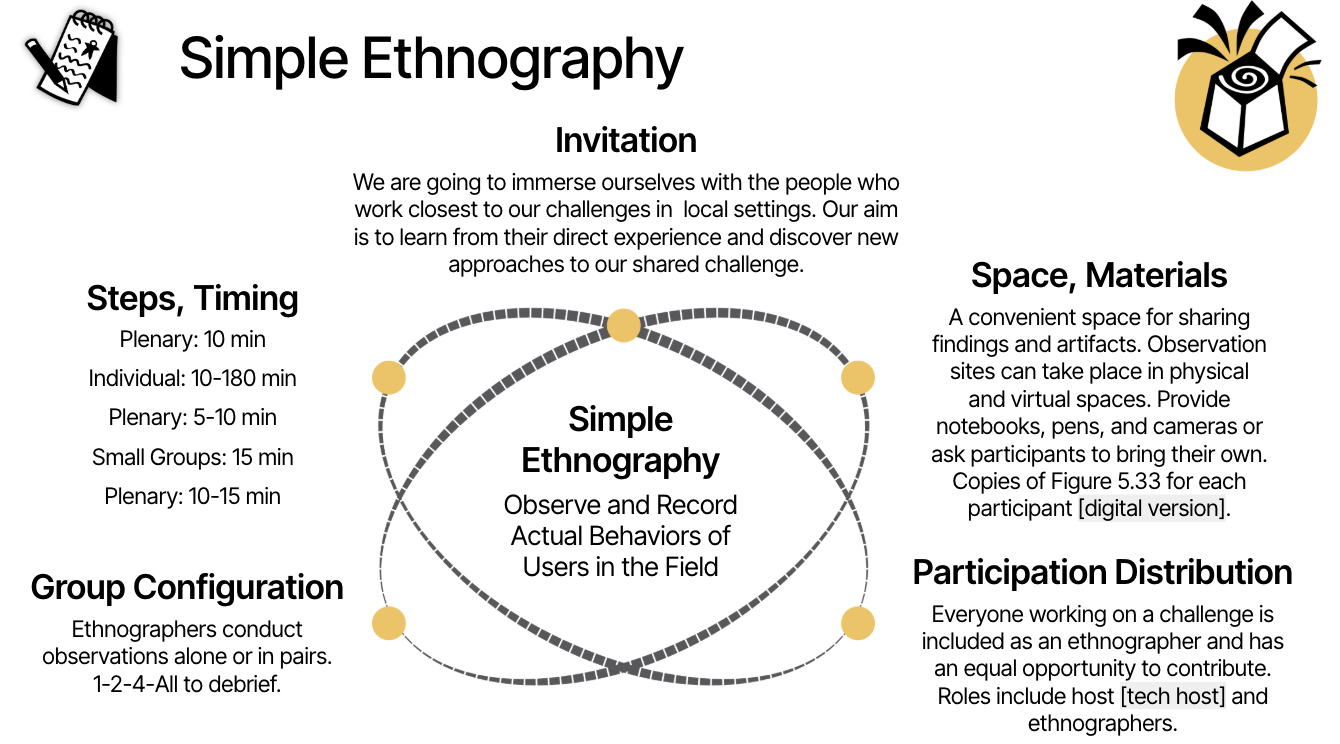
Microstructural elements of Simple Ethnography in the constellation format.