

Discovery and Action Dialogue (DAD)
Discover, Invent, and Unleash Local Solutions to Chronic Problems (~35–80 min.)
“Live the questions now and perhaps without knowing it you will live along someday into the answers”
Purposes
DAD makes it easy for a group to discover better practices that only a few members are using to solve a common problem, called positive deviant behaviors. When held in a local setting close to where the problem manifests, it creates a safe space to invent new and more effective practices, sparking imagination and strengthening resolve to take action. It also builds relationships between people in diverse roles. This structure enacts LS Principle #2, Practice Deep Respect for People and Local Solutions.

Principle: Practice Deep Respect for People and Local Solutions
Five Structural Elements—Min Specs
Structuring Invitation
We’re going to uncover the behaviors and practices some of us are already using to tackle our shared challenge. It’s like going on a treasure hunt to find the solutions hidden in our midst.”
Space and Materials
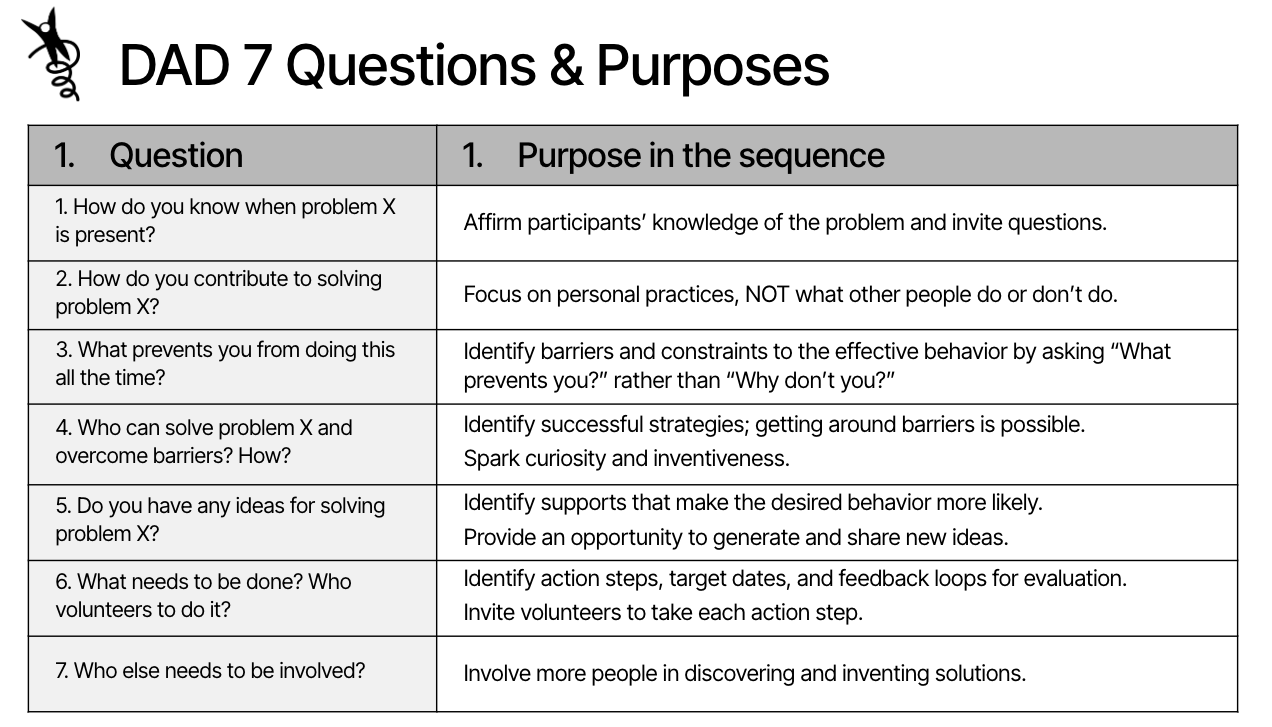
Space for groups of five to seven to stand or sit around tables [breakouts of five to seven]. Paper for each group. Seven questions prepared in advance for small groups to display (see table below).
Participation Distribution
Roles include host [tech host], group hosts, scribes, and participants. Minimum group size is two. Everyone is invited and has an equal opportunity to contribute.
Group Configuration
Groups of five to seven, whole group
Steps and Time Allocation
Intro: Describe the shared problem and share the structuring invitation. (1 min.)
DAD Groups Assemble: Participants form small groups of five to seven [breakouts]. They name a host to manage the conversation and make sure each question is addressed and a scribe to take notes. (3 min.)
The Magnificent Seven: Each group host restates the problem and asks the seven questions. They display the questions for the group [in screen share and in the chat].
How do you know when problem X is present?
How do you contribute effectively to solving problem X?
What prevents you from doing this or taking these actions all the time?
Do you know anybody who is able to frequently solve problem X and overcome barriers? What behaviors or practices made their success possible?
Do you have any new ideas for solving problem X?
What needs to be done to make it happen? Who volunteers to take these steps?
Who else needs to be involved? (5 min.)
Launch the Treasure Hunt: Participants in each group answer the questions together, one at a time. The group host poses each question and keeps the group on track but does not participate in answering the questions (see Tips for DAD hosts below). The scribe takes notes and may help answer the questions. Signal [broadcast a message] when it is time to move to the next question, allotting equal time for each one. (15–60 min.)
Recap Highlights: Everyone returns to plenary. Invite each group’s scribe to highlight “wow” stories, behaviors, or actions the group discovered, and share next steps from their group. [Participants can list suggestions in the chat.] (5 min.)
Who Else to Invite?: Ask the whole group who else to invite to the next dialogue. (3 min.)
Tips for DAD Hosts
Do not
Answer unasked questions.
Go on about a personal interest.
Miss opportunities to record participant actions or behaviors that solve or start to solve the problem.
Take on work that should be done by participants.
Make decisions about someone without them.
Judge contributions. Let the group evaluate.
Do
State the purpose clearly. “We’re here to stop safety lapses.”
Give questions back to the group. Wait for responses.
Encourage quiet people to contribute.
Challenge cynicism with positive reframing. Has this ever been done well?
Be flexible with the order of questions.
Maintain humility and learn from the group. Be willing to “sit at the feet” of people with solutions.
Taking It Online
DAD works online with no major adjustments.
Practice Insights
Tips
Create an informal climate for DAD by starting with introductions, restating the shared tough problem in plain language, and sharing an anecdote. Hold DAD where the participants work to minimize obstacles to participation. Group hosts need practice to become skilled at this approach; encourage them to ask their scribes for direct feedback. See tips for group hosts above.
Riffs and Variations
Use the first three questions to prompt creative destruction and explore factors that make a problem worse (“What can you do to make sure that problem X becomes much worse?” etc.). Use the same questions to guide one-on-one conversations.
Practical Applications
DAD can help cross-functional groups reduce harm to patients from safety lapses, collect data for an ethnographic project, and aid team members remedy dysfunctional behaviors that are eroding trust and productivity.
Optional String
Use insights and curiosity generated by DAD to launch action research with Simple Ethnography or Improv Prototyping.
Attribution
Liberating Structure developed by Henri Lipmanowicz and Keith McCandless. Dig deeper by exploring Positive Deviance, an approach to behavioral and social change.
Collateral Materials
Link to supporting resources for DAD.
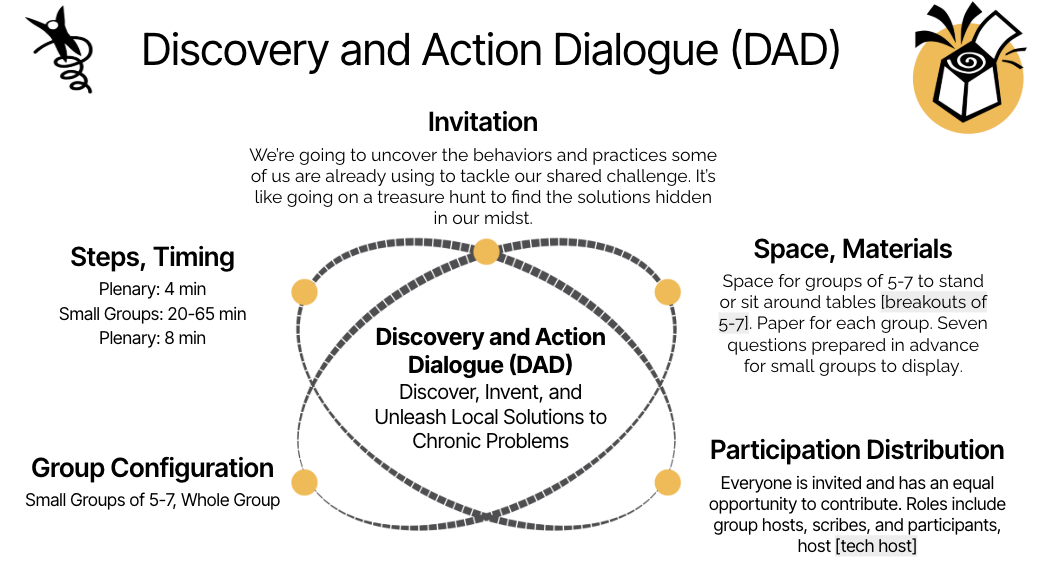
A one-slide overview of the elements of Discovery and Action Dialogue in the LS constellation format.