

Improv Prototyping
Develop Effective Solutions to Chronic Challenges While Having Serious Fun (~20 min. per round)
“To be playful is not to be trivial or frivolous. To be serious is to press for a specified conclusion. To be playful is to allow for unlimited possibility.”
Purposes
In Improv Prototyping, participants respond to a challenge by acting out possible solutions. This seriously fun structure engages people in learning and rapid improvement by tapping three levels of knowledge: (1) explicit (shared by participants), (2) tacit (discovered through observing others’ performance), and (3) latent (emerges through collaboration). As participants improvise, they create innovative solutions from “chunks” that can be combined. This structure embodies LS Principle #4, Learn by Failing Forward.
Principle: Learn by Failing Forward.
Five Structural Elements—Min Specs
Structuring Invitation
“Get ready to address a shared challenge by acting out the situation and improvising prototypes of possible solutions. You will be dramatizing the simple elements that work to solve a problem with a playful way to get very serious work done!”
Space and Materials
An open space or stage at the front of a room [spotlight]. Chairs for participants to sit in clusters of three to four [breakouts]. Props for scenes (optional).
Participation Distribution
Roles include host [tech host], players, and observers. Minimum group size is nine. Everyone is included as both players and observers.
Group Configuration
A central group of three to four players and many small groups of three to four observers.
Steps and Time Allocation
Intro: Share the structuring invitation and identify a shared problem. Invite a few participants to be players in a short, improvised scene. (1 min.)
Preparation: Send the players to a separate area [breakout room] to plan their scene while the observers divide into small groups. [Prepare breakout rooms.] (3 min.)
Acting Out the Scene: The players return and act out their scene while everyone else observes. [Spotlight the players.] (5 min.)
Whole-Group Debrief: The group debriefs using 1-2-4-All [Chatterfall], identifying successful and unsuccessful “chunks” from the scene. (3 min.)
Prototyping: Observer groups return to their breakouts [send participants to same breakout rooms] to piece together successful chunks into a new prototype. Each group selects volunteers to act out their prototype. (5 min.)
Acting Out More Scenes: Everyone returns to plenary. Invite a few groups to share their improved prototypes. Continue with as many rounds as necessary to arrive at one or more prototypes that are good enough to put into practice. Thank everyone who acted! (3–5 min. per scene)
Taking It Online
Improv Prototyping works online with no major adjustments. It can be scaled to larger groups more easily online than in person.
Practice Insights
Tips
A concrete and sharply defined problem will lead to better results. Specify details for the scene such as key roles, location, and props. Coach players on the rules of improv: Trust and accept all offers (“yes, and . . . ”); make action-filled choices, giving and taking; engage in one conversation at a time; listen, watch, concentrate (look, don’t think!); and work to the top of your intelligence.
Riffs and Variations
Invite a “creative director” to help specify scene details and redirect the players if needed. Discover better (and worse) actions by inviting the audience to replay the first scene in small groups, inviting face-off competitions judged by an “applause-o-meter.”
Practical Applications
Improv Prototyping can provide an engaging alternative to dry trainings or conventional courses, inspire new ways for sales reps to interact with customers, help teachers discover effective responses to disruptive classroom behaviors, and stop the spread of superbugs by illustrating what not to do when maintaining infection precautions (e.g., wear a tie and examine a wound without gloves — see image below).
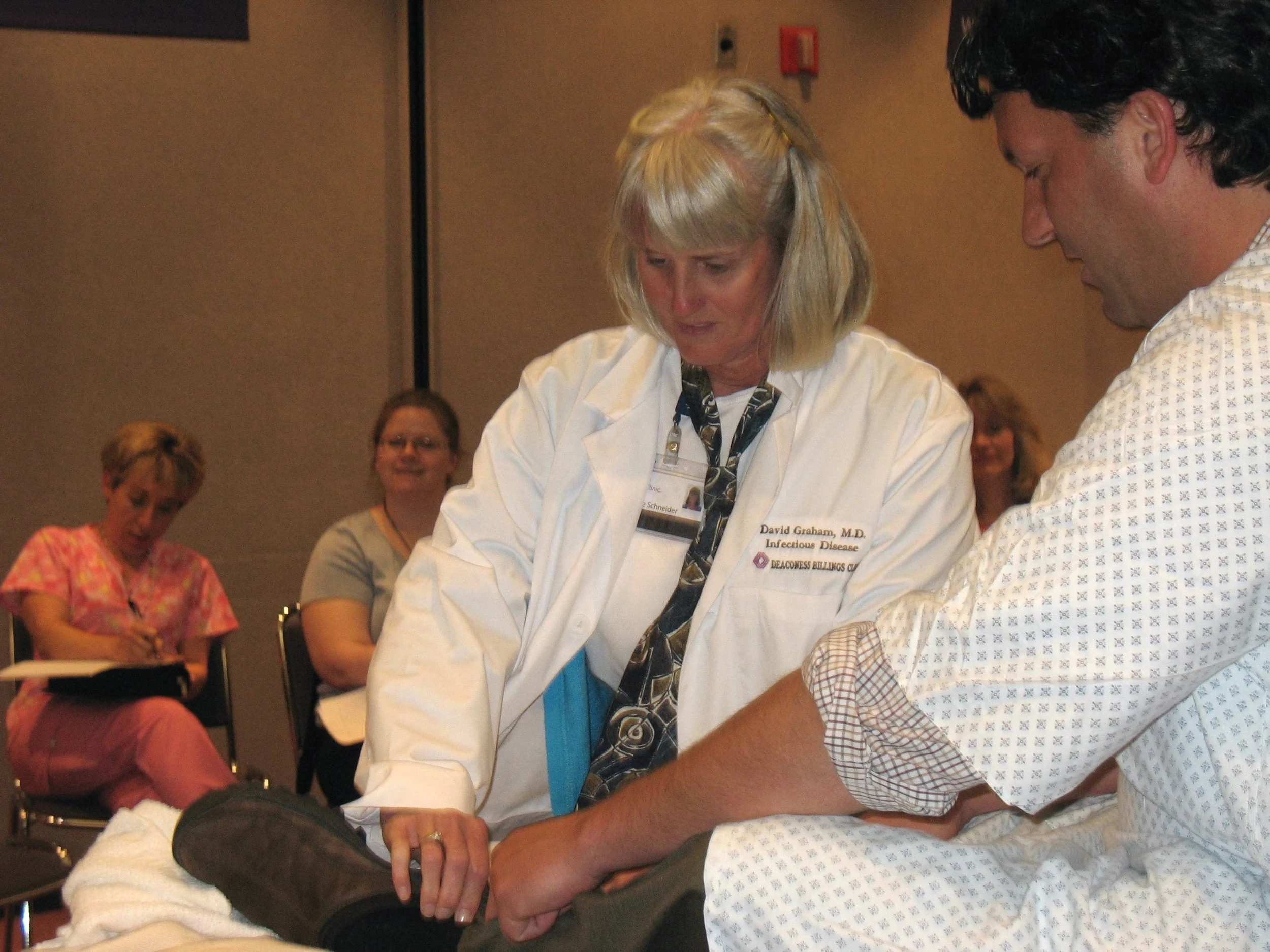
Improv Prototyping in action at a hospital working to reduce superbug infections.
Optional String
Start with Discovery and Action Dialogue, Simple Ethnography, or User Experience Fishbowl to define the theme for Improv Prototyping.
Attribution
Liberating Structure developed by Henri Lipmanowicz and Keith McCandless. Dig deeper by exploring the creative civic initiatives of Antonas Mockus (mathematician and former mayor of Bogota).
Collateral Materials
Link to supporting materials for Improv Prototyping.
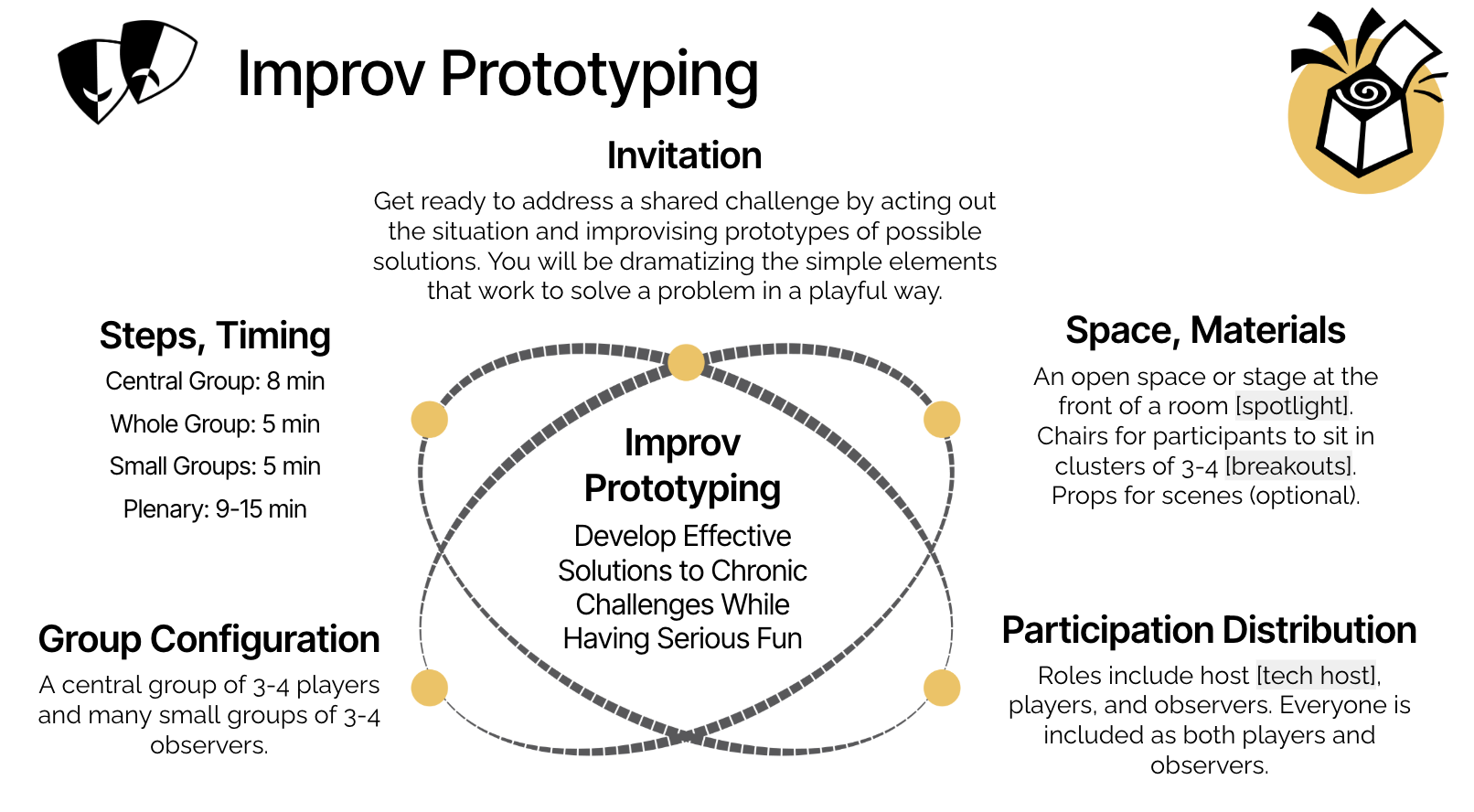
Microstructural elements of Improv Prototyping in the constellation format.