

Critical Uncertainties
Develop Strategies for Operating in a Range of Plausible Yet Unpredictable Futures (~90 min.)
“There is a tendency to think that what we see in the present moment will continue. . . . What leaps out from the history of the past hundred years is its utter unpredictability.”
Purposes
In Critical Uncertainties, groups develop strategies for handling factors that are impossible to predict or control. This helps to quickly test strategies and improve our ability to respond to future challenges. Rather than creating fixed plans, this structure builds creative adaptability, enabling groups to envision multiple futures, articulate higher-order goals, and act flexibly. It brings to life LS Principle #7, Emphasize Possibilities: Believe Before You See.

Principle: Emphasize Possibilities: Believe Before You See
Five Structural Elements—Min Specs
Structuring Invitation
“Let’s develop four plausible future scenarios and identify strategies that would help us succeed in each. Then we will review options to make our current strategies more adaptable. The future is uncertain, but we can prepare for it.”
Space and Materials
An open wall with space to draw a Critical Uncertainties template (see below for an example). Groups of four chairs around small tables [breakouts of four]. Sticky notes, flip charts, or large paper for each group [visual collaboration space with template].
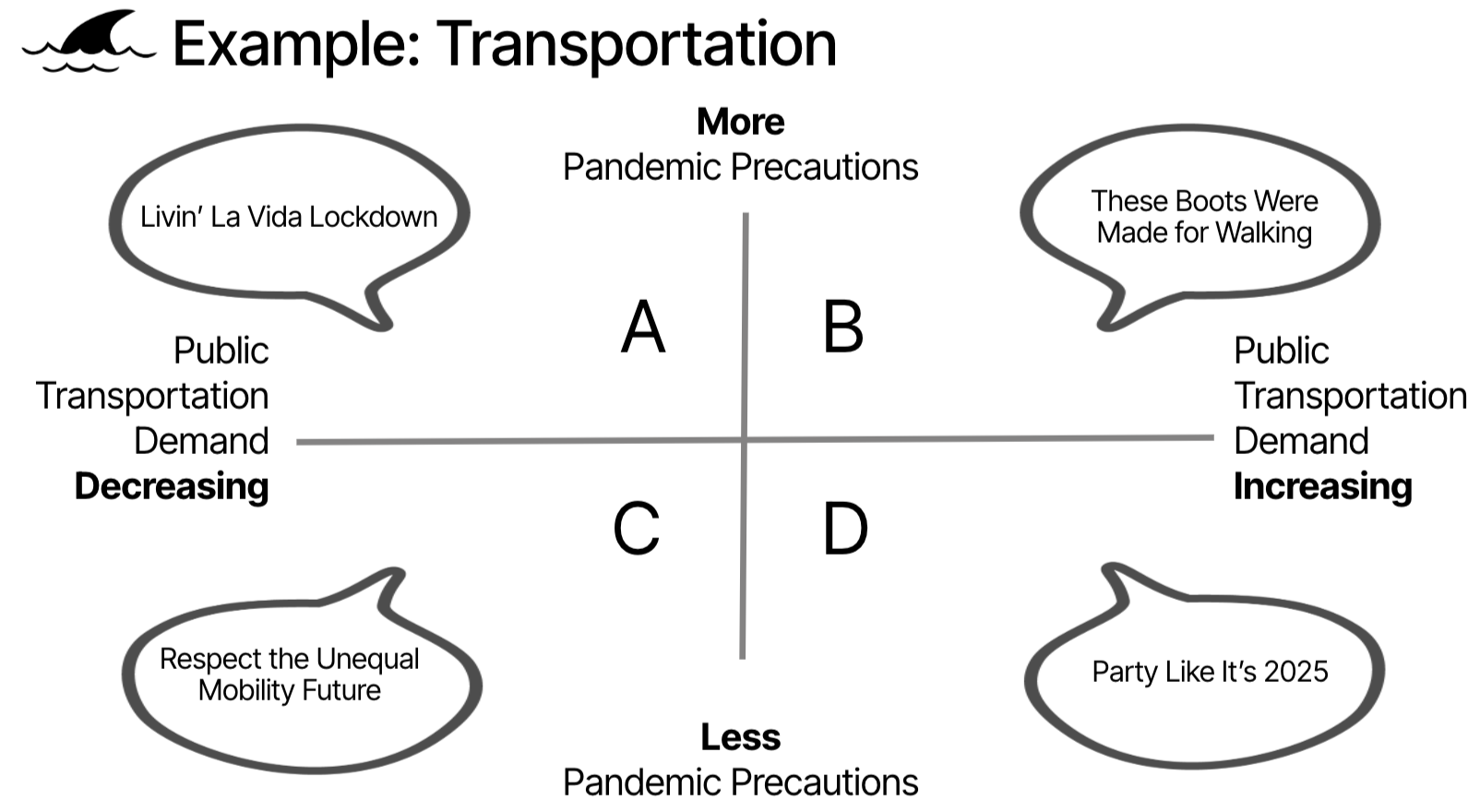
Critical Uncertainties Example: Transportation during COVID-19.
Participation Distribution
Roles include host [tech host] and participants. Minimum group size is eight. Everyone responsible for planning and executing strategy is included and has an equal opportunity to contribute.
Group Configuration
The ideal configuration is four groups of four to five. With fewer than twelve people, divide into two small groups and assign each group two to four quadrants. With more than twenty people, divide participants into groups of four to five and assign more than one group to each quadrant. Plan additional time for sharing work if there are multiple groups per quadrant or vice versa.
Steps and Time Allocation
Intro: Share the structuring invitation. (1 min.)
List Uncertainties: Participants list uncertainties, meaning factors in their operating environment that are impossible to predict or control. (5 min.)
Identify Critical Uncertainties: Participants form pairs [breakouts] and identify which factors most threaten their ability to operate successfully, especially thinking five to ten years in the future. (10 min.)
Select the Top Two Uncertainties: Everyone returns to plenary. Participants select the two most critical and uncertain factors (X and Y) based on history and field experience. With larger groups, use a poll or dot voting [digital versions]. (5 min.)
Label Axes: On large paper, draw a grid with two axes and label the ends with a continuum representing high to low values of each critically uncertain factor. (See example above.) (5 min.)
Invent Quadrants: Participants split into small groups [breakouts] and assign each a quadrant (see Group Configuration). Each group gives their quadrant a creative name and two-sentence scenario and records them on sticky notes or a shared template [digital versions]. (10 min.)
Share Scenarios: Everyone returns to plenary. Each small group shares their title and scenario. (8 min.)
Strategize for Scenarios: Participants return to their groups [same breakouts] and brainstorm three strategies for operating successfully in their scenario. They list them on sticky notes or the shared template [digital versions]. (10 min.)
Share Strategies: Everyone returns to plenary. Each group briefly shares their strategies. [Optional: Use Chatterfall and call on a few people to share out loud.] (8 min.)
Sort Strategies: The whole group identifies which strategies can succeed in multiple quadrants (“robust”) and which can succeed in only one but prepare you for big disruptions or surprises (“hedging”). (10 min.)
Debrief in Small Groups: Participants form new groups of three to six [breakouts] to debrief with W3, considering how their current strategy compares with the ones they just developed. (10 min.)
All-Together Sharing: Everyone returns to plenary. A few participants share first steps or “Now What” actions that everyone should hear. (10 min.)
Taking It Online
This works online with no major adjustments. Digital polling and dot voting can be easier online. Premade templates are helpful because creating visuals can take too much time.
Practice Insights
Tips
When brainstorming uncertainties, recall predictions and events that have caught the group off guard. Challenge wishful thinking and misrepresentation of facts about the past. Have fun with naming quadrants! Song and book titles work nicely. Consider taking a break in the middle to prevent cognitive overload.
Riffs and Variations
Use 1-2-4-All in short cycles for each step. Prepare the two critical uncertainties in advance and skip the first three steps to save fifteen to twenty minutes. The activity can also be used to express scenarios creatively. Use generative AI to create scenarios and strategies for addressing preestablished critical uncertainties.
Practical Applications
Explore which features to include in a new product or service. Help university research scientists explore scenarios for policymakers. Help executives create a twenty-year strategic vision.
Optional String
When Critical Uncertainties reveals a difficult crossroads with far-reaching consequences, explore with Folding Spectrogram. Follow with Talking with Pixies or Grief Walking to prepare everyone.
Attribution
Liberating Structure developed by Henri Lipmanowicz and Keith McCandless. Dig deeper by exploring the scenario planning work developed by the Global Business Network.
Collateral Materials
Link to supporting materials for Critical Uncertainties.
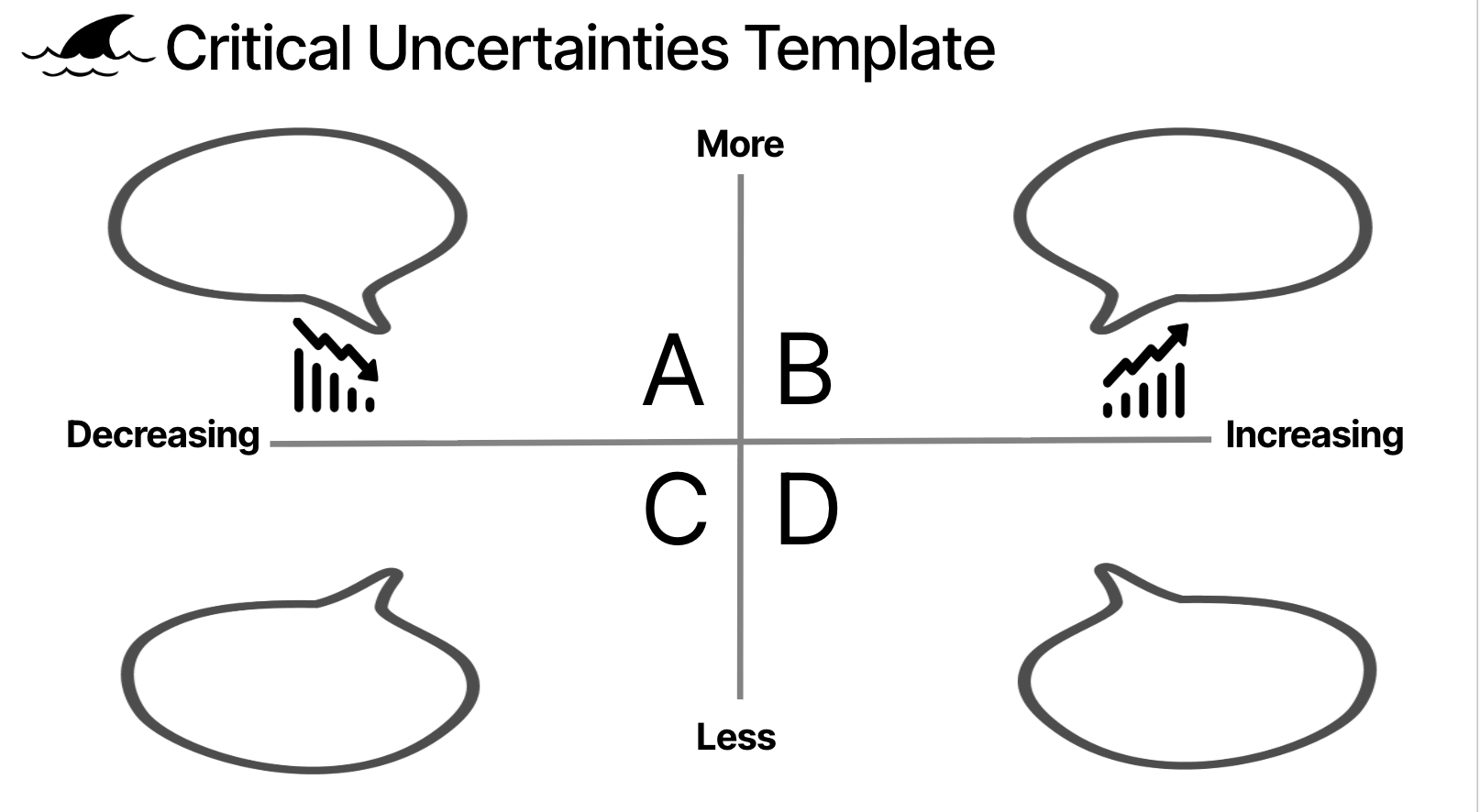
Critical Uncertainties Template
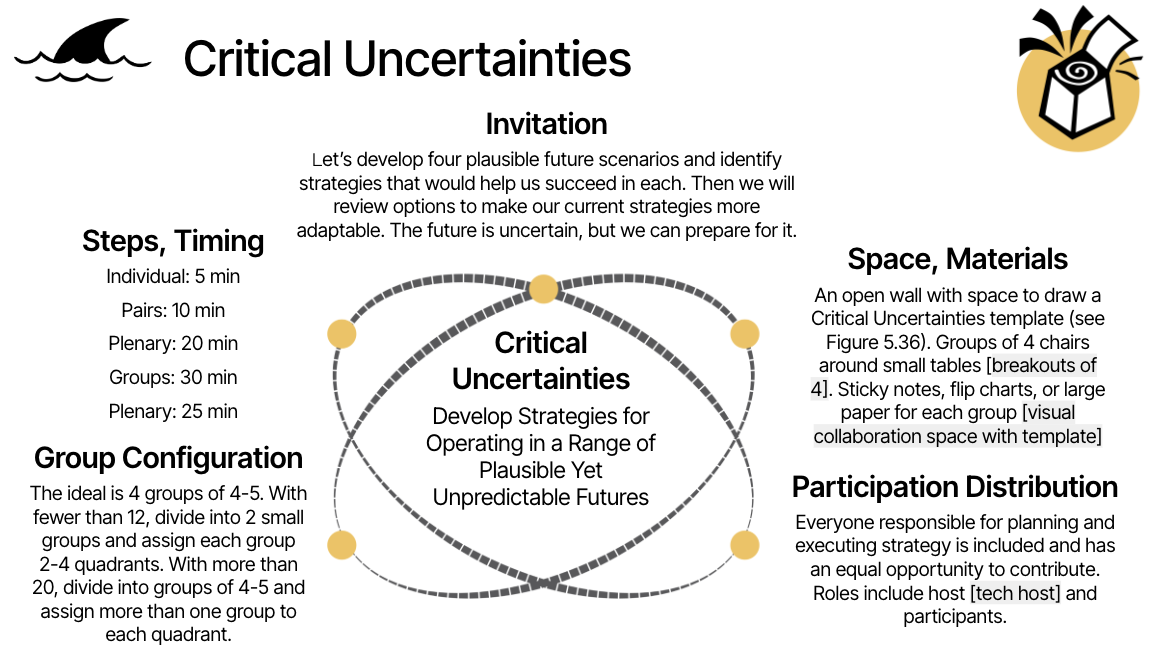
Microstructural elements of Critical Uncertainties in the constellation format.