

Network Relationship Patterns
Identify and Shape More Productive Work Patterns (~25 min.)
“We are what we repeatedly do. Excellence, then, is not an act but a habit.”
Purposes
In Network Relationship Patterns, participants identify how their group describes its work, how it actually works, and how it wants to work. This structure clarifies current relationship patterns to map a transition toward new ones. It is designed to make conversations about intangible group dynamics easier by providing a shared language for describing and visualizing patterns. It brings to life LS Principle #7, Emphasize Possibilities: Believe Before You See.
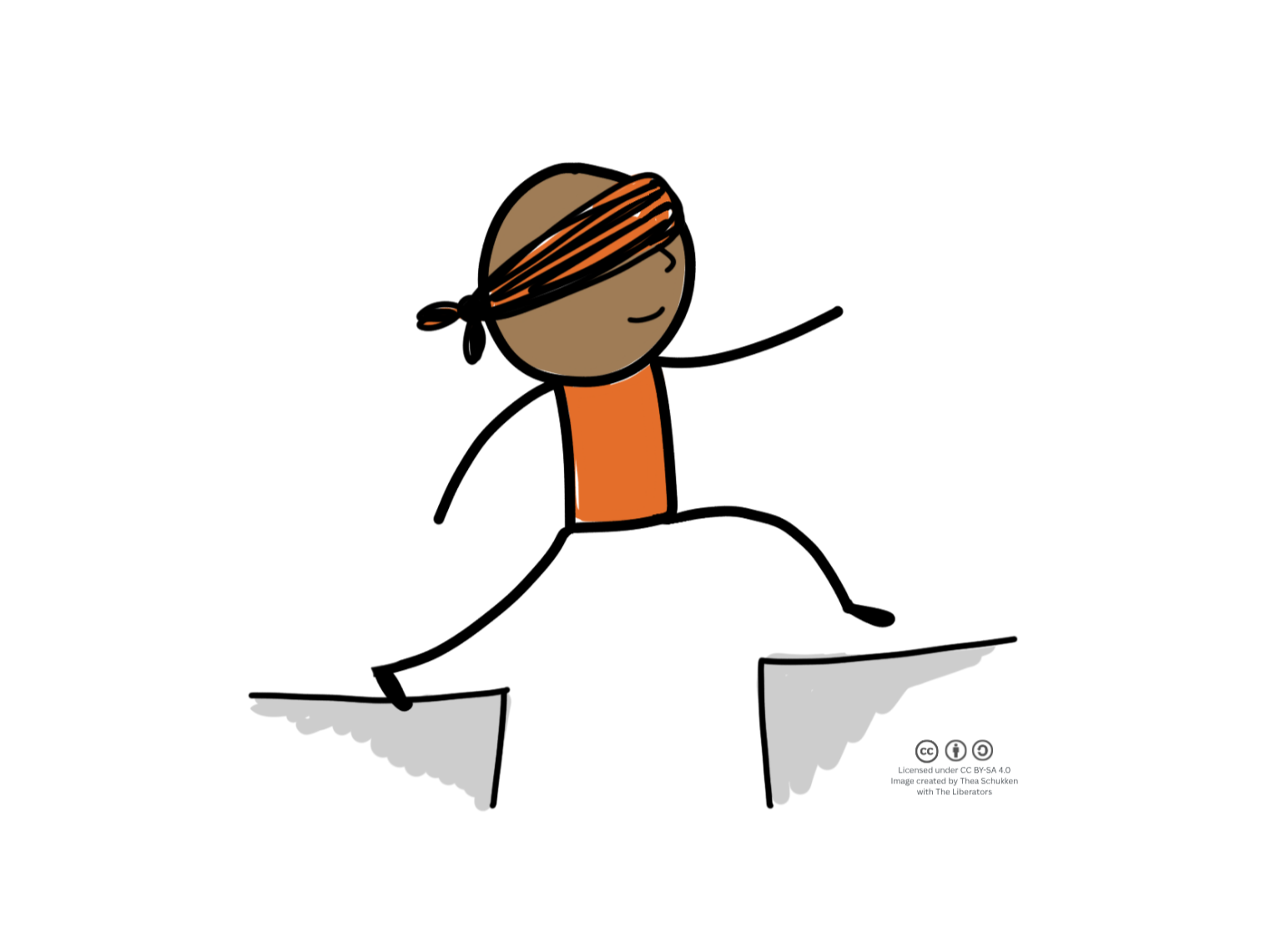
Principle: Emphasize Possibilities: Believe Before You See
Five Structural Elements—Min Specs
Structuring Invitation
“Rather than accepting the status quo, we can deliberately design how we work together to improve our work. We are going to explore and assess our current network relationship patterns and select a new pattern to explore.”
Space and Materials
Groups of four chairs [breakouts of four]. Copies of Network Relationship Patterns handout (below) and Risks and Benefits handout (see online resources) for each F2F participant [digital versions in a visual collaboration space].
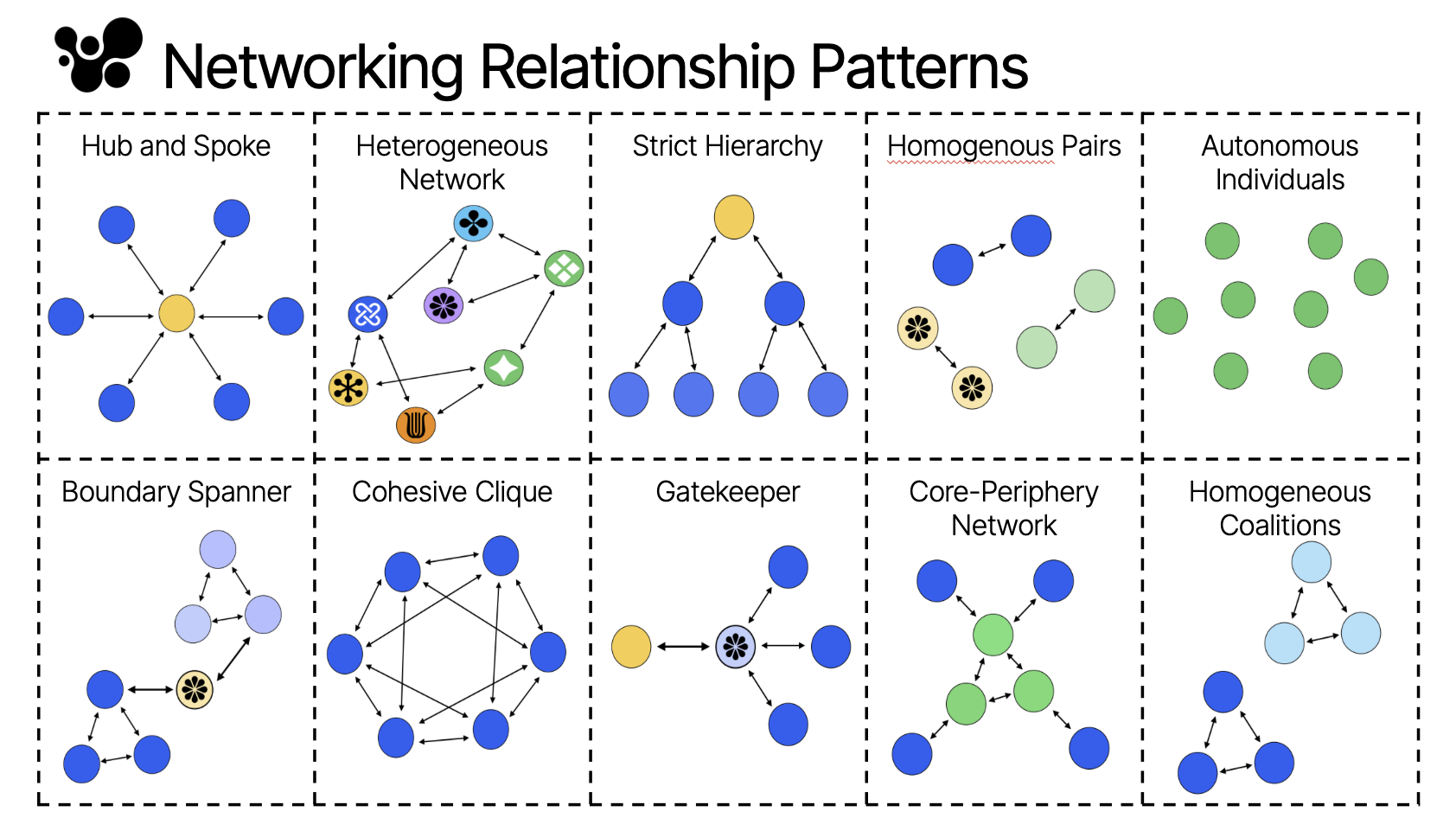
Handout with ten network relationship patterns
Participation Distribution
Roles include host [tech host] and participants. Minimum group size is four. Everyone is invited and has an equal opportunity to contribute.
Group Configuration
Alone, quartets, whole group.
Steps and Time Allocation
Intro: Share the structuring invitation and identify a shared purpose. Hand out materials. (1 min.)
Individual Reflection: Participants look over the ten patterns and reflect on which ones seem familiar. They can read the Risks and Benefits for extra insights. If none of the patterns seems right, they can add their own. (4 min.)
How We Say We Work: Ask “Which pattern would we use to show someone outside the group how we work together?” Participants circle their answer [jot it down and mark it in the collaboration space]. They use a different color or label for each step. Emphasize that different participants may give different answers depending on their role, experience, and perspective. (2 min.)
How We Actually Work: Ask “Now be honest—which pattern best reflects how we really work together, day to day?” Participants mark their answers. (2 min.)
How We Want to Work: Ask “Which pattern would help us be the most productive, have the best interactions, and work at our highest intelligence?” Participants mark their answers. (2 min.)
Reflect in Small Groups: Participants form quartets [breakouts] to discuss the patterns they chose, exploring similarities and differences. (8 min.)
All-Together Sharing: Everyone returns to plenary. A few groups share insights that everyone should hear. Everyone listens for opportunities to adopt a new pattern to help the group achieve its shared purpose. (3 min.)
Making a Change: The whole group discusses possibilities. Ask: “What’s one thing we can do today to start working in a different way? What else will it take for each of us to make a transition?” A few people share their ideas [aloud or in chat]. (3 min.)
Taking It Online
This structure works online with no major adjustments.
Practice Insights
Tips
Remind participants that no single pattern will fix everything and that each one has risks and benefits. Invite participants to combine patterns or invent their own and share them with the group. Avoid helping too much with defining the patterns for participants; instead, let them do the work.
Riffs and Variations
Print the patterns on cards for a more tactile experience—give one set to each participant. Add twenty-five minutes to the last three steps to dig deeper into where different perspectives come from, what some group members know that others don’t, and next steps. Spend more time exploring the risks and benefits of each pattern.
Practical Applications
Guide an organizational merger by selecting new patterns for operating together as a single new organization. Decide how to structure a new community of practice.
Optional String
String with Troika Consulting and 15% Solutions to shape next steps and the resolve to take action. String with Drawing Together to depict network relationship patterns as part of a story.
Attribution
Developed by Eva Schiffer (Net-Map) and Keith McCandless. Dig deeper into Eva Schiffer’s inspiring work and the Net-Map toolbox. For an expanded version of the patterns, artfully printed on cards, check out this website. A card deck helps participants see current patterns and design new ones.
Collateral Materials
Link to supporting materials for Network Relationship Patterns.
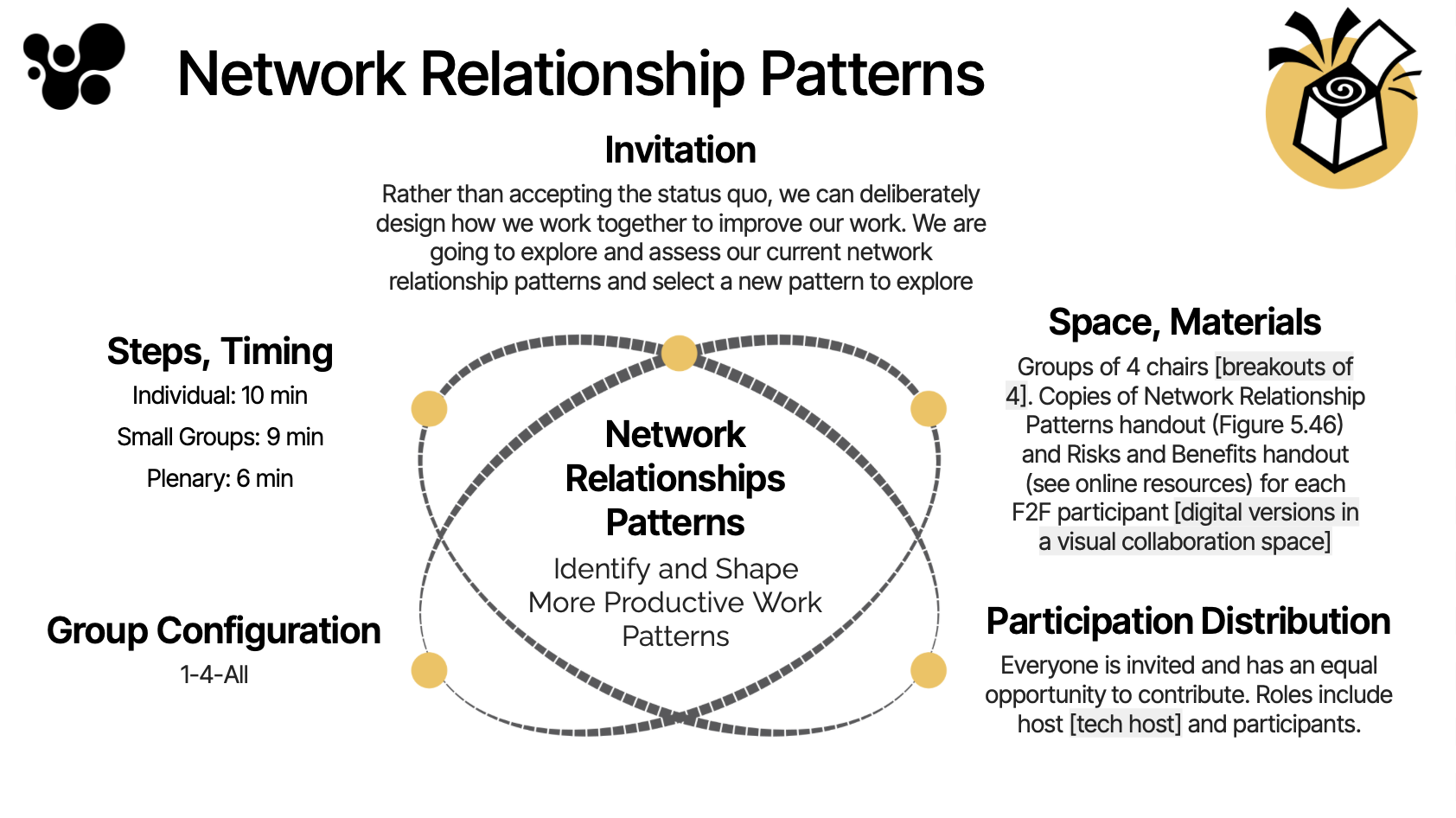
A one-slide overview of the elements of Network Relationship Patterns in the LS constellation format.