
Preamble & Framing
Dr. Daniel Pesut is an educator, scholar, former chair of the Plexus Institute, and nurse researcher who operates as an inveterate meta-synthesizer. For decades, Dan has stood at the crossroads of complexity science, adult cognitive development, and creative foresight— consistently challenging professions to stop defending narrow disciplinary silos and start developing adaptive, collective capacity. He has explored more theories, developmental frameworks, and coaching certifications than anyone I know.
We go way, way back to when the Plexus Institute (2000) was formed to translate complexity science insights into practical innovation for healthcare. We started with a few hints and a hunch that these insights could be applied across scales and domains, working for individuals, groups, and communities across diverse settings and cultures. It was a heady time full of learning and experimentation.
Recently, Dan turned his imagination toward a playful format: "Three Structures Walk Into a Bar." By anthropomorphizing individual Liberating Structures, placing them around a tavern, and giving them witty banter mediated by a seasoned bartender, Dan reveals how microstructures intermingle, ignite creative friction, and weave together into generative strings.
What looks like humor on the surface is actually serious developmental design: a way to grasp how Liberating Structures combine to transform patterns of human relating, spark group flow, and unlock collective action. The conversation revolves around: Who really knows things around here?; and, How does knowing move from one person to another?
Three Structures Walk Into a Bar
By Dan Pesut
The Scene: A Quiet Tuesday at The Microstructure
The bar sits two blocks from a teaching hospital. Its regulars are night-shift nurses, residents who should be sleeping, and the occasional consultant hiding from a steering committee. The bartender is a retired charge nurse named Rosalind. She has run more huddles than most executives have run meetings, and she still believes the best question in any room is the one nobody has been invited to ask.
The door opens three times in quick succession.
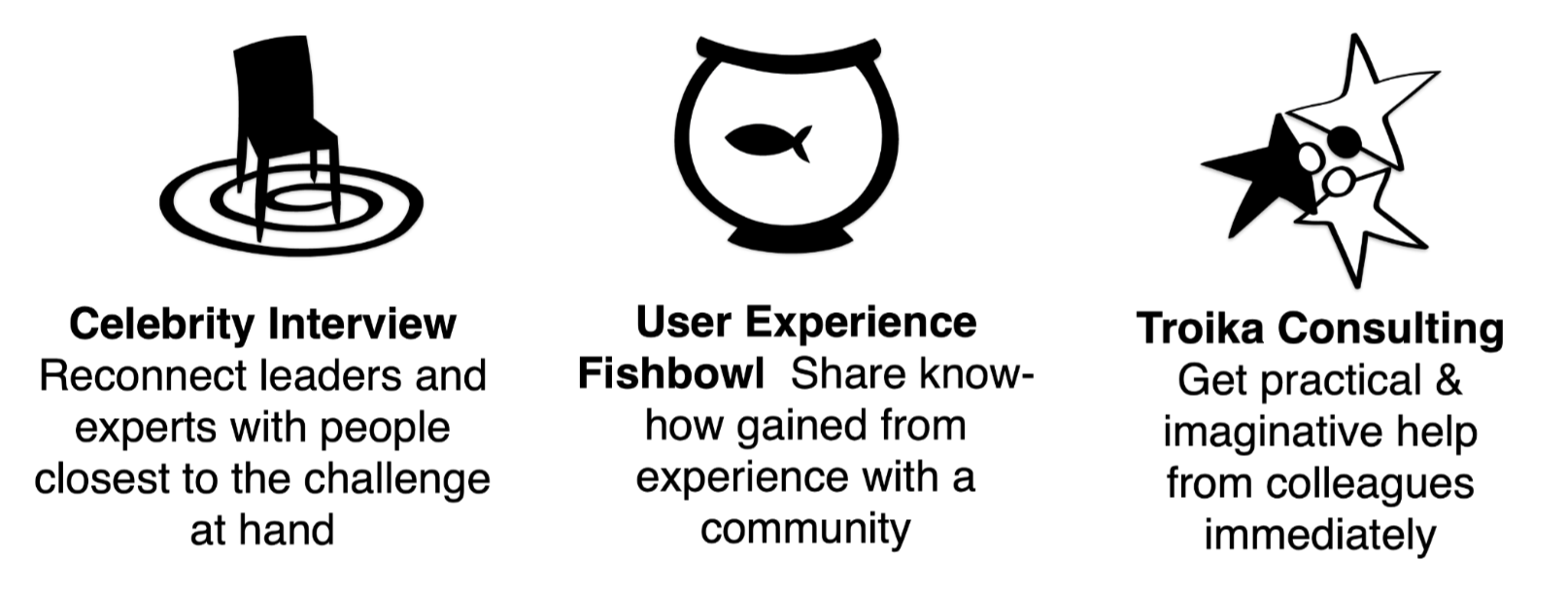
The first to enter is Celebrity Interview. She arrives as if a spotlight follows her, though she is quick to say the light is not for her. She carries a stack of index cards and a microphone she has no intention of keeping.
The second is User Experience Fishbowl. He drags a ring of chairs into the middle of the room, sits three friends inside it, and asks everyone else to listen without interrupting.
The third is Troika Consulting, who arrives as three people sharing one stool. They argue briefly about who sits facing the bar. One of them cheerfully turns around to face the wall.
Rosalind wipes the counter. "Let me guess. You three are here to tell me who really knows things around here."
"Close," says Celebrity Interview. "We are here to argue about how knowing moves from one person to another."
"Then the first round is on the house," Rosalind says. "Knowledge that stays in one head has never saved a patient."
Round One: Introductions
Celebrity Interview goes first, because of course she does.
"People misunderstand me," she says. "They think I exist to make the leader look good. I exist to make the leader look human. A host sits with the chief nurse or the new CEO in front of the whole room. Instead of forty slides, we ask for stories. What gives you strength right now? What must we let go of? What is your part in the letting go? Then the audience gathers in pairs and fours and writes the questions they would never dare ask alone. The host reads them out.Nobody has to raise a trembling hand."
"Thirty to fifty-five minutes," she adds. "Twelve people minimum. I build trust as I go."
Rosalind nods. "So, you turn a podium into a porch."
"Exactly. Expertise stops performing and starts confessing."
User Experience Fishbowl speaks next. He is used to listening, so he keeps it brief.
"I put three to seven people in the middle," he says. "People who have actually made progress on the shared challenge.Not the people who wrote the policy. The people who lived it. They talk to each other, not to the crowd. Two rules: no speeches, and the good, the bad, and the ugly are all welcome."
"The outer circle watches and takes notes. Then they huddle in threes and fours and come back with questions. At the end we ask one thing: what seems possible now?"
"I practice deep respect for people and local solutions," he says. "The wisdom is usually already in the building. It just sits on the wrong floor."
Troika Consulting goes last, all three voices taking turns.
"We are the smallest consulting firm in the world," says the first. "Three chairs, no table."
"One of us is the client," says the second. "She names her challenge and what help she needs. We ask clarifying questions. No judging, no fixing."
"Then she turns her back," says the third, the one facing the wall. "And listens while we talk about her challenge as if she were not there. It sounds rude. It is the most generous thing we do. She hears her problem without having to defend it."
"Then she turns around and tells us what was useful. Then we rotate. Three rounds, roughly half an hour, and everyone is both helper and helped."
Rosalind smiles. "Nurses do that at the station every shift. We just never gave it a name."
Round Two: The Friction
The second round brings out the honesty that only a second round can.
Fishbowl turns to Celebrity Interview. "With respect, you still put one person on the stage. In a hospital, that is usually the person furthest from the bedside. Why should the room learn from the executive instead of the night nurse who fixed the handoff problem?"
Celebrity Interview does not flinch. "Because the room needs to know where the leader stands. Rumor fills every silence a leader leaves. When a new CNO arrives, or a merger is announced, people do not need more data. They need to hear a voice, see a face, and ask the hard question without risking their job. I make power answerable."
"Answerable," says Troika, "but still central. You and the Fishbowl both have an audience. We have no audience at all. Nobody watches. Nobody performs. That is where people admit what they actually do not know."
"And that," says Fishbowl, "is your blind spot. Three people can share a lot of ignorance. Your consultants are peers, not people who have solved the problem. Sometimes you need someone in the middle who has already been to the other side."
Troika's third member, still facing the wall, laughs. "Fair. We give you fresh eyes. You give us field experience. She gives us the view from the top. None of us is the whole picture."
Rosalind sets down three glasses and names the tension plainly:
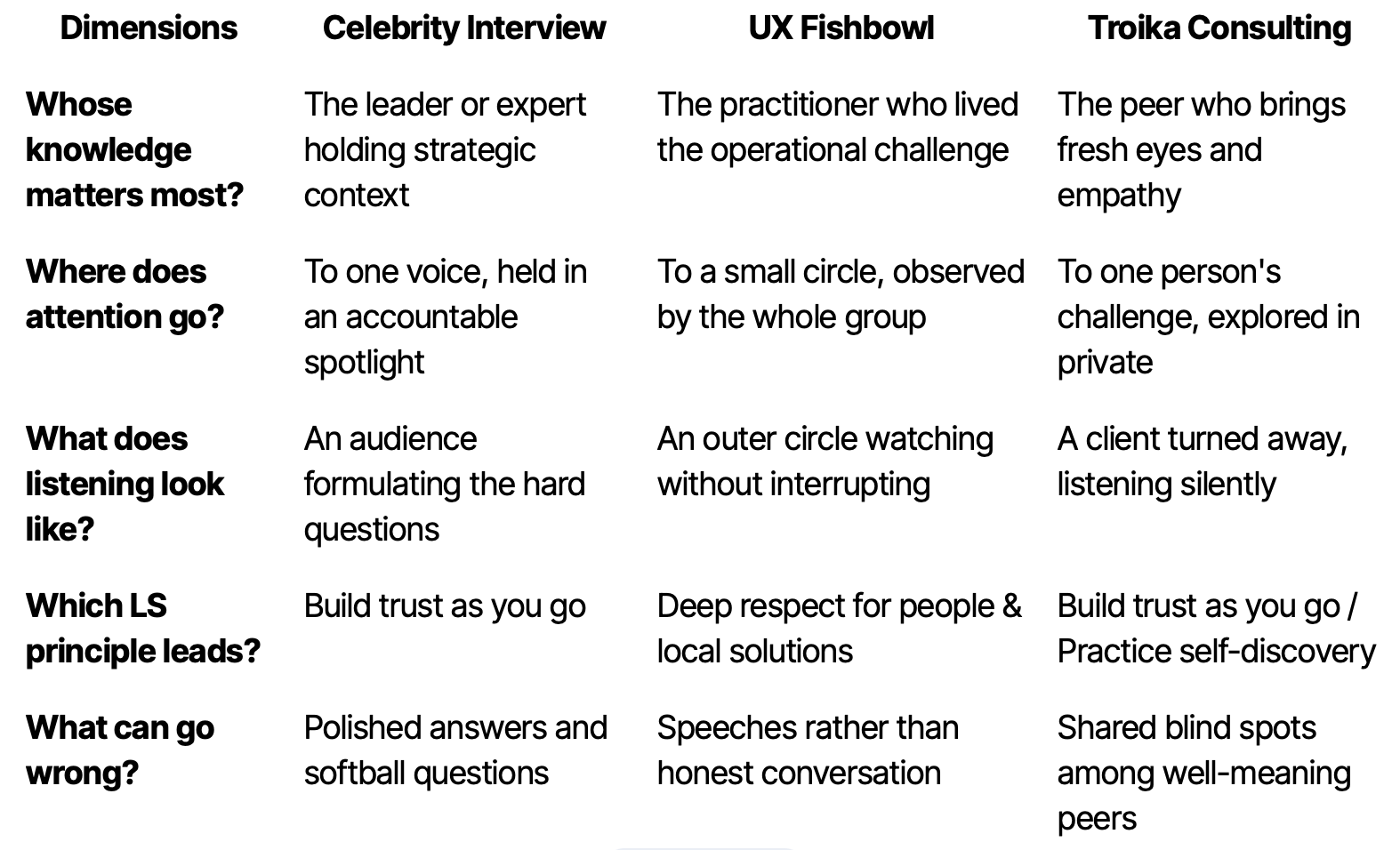
"Each of you," Rosalind says,"is a different answer to the same wicked question: How does a system learn from the people inside it when those people sit at different distances from the work?"
Round Three: The Convergence
By the third round, the argument has softened into design.
"What if we stopped competing," says Celebrity Interview, "and started stringing?"
The three sketch a sequence on a cocktail napkin for a hospital launching a new team-based care model:
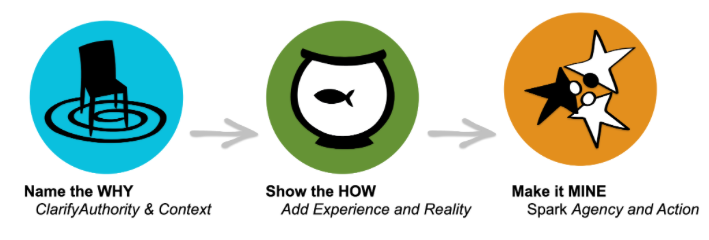
Celebrity Interview: Name the Why (~45 min)
The chief nursing officer is interviewed in front of the nursing councils. The host asks what she hopes is possible,what must be invented, and what she is willing to let go of. Tables generate the questions people fear to ask. She answers openly in the room.User Experience Fishbowl: Show the How (~60 min)
Four people from the pilot unit sit in the inner circle: a staff nurse, a nursing assistant, an educator, and a night charge nurse. They talk about what worked, what failed, and what surprised them. The outer circle observes, then huddles to ask: What seems possible now?Troika Consulting: Make It Mine (~35 min)
Every manager and charge nurse forms a trio. Each brings one specific operational obstacle from their own unit and receives two colleagues' candid thinking while their back is turned.
"Look at the arc," says Fishbowl. "Authority, then experience, then agency."
"Or," says Troika, "the head, the hands, and the heart. Why it matters, how it works, and what I will do on Monday."
Celebrity Interview raises her glass. "Hindsight from the fish. Foresight from the leader. Insight from the peers."
"Renewal requires both hindsight and foresight. You three just built a bridge between them," says Rosalind.
Each structure quietly corrects the others' trap:
Fishbowl grounds Celebrity Interview’s polished answers in field reality.
Troika turns Fishbowl’s collective inspiration into concrete personal commitment.
Celebrity Interview gives Troika’s local fixes the strategic context they would otherwise lack.
Alone, each structure is a good meeting. Together, they are a learning system.
Last Call: The Bartender's Reflection
The three structures leave together: index cards, a ring of chairs, and one stool shared three ways. Rosalind stays behind to close out the till.
She reflects on how each structure redistributes three things hierarchy routinely hoards: voice, attention, and permission.
Celebrity Interview gives the many permission to question the few.
Fishbowl gives frontline practitioners the focused attention usually reserved for executives.
Troika gives every individual an active voice in solving their own challenge—and the rare gift of being heard without having to defend.
For leaders and facilitators, the lessons are immediate:
Match the structure to the distance between knowledge and need. When people need context from leaders, interview the leader. When they need know-how from people who have lived it, run a fishbowl. When individuals need help with their own next steps, form troikas.
Design for the hard question. All three structures protect the person admitting or asking something difficult. Psychological safety is not an executive speech; it is a seating arrangement.
Keep practitioners close to the center. In healthcare, the people closest to the patient hold the insights the system needs most.
Strings build learning systems. One structure makes a better meeting; an intentional string builds an enduring change process that people own.
Build resilience through mutual aid. Burnout grows in isolation. Practiced routinely, peer consulting turns support into a daily reflex rather than an emergency intervention.
Nobody gets through a hard shift alone. These three structures are simply that truth with better furniture.
Liftoff: Questions to Ponder
The Barroom Test: If the last three structures or methods you used in a meeting walked into a bar together, what would they argue about? Where would they complement each other, and where would they clash?
Barroom Imagination for Stringing: What three Liberating Structures would you love to hear talking, disagreeing, and finding a way to work together? How might staging that conversation in your mind sharpen your next design?
Bonus Material: Behind the Bar with Dan Pesut
Dan’s witty bar essays are just the tip of the iceberg. Beneath the humor lies decades of deep thinking about cognitive development, complexity, healthcare, and how humans learn together. I chatted with Dan to dig into the philosophical roots and frameworks driving these stories. Here is an excerpt from our conversation:
Keith: You often talk about the interplay between hindsight, foresight, and insight. Why is lineage so essential to making sense of what we are creating right now?
Dan: There is a startling disregard for looking back at the origin of things. In academic conferences today, you see arbitrary rules like "references cannot be more than five years old." That decontextualizes knowledge. Foresight requires hindsight.
To gain real insight, you need all three operating together:
Hindsight: Honoring the lineage, the groundwork, and the pioneers who forged the language we use today.
Foresight: Visiting plausible futures to see beyond our immediate operating assumptions.
Insight: Discerning what needs to change in the present moment to move forward.
When people ignore genealogy, they get trapped in a "protect and defend" stance—guarding narrow professional boundaries instead of learning, growing, and serving a larger purpose.
Keith: You bridge adult development, systems thinking, and complexity as a kind of meta-integrator. How does that perspective shape your view of Liberating Structures? In the new LS Fieldbook, we call it “building the capacity to address higher-order goals.”
Dan: Complexity in human systems isn't just an abstract theory; it's about adult cognitive development and action logic. Decades ago at Harvard, Robert Kegan showed us how easily groups default to "BMW discourse"—Bitch, Moan, and Whine. He taught us that leadership is about transforming complaint into appreciation, inquiry, and commitment.
Liberating Structures are developmental engines. They don't just provide horizontal tools or certifications; they support vertical growth—expanding a group's capacity to hold ambiguity, distribute agency, and act collectively in the midst of messiness.
Keith: You used Claude to help write these bar essays, prompting the AI with your personal philosophy, values, and frameworks. How does that creative partnership work for you?
Dan: AI is an imaginative sparring partner. I trained Claude on my voice, my background as a nurse educator, and frameworks like William Smith's AIC (Appreciation, Influence, Control). It acts as a foil that helps me meta-integrate ideas I might not otherwise juxtapose.
It requires constant vigilance—checking suggestions against judgment and iterating prompts. But when used creatively, it can externalize the patterns of thought that seasoned facilitators carry intuitively, turning them into stories anyone can explore.
