
Weaving Practice & Theory
Sure Liberating Structures work in practice, what about theory? Explore how Liberating Structures flip the script on meetings and planning while learning about the tenets that underpin the work.
Exploring and Leveling Up
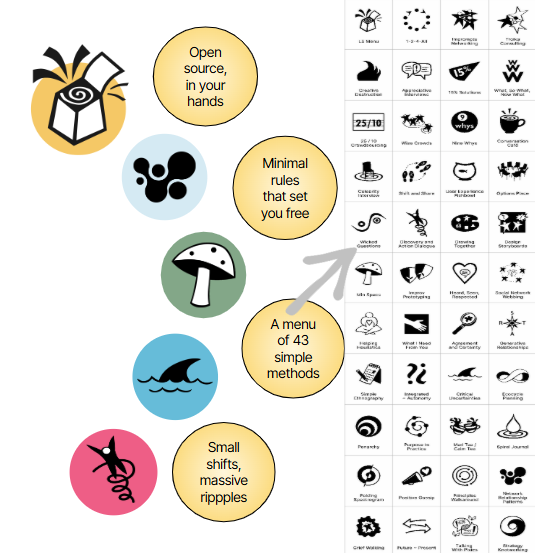
The "Weaving Theory into Practice" path bridges the gap between "the practical matters of running a meeting" and "understanding the tenets that underpin the whole body of work."
This section is designed for people who like to explore concepts and theory. We invite you to dive into twelve segments sequentially, weaving and leveling up as you go.
Twelve Explorations (HYPERLINKED TO SECTIONS below. )
The Deliberate Paradox: Structure Sets Us Free
Working with Complexity, Not Trying To Flatten It
The Microstructural DNA of LS
The Limitations of the "Big Five" Patterns
Purpose, Principles & Fidelity of LS
A Reliable Group Flow State: Creative Adaptability
From Expert to Guide on the Side
"Confusiasm" That Sparks Imagination
Seeing the Forest & The Trees
Designing and Evaluating Strings of LS
Matchmaking and Repertoire Building
The Transdisciplinary Roots & Future Horizon
The Deliberate Paradox: Structure Sets Us Free
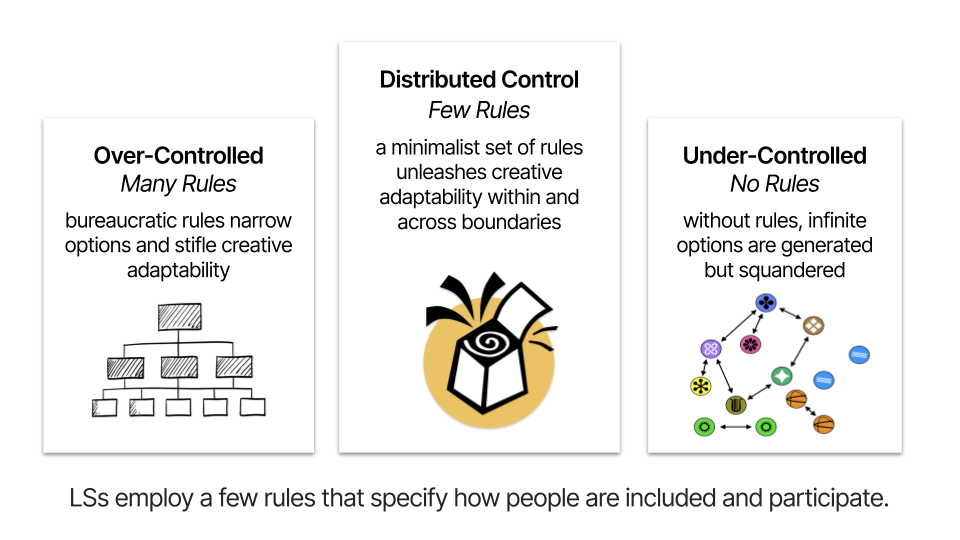
The heart of Liberating Structures (LS) lies in its deliberate paradox: the imposition of simple, minimalist rules that, instead of restricting, sets groups free from stifling constraints.
By meticulously structuring who speaks, how time is distributed, and what questions are addressed, LS decentralizes control and unleashes a vast reserve of latent imagination, resolve, and action.
Key point: freedom isn’t the absence of structure; it is the presence of minimalist constraints designed to include and unleash everyone.
I started putting the text into the accordion, but no images. So I moved the accordion below and put in text and images. Could hyperlink at the top with a TOC.
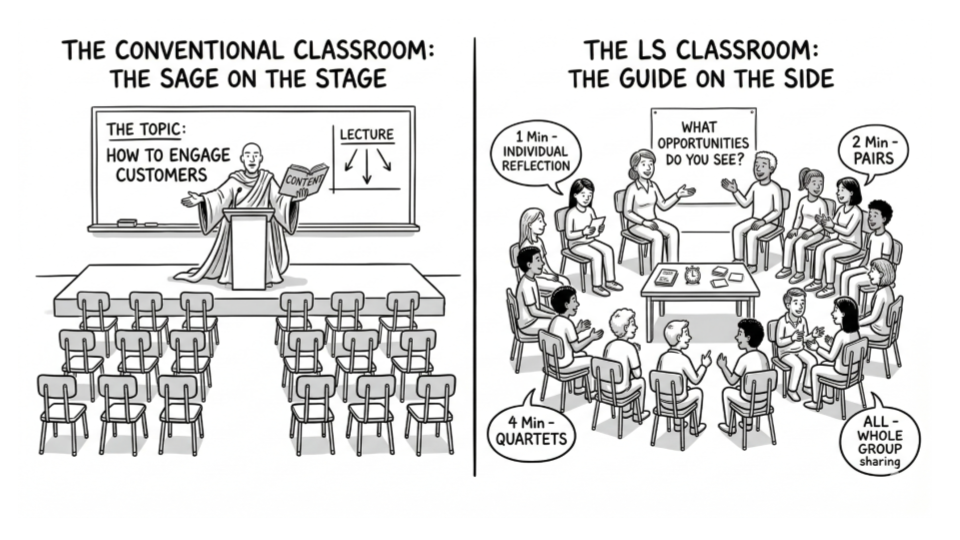
To grasp the essence of Liberating Structures, contrast these two very different classroom patterns tackling the same topic: How to Engage Customers.
The Conventional Sage on the Stage
Students sit in fixed rows, facing a teacher who delivers a rapid-fire PowerPoint. As the "expert," the teacher controls the flow, pausing occasionally for a few questions while racing to "cover the content."
Information moves in one direction—from the front of the room to the back. All learning unfolds one voice at a time in a serial fashion.
The LS Guide on the Side
The instructor sits within a circle of students. Instead of a lecture, the session begins with a 1-2-4-All invitation:
1 Minute: Silent individual reflection on personal customer experiences. 2 Minutes: Sharing and building insights in pairs. 4 Minutes: Refining patterns in quartets. All: The whole group identifies similarities and differences.
The instructor then weaves insights from all voices into the broader theory, deepening the discoveries that unfolded in a parallel fashion.
-
The heart of Liberating Structures (LS) lies in its deliberate paradox: the imposition of simple, minimalist rules that, instead of restricting, sets groups free from stifling constraints.
By meticulously structuring who speaks, how time is distributed, and what questions are addressed, LS decentralizes control and unleashes a vast reserve of latent imagination, resolve, and action.
Key point: freedom isn’t the absence of structure; it is the presence of minimalist constraints designed to include and unleash everyone.
-
Description text goes here
-
Description text goes here