
Spidergram Mirror
Perhaps what you measure is what you get. More likely, what you measure is all you’ll get. H. Thomas Johnson
The purpose of this post is to invite further development and testing of a developmental evaluation tool we’ve called Spidergram Mirror. We think of it both as an evaluation tool and a LS in development unto itself.
Currently, the Spidergram Mirror is dynamically incomplete - we are iterating our way forward taking an action research approach. Join us in helping field test it: you can point out the "holes" and fill them with your local testing.
We have written it up in a familiar Liberating Structures format and recommend that you try a “field test” with the specifications below. Then, go wild with adaptations and share back with the LS community. See the Liftoff questions to ponder at the end of the post.
Spidergram Mirror (40 min)
Take a snapshot of group engagement and dynamics influencing growth
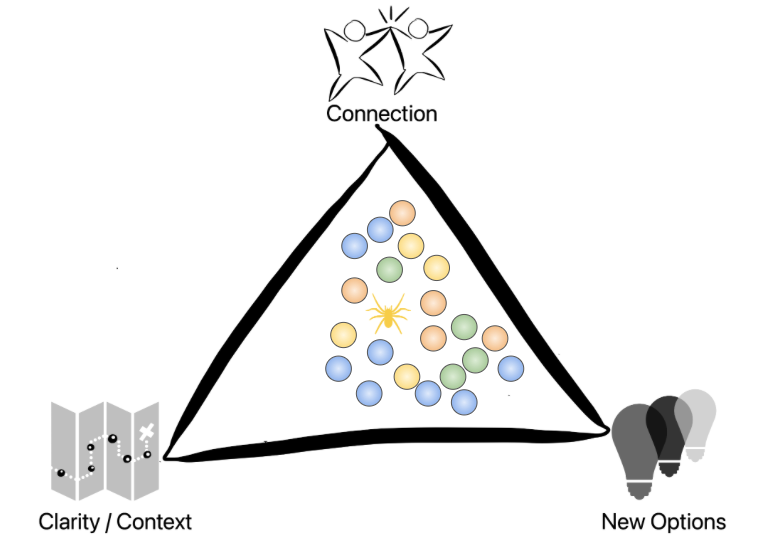
To create a sharp picture of group dynamics and opportunities for building “creative adaptability,” ask participants to rate their experience regarding deepening connection, generating new options, and clarifying context for taking next steps.
It takes just a few minutes. Everyone can see similarities and differences in their collective experience and consider how they can shape goals for making their next meetings even better.
PURPOSES
Spidergram captures a picture of engagement, group dynamics, and potential for growth. Each group member reflects on a recent meeting or activity with three developmental attributes in mind: deepening connection among participants, increasing clarity about the context or operating environment, and generating new options for next steps.
Each attribute is made up of more specific traits easily rated as more or less present than expected. Connection traits include: rapport with colleagues deepening (trust); and, personal insights or talents discovered through group exchanges (identity). Context-Clarity traits include: a story about the work together or transition is unfolding (narrative); obstacles and opportunities being mapped (challenge); and, purpose and priorities coming into focus (resolve). New options traits include: freedom to explore and shape next steps toward goals (authorship); steps or paths into uncharted territory being revealed (discovery); and imaginative or surprising possibilities being generated (creativity). Everyone can see similarities and differences in their collective experience and consider how they can better support each other. Then, members are invited to shape goals and next steps for making things even better in future meetings and activities.
Gain a clearer understanding of group dynamics, strengths, and weaknesses
Create a baseline assessment so members can identify areas for adjustment
Learn more about each other and how to support each other in the future
Focus attention on developmental goals as a group shapes next steps
Understand more about factors that generate engagement or withdrawal
FIVE STRUCTURAL ELEMENTS—MIN SPECS
1. Structuring Invitation
Let us look back at our time working together using three main traits and their smaller parts, then rate each attribute was more or less than we thought it would be. The Spidergram is like a magical mirror that helps you see how you're really doing and how you might change your shape in the future. It's a fun and easy way to check in with everyone, understand your shared experiences, and uncover ways to make things better.
Based on your own ratings and what you see from other members, what goals and first steps make sense?
2. How Space Is Arranged and Materials Needed
Unlimited number of groups. Chairs for people to sit in small groups of 3-4; small tables are optional [Breakout groups of 3-4.]
Spidergram and triangle figures as a handout and on a large wall chart or flip chart [slide, doc or whiteboard]. Two colors of 2 by 2 “ sticky notes (16 for each participant. [Slide, doc or whiteboard to collect answers from the full group.]
3. How Participation Is Distributed
Everyone is included
Everyone has an equal opportunity to contribute at each table or in breakout rooms
4. How Groups Are Configured
Individuals
Groups of 3-4 (If the group is 5 people or smaller, stay as a whole group.)
Groups can be established teams or mixed groups
Whole group
5. Sequence of Steps and Time Allocation
Share the structuring invitation. The Spidergram isn't just another assessment – it's a catalyst for collaborative growth. Celebrate achievements, tell stories, learn from challenges, and weave an even stronger, more connected group.
Getting Started: Let’s dive into our group dynamics by revisiting past meetings and envisioning new options. I will guide you through, thinking back to one or more recent meetings or interactions. We will break into smaller teams for some deeper discussions. 1 min
Part 1: Test Drive Themes. Consider this particular meeting, project or initiative. Place a single dot on the triangle that represents the balance of three attributes–connection, new options, context clarity (2 mins). Turn to your neighbor and chat about your placement. 3 mins
A dot in the center = perfect balance of all three themes.
A dot at the top = the meeting resulted in strong bond among group members,
A dot between points of the triangle = two of the three attributes were present and the third was neglected.
Take note of the similarities and differences among your colleagues’ placements and how they defined the attributes.
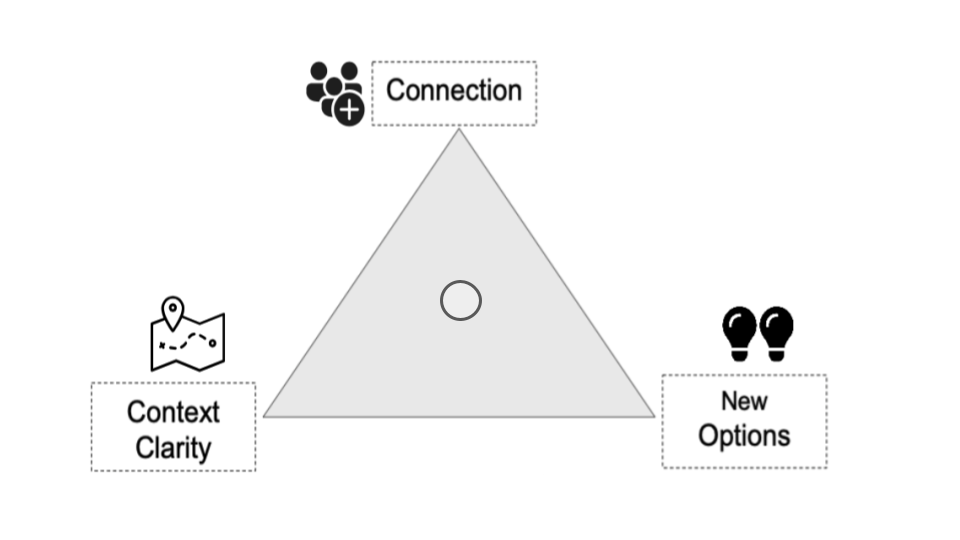
Within a blank triangle with the three attributes at each point, invite each participant to place a dot that represents the relative balance of their experience.
Connection: Are you deepening relationships with group members?
Context Clarity: Are you gaining a clearer picture of our context?
New Options: Are you exploring new possibilities for next steps and the future?
Continue to Part 2 if you have another 35-45 minutes and are ready to go deeper.
Part 2: Look Into the Spidergram Mirror: It looks a bit like a spider web (hence the name), with three main attributes branching out into smaller traits. [Verbalize and then place questions and notes in Chat so they can be referenced in breakout rooms.] 2 min
Connection: Are you deepening relationships with group members?
Clarity: Are you gaining a clearer picture of our context and why it matters?
New Options: Are you exploring new possibilities for next steps the future?
As We Walk Through, Rate Your Experience: Each attribute has a few specific points or traits to think about. Look at your spidergram. For each leg, ask yourself what was my experience: more than expected (circle 5,) less than expected (circle 1,) or about as expected (circle 3?) Then, mark your rating on each leg of the Spidergram web!
Round 1: Host reads the short description on each leg and invites participants to reflect and then rate their experience by circling a number on their personal copy of the Spidergram. 1-2 min per leg, 10 min total
Round 2: Host invites each participant to pull back and take a look at the bigger picture of their ratings as a whole. Now, looking forward over the next few months, what goals do you have for making adjustments to any of the eight traits? Mark spots on your Spidergram that represents a personal goal for focusing more or less attention on any of the elements? See the figure below for sample sketches. [5]
What?: Now form small groups of 3-4 [breakouts], take turns talking about what you noticed. Review your ratings. Did any themes or legs stand out? Are your ratings similar or different? Share your thoughts and experiences! 5 mins
So What? Return to plenary. Now, let's dig deeper. What do your ratings tell you about our cohort, team or group? What was similar and different about the goals you set to improve our connection, context clarity, and new options? Why are these goals important to you? Return to your same small groups and discuss [breakouts] ] 5 mins
Now What: Return to plenary. Host invites each participant to place ratings on a large chart or white board. Finally, let’s share the highlights from your small group discussions. We will collect insights, goals, and next steps on a chart [whiteboard], so everyone can see the big picture. 5 mins
OPTIONAL STRING
Before using the Spidergram, pair with Appreciative Interview, Spiral Journal, 1-2-4-All, or an LS that draws out more detail associated with each participant’s experience within the group. LS that draw out stories like Future~Present and Critical Uncertainties can add imagination and resolve to making progress together as a group.
TAKING IT ONLINE
There are no specific online implications for the Spidergram Mirror. We do note it can be easier to capture the assessments in an online environment with digital tools.
TIPS AND TRAPS
When sharing in the whole group, collect one important contribution at a time from different small groups. Avoid long repetitive lists from a single group. Seek out unique answers that are full of meaning for the group’s participants.
Particularly useful when the participants have role in shaping how the group interacts in the future (e.g., a slice of the participants are in a design group).
Not all activities need more of every attribute or an equal emphasis. The purpose of your interaction will often point to a unique balance among the attributes.
Reframe away from “fact” and focus on observation. Observations can cover the environment, who did what, what happened, how people reacted or the emotion you felt, etc.
Make it the norm to return to the Spidergram Mirror on a predictable periodic basis so that members can evaluate their progress
If the assembly of people do not see themselves as a group or team, the gaps between current rating and goals may not make much sense
RIFFS AND VARIATIONS
Prior to rating, add a step where small groups start to define each Spidergram attribute within their unique local context (e.g., for graduate students, “authorship” may mean getting published). 1-2 minutes for each legs may be enough.
Create an artifact at the end of one meeting to use at the beginning of the next. This may help the group “lift off from where you left off.”
Use Conversation Cafe or Troika Consulting for generating next steps with more depth (LINK)
Use when moving into designing future meetings or activities
PRACTICAL APPLICATIONS
For any group, meeting or class that has developmental goals
To address disengagement or withdrawal linked to group dynamics
Use at frequent intervals in a multi-day design sprint
In tandem with the LS Selection Matchmaker with a group selecting LS for a project or special event
ATTRIBUTION
Liberating Structure developed by Nancy White and Keith McCandless
COLLATERAL MATERIALS
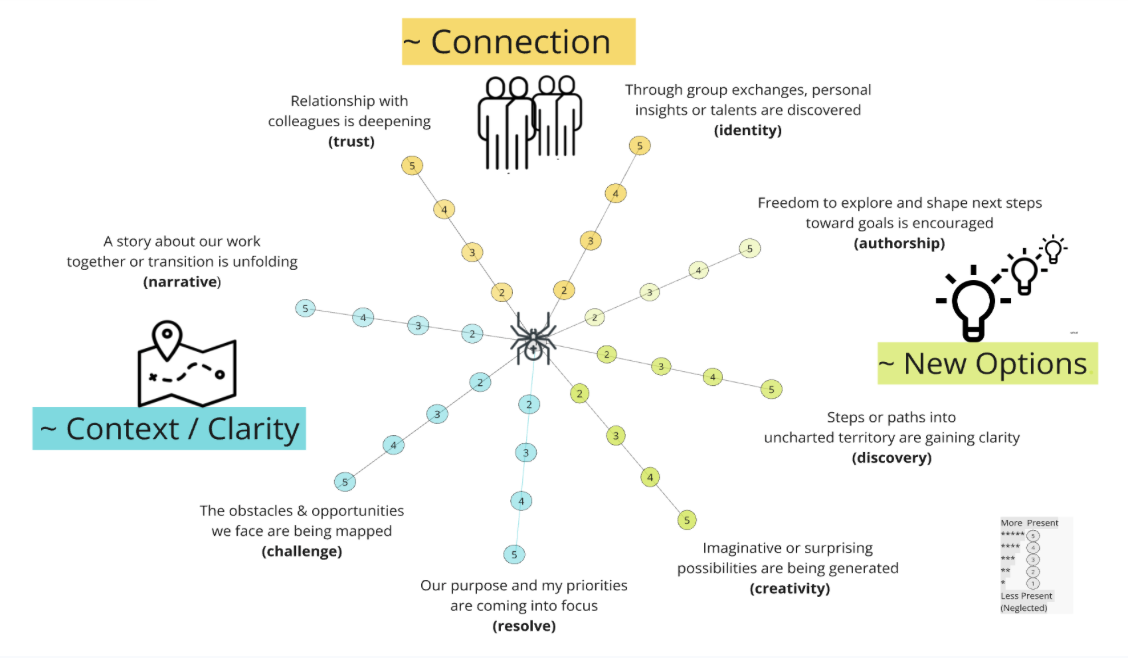
Template specifying each of the eight attributes and a rating scale: 5 = more present to 1 = less present.
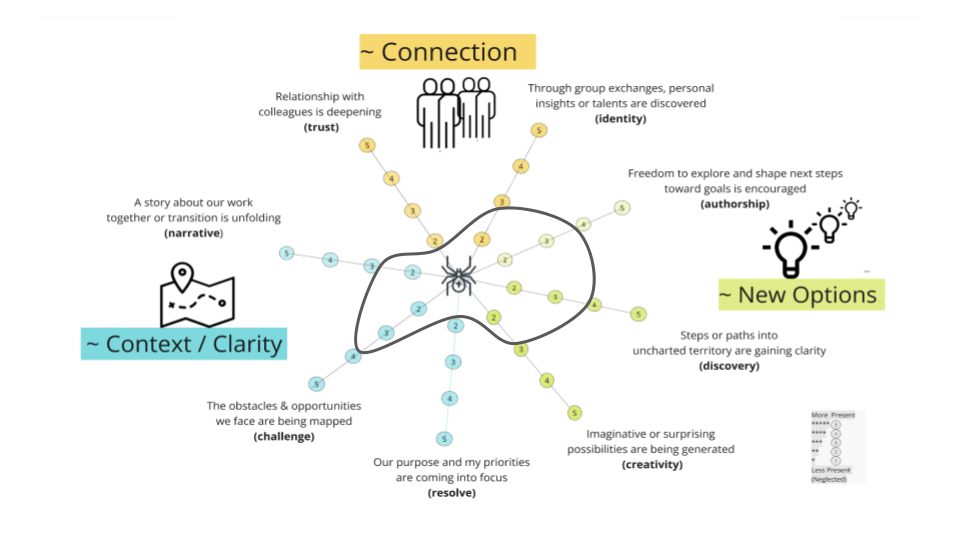
Spidergram Mirror template with a curved line that represents one participant’s rating for each of the eight legs.
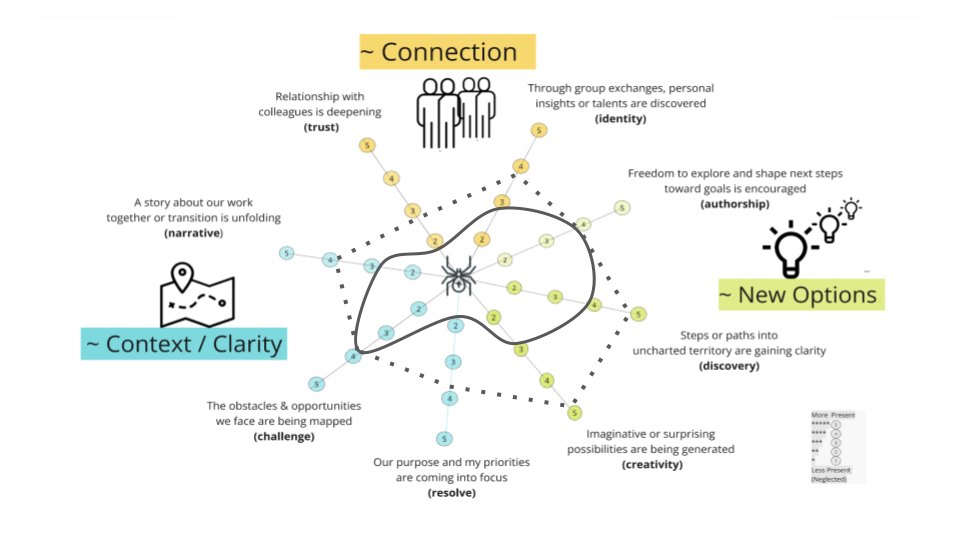
One participant’s baseline ratings plus goals for the next few months.
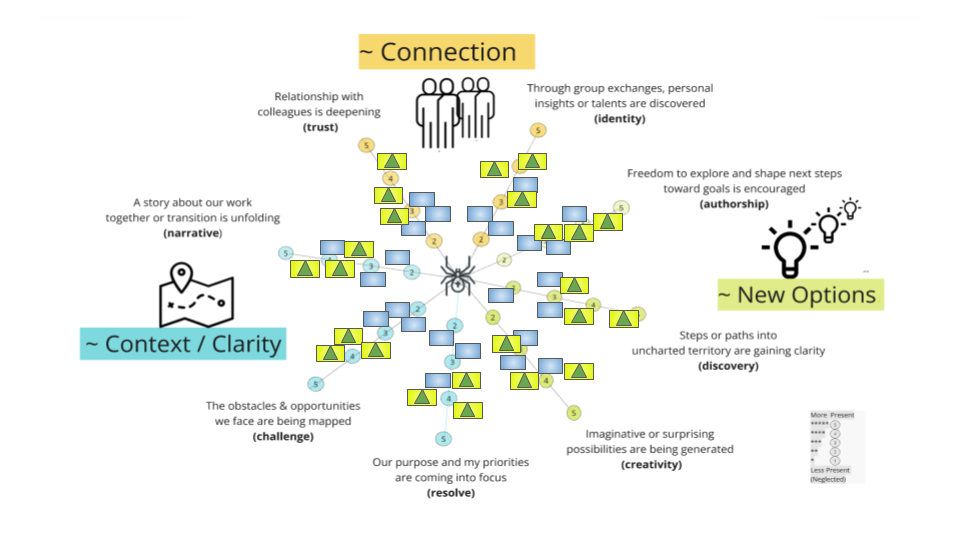
For each of the eight legs, combined participants’ ratings and goals displayed on a large chart. Rectangle = baseline rating. Rectangle with triangle = goals for the next few months.
Liftoff
After a prototyping effort, here are questions to ponder:
1. The Context & Setup
Where did you use the mirror? What type of group did you invite to look into the Spidergram Mirror (e.g., project team, graduate cohort, cross-organizational network)?
What was the core challenge?
2. Experience with the "As-Written" Min Specs
How did the sequence flow? How well did the 50-minute timing and the What, So What, Now What dynamic work for your group? Did any specific step (e.g., the 3-attribute triangle warmup vs. the 8-trait Spidergram) yield unexpected insights?
Visual sensemaking: For Part 1, did the triangle ratings make sense without much explanation? For Part 2, how did capturing baseline ratings alongside future goals (the rectangles and triangles) land with participants? Did seeing the full-group chart trigger meaningful course correction?
3. Adaptations & Riffs
Local context definitions: Did you add time to let the group define attributes like authorship or narrative in their own words? How did that alter the ratings?
Digital vs. In-Person: If you hosted this online, what digital whiteboard setup or tools did you use, and how did that affect participation?
Strings & Combinations: Did you pair the Spidergram with another Liberating Structure (e.g., Appreciative Interviews, Troika Consulting, or 1-2-4-All) before or after the mirror exercise?
4. Community Insights & Feedback for Prototyping
What surfaced? What surprised you or the participants about the gaps between where the group is and where they want to be? Did they discover anything to STOP doing?
Tips, Traps, & Refinements: What worked seamlessly, and what felt clunky? If you were to run this prototype again tomorrow, what single tweak would you make?
