
Switching Out the Failing Routine
There are paradoxical-yet-complementary tensions inherent in our work. The goal of this post and Wicked Questions is to move beyond "either-or" thinking and spark deeper, wider explorations of new options.
When I’m invited into a planning session for an upcoming meeting, I find myself listening for the "Big Five" conventional patterns. They fail us by over-controlling and under-engaging. They are so ubiquitous that they feel like the only options on the menu.
A Wicked Question comes to mind:
How is it that we possess the fierce imagination to shape a new world WHILE we hesitate to rearrange the chairs, the invitations, and the predictable order of the next sixty minutes?
Part of the wickedness, comes from the difficulty of seeing the patterns underneath “the mundane way we do things everyday.” Here are the Big Five routine patterns.

The Big Five patterns: presentations, managed discussion, status reports, brainstorming, and open discussion.
[Images created by Thea Schukken in partnership with The Liberators]
But when I hear them being scheduled, I can’t help but see the Liberating Structures (LS) replacement patterns that are just waiting to be unleashed.
If the organizer is new to LS, I usually start with a simple, curious question: “How is that working for you?” If I get a shrug, an eye roll, or a weary sigh, I know the door is open. I’ll follow up with: “Would it be possible to try something new? Something that hits the same goal but unlocks the imagination and momentum currently sitting dormant in the room?”
A Subtle, Powerful Shift
The shift isn't just about using a "better tool"; it’s about acknowledging the unintended consequences of our habits and choosing a different path. Here is what I think and often say about switching out the pattern:
1. When you hear "Presentation"
We’ve all seen it: the information monopoly. One “sage on the stage” flattens the diverse voices in the group and effectively kills any sense of authorship or shared ownership.
The Switch: Instead of a broadcast, try a Celebrity Interview, a rapid-fire Shift & Share, or even a Mad Tea / Calm Tea to get the content cooking.
The Shift: You move from broadcast to full throated engagement.
2. When you hear "Managed or Facilitated Discussion"
This often feels like predetermined collusion. The organizer and facilitator work in cahoots. The outcomes are already pre-baked, and everyone knows it, leading to a deep cynicism.
The Switch: Break the mold with Purpose-to-Practice (P2P), Min Specs, or a simple 1-2-4-All.
The Shift: You move from over-control to shared authorship.
3. When you hear "Status Update"
Too often, these are go-around-the-table exercises in performative rosiness. Real-time evidence about risks and failures is sanitized before it ever reaches the table. Onlookers engage in polite silence or boredom.
The Switch: Replace the "all-clear" with What, So What, Now What? (W3), Troika Consulting, or a round of Creative Destruction.
The Shift: You move from reporting to active sensemaking.
4. When you hear "Brainstorming"
Standard brainstorming often yields abstract imports—disconnected "best practices" that displace the hard-won local know-how of the people actually doing the work.
The Switch: Tap into the collective edge with 25/10 Crowd Sourcing, Discovery & Action Dialogue (DAD), or Options Place.
The Shift: You move from volume to actionable discoveries.
5. When you hear "Open Discussion"
Without structure, open discussion often devolves into poor listening and uncoordinated clamor. It generates noise and relational fatigue without ever reaching a resolve.
The Switch: Bring focus with a Conversation Café, Wicked Questions, Impromptu Networking, or Purpose-to-Practice (P2P).
The Shift: You move from opinion to a better map of the territory with context to take next steps.
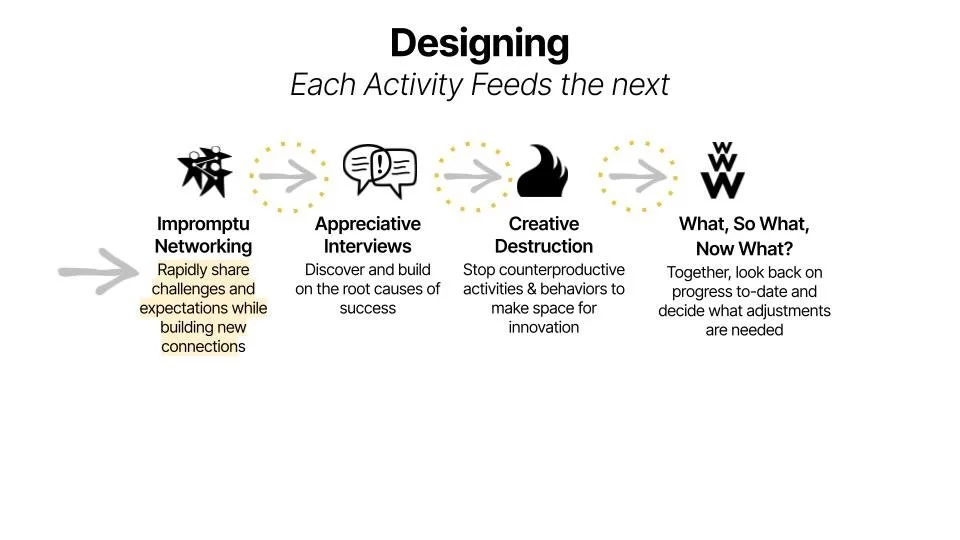
String Design: When more than a single switchout is needed, composing a string of Liberating Structures involves thinking through a logical sequence in which each activity feeds the next.
Liftoff
Rearranging the order of a meeting can start with a single "switch-out." You don't have to replace the whole string at once; you can build momentum from a relatively small success.
Which "Big Five conventional pattern" is currently the most magnetic in your organization?
What is the specific unintended consequence (e.g., over-control, under engagement) you want to change?
If you made one "Switch-Out" this week, what is a low risk, high reward place to try it?
